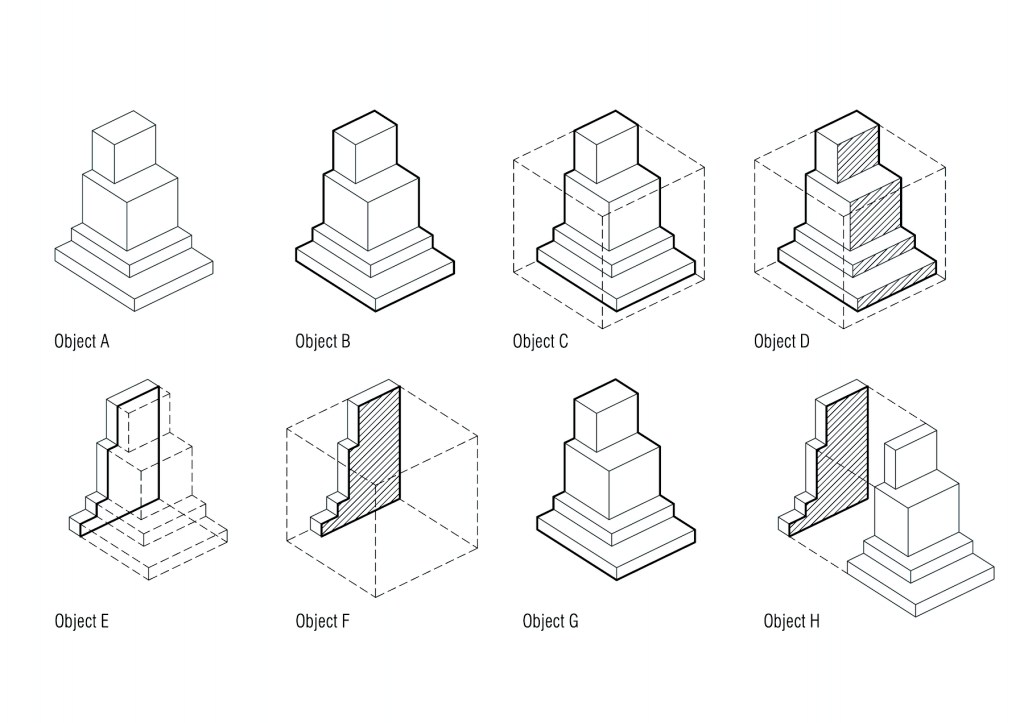
I have been teaching basic drawing course (technical drafting to be precise) skills for first year students for a few years now. Each time I teach, it is a great reminder to myself saying one needs to draw with ‘care’ – and thats all matters. The ‘care’ gets manifested in the drawings implicitly. It is this ‘care’ which translates into actual construction too. I am looking for new ways in the class to emphasis this point. Here is a drawing i made for this week’s class to make this point. The difference between object A and B is just an extra bold silhouette. It takes only 10 % of extra time to finish the drawing but then makes the drawing read many times better. The extra line itself doesn’t matter per se, but the time and mindset it takes to take a bit extra ‘care’ is what matters. Drawing as carrier of ‘care’ and ‘attention’.
In the seminal book ‘Why Architects Draw’ Edward Robbins makes this observation while talking about Moneo’s drawings and design process ” This emphasis on the craft of drawing comes from the belief that craft must be a part of the whole process of design and building. This care for craft and for beauty must start at the very beginning of the process of design and be kept all the way through that process. As drawing is essential to design, it too must always reveal a sense of craft and a sense of the qualities of beauty that in the end one wants one’s building to show.”
After i posted this previous post, Aabid dropped me a message asking what i meant by the last sentence, “Architecture can become more inclusive, by understanding what rhymes with the everyday, ordinary, familiar and relevant.” On rereading, it also seemed to me a bit of disconnect to what i was saying earlier on how to bend the genres of modernism and vernacular. I have been thinking of his question and I thought i could explain it a bit more.
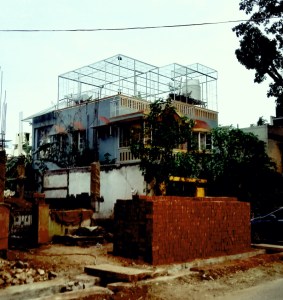
Does architecture always has to only rhyme with the unique and the sophisticated (say Modernism), crafted and the refined (like the vernacular)? Can it also rhyme with the ‘everyday, ordinary, familiar and relevant’ and just be rudimentary? – Like this house in my neighbourhood in Mysore has this metal mesh box built on the terrace to house its ever-growing garden. Can i rhyme with a condition like this too.
I have reproduced here a brilliant text on ‘Genre’ from Seth Godin’s recent book called ‘The Practice : Shipping Creative Work’. I thought of paraphrasing this subchapter, but it is so crisply written, it couldn’t be made any shorter. (note all bold emphasis is mine)
“Genre, not Generic The world is too busy to consider your completely original conception. The people you bring your work to want to know what it rhymes with, what category it fits in, what they’re supposed to compare it to. Please put it in a container for us, they say. We call that container “genre.” That’s not a cheap shortcut; it’s a service to the person you’re seeking to change. Generic work is replaceable. A generic can of beans can come from any company, because they’re all the same. But genre permits us to be original. It gives us a framework to push against. Shawn Coyne has written brilliantly about genre. Not generic, which is boring, but genre, which gives your audience a clue as to what this work is about. What’s the format? What should it cost? What does it remind me of? Ski resorts are a genre. So are monster movies. Without genre, we’re unable to process the change you seek to make. It’s too difficult to figure out what you are doing and for whom, so we walk away. No one goes out of their way to get a copy of a commodity because copies don’t make change happen. Copies aren’t worth much. Genre is a box, a set of boundaries, something the creative person can leverage against.The limits of the genre are the place where you can do your idiosyncratic work. To make change happen, the artist must bend one of those boundaries, one of those edges. Generic is a trap, but genre is a lever.”
It is a consolation to read this and it is an interesting premise to work with. Isn’t this what Nolan did with The Dark Knight Trilogy. He took the very familiar super hero genre and pushed the boundaries – imperfect hero, real world scenarios, strong supporting characters, super powers backed by science and an iconic first origin story (1)
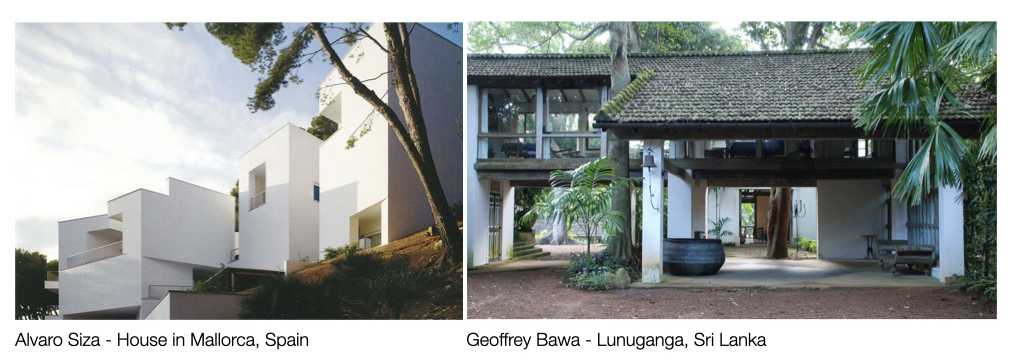
Isn’t this what Alvaro Siza did with the genre of Modernism – made it malleable to the specificity of a place. Like in the house at Mallorca, he fragments the overall form of the house to negotiate with the landscape, unlike the super-neutral white boxes lifted from ground.
Isn’t this what Geoffrey Bawa did with the vernacular – pushed the language of the local and the familiar to adapt to new typologies. Like in Lunuganga, the additions made by him removes the weight of the stereotomic volumes of the vernacular to more translucent fluid spaces connecting the nature and the built form.
Architecture can become more inclusive, by understanding what rhymes with the everyday, ordinary, familiar and relevant.
This is what Nassim Nicholas Taleb writes in his eccentric (I am saying this because he hates academics) and excellent book ‘Anti-Fragile: Things that Gain from Disorder” about interesting thought experiment ‘Buridan’s Donkey’ :
“A donkey equally famished and thirsty caught at an equal distance between food and water would unavoidably die of hunger or thirst. But he can be saved thanks to a random nudge one way or the other. This metaphor is named as Buridan’s Donkey, after the medieval philosopher Jean de Buridan, who – among other, very complicated things – introduced the thought experiment. When some systems are stuck in a dangerous impasse, randomness and only randomness can unlock them and set them free. You can see here that absence of randomness equals guaranteed death”
If one is aware of this condition, it might make it easier for one to keep a certain momentum in design process. Imagine as a student how many times we have lost steam waiting to make the ‘only right’ choice. As now i am in the teaching boat, i need to be a bit more precise in this articulation, as a student might use this against me to make design decisions. This irrational sounding ‘random nudge’ must be placed in between the ‘whim’ and ‘rational’. The ‘nudge’ (also a nice word to keep in mind for teachers) has to lean towards ‘rational’ side, i guess. I would read the ‘hunger’ in the donkey as ‘rigour’ here. And there are ‘two’ options, so i equate this to more ‘possibilites’ on paper. Then the ‘random nudge’ can be justified, if it ticks both the boxes of ‘rigour’ and ‘possibilities’. If this nudge works, a teacher has to be careful enough not to ask the student to justify that move in design process.
Here is a nice clip from Big Bang Theory which makes the point.




You must be logged in to post a comment.