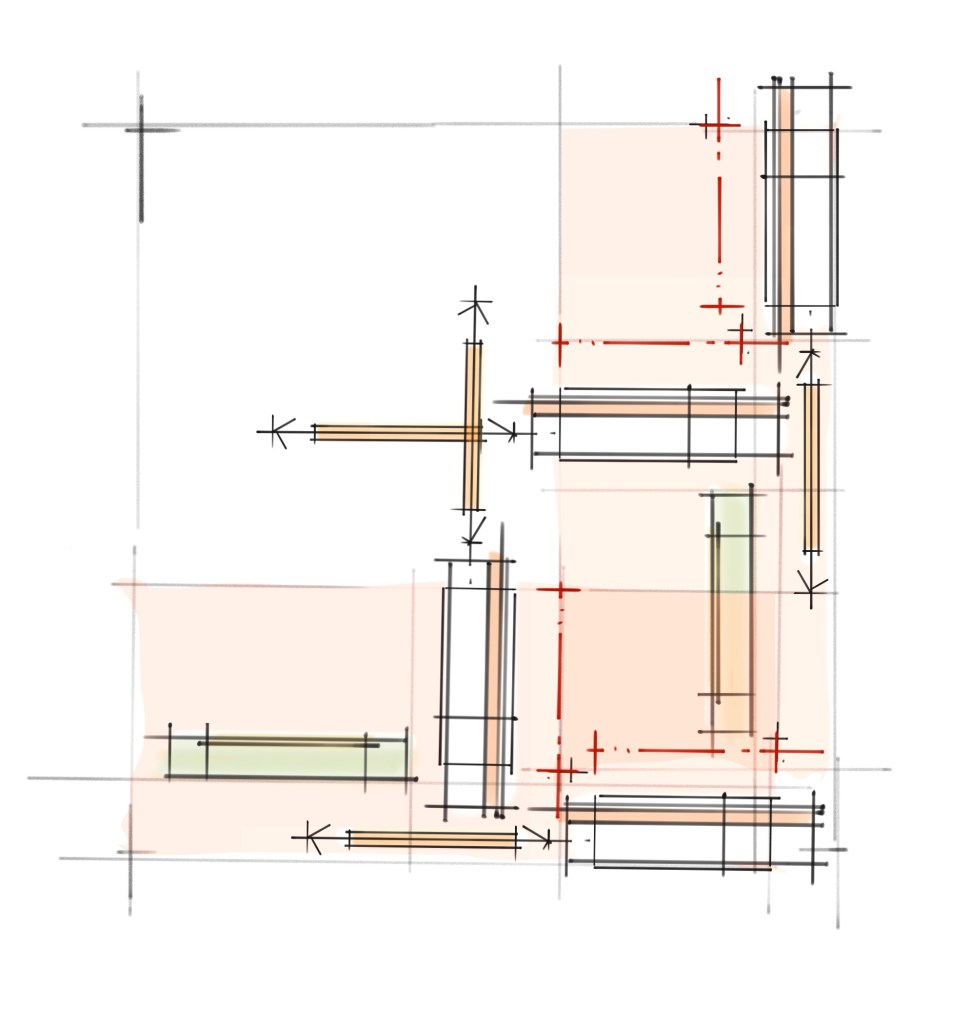
Keywords : Implied Diagonal, Linearity, Overlapping Fields

Keywords : Implied Diagonal, Linearity, Overlapping Fields
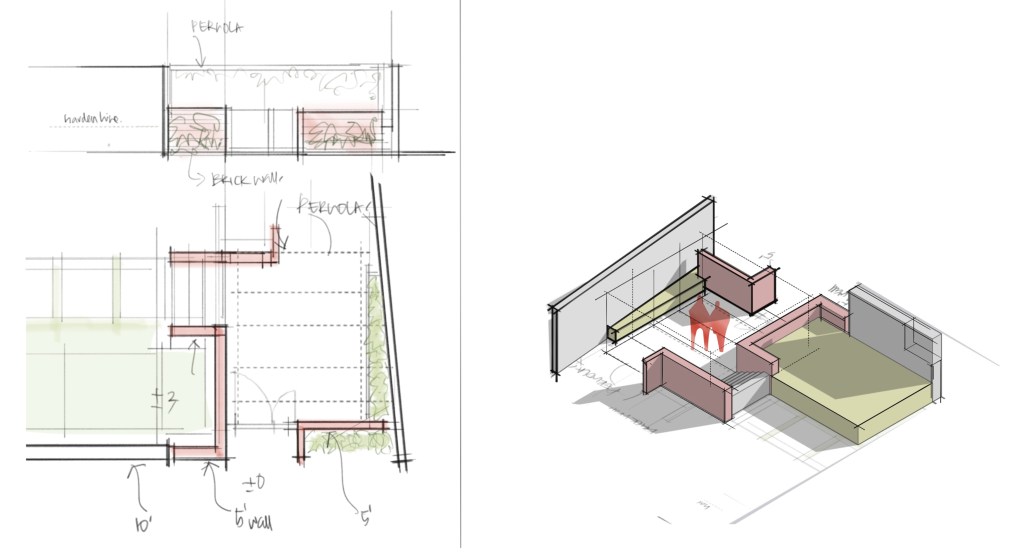
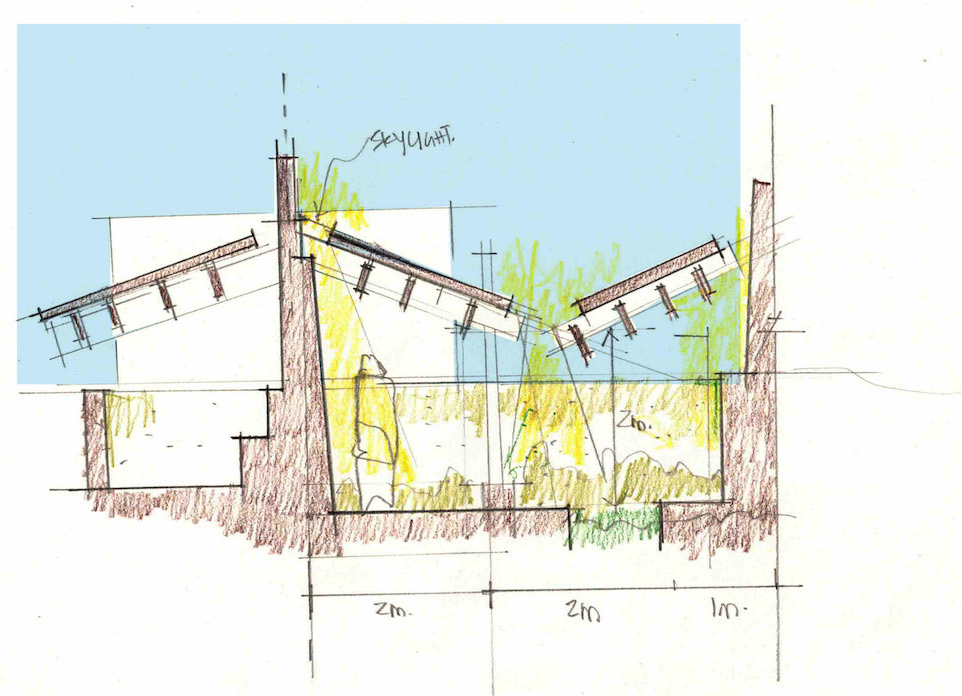
A quick study for the entrance threshold of a house in Mysore (not taken forward by the client). The exploration focused on resolving a corner condition by negotiating tilt and level difference. Rather than treating the entry as a frontal gesture, the study tested how minor shifts in plane and ground could recalibrate movement, slow arrival, and mediate the transition from street to interior.
Project in collaboration with Studio 4B/16 (Saurav and Anu)
Drawn and Traced in Morpholio Trace / Text Edited with LLM
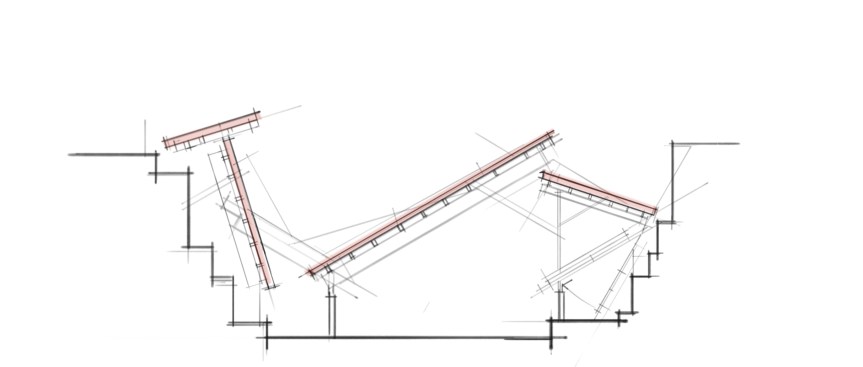
While drawing this, I had some sense of what I wrote below, but I had to draw and then write to clarify that thought.
A strongly modulated, weighted ground paired with a lighter, almost dematerialised roof sets up a clear gravitational dialogue: the ground as anchor, the roof as release. The roof “wanting to float” but being held down suggests a tension between earth and sky, heaviness and lightness, permanence and transience. This is not accidental—it frames architecture as something negotiated between forces, not simply assembled.
Drawn and Traced in Morpholio Trace / Text Edited with LLM
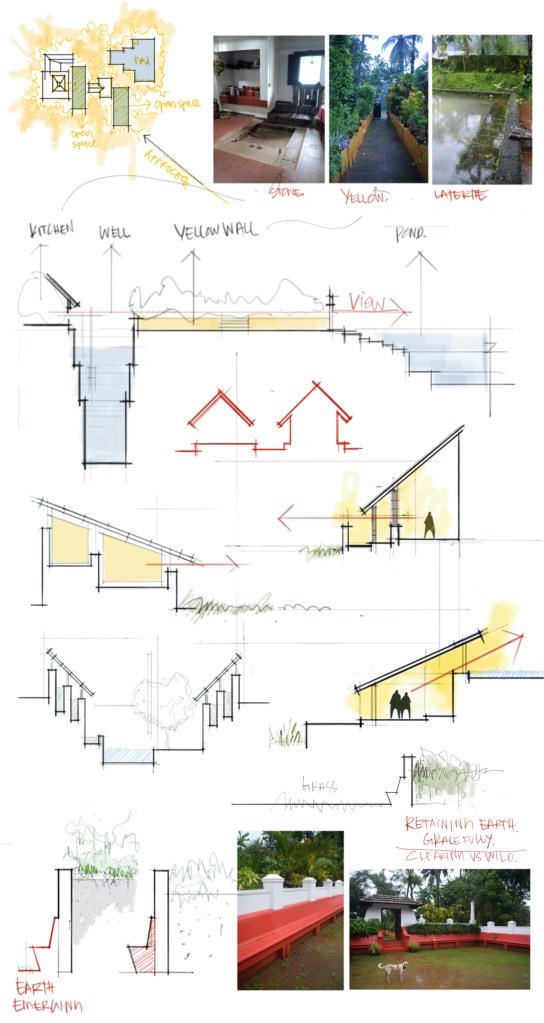
Sketches (some real / some imagined) from my recent trip to Kannur (July 2023). This is my second visit. Incidentally both the times I visited (almost 9 years apart), it was during monsoon. I witnessed concentrated spells of rain, very different from the Mysore rains. I was amazed by how the sloping roof modulated scale, view, water and heat – as elemental as the ubiquitous umbrella – light and playful. The 300 yr old estate bungalow we stayed provided ample reminders in the fundamental quality of architecture – surfaces, colour, light, landscape (both contained and wild), connection to nature. I loved how some of the walls, which meandered through the landscape. They articulated shifting topographies gently. They were holding earth with different attitudes. The form and shape expressed its loyalty to the ground it was holding. The colours stood in delightful contrast to the lush green rain drenched surroundings.
Ending here on a note from Chipperfield, reminding the “fantastical reality” of an old building :
In the book, you wrote, “The length and sequence of the architectural process isolates us from the substantial matter of the project……. from the simple, physical consideration of our craft”
Shouldn’t the physical realisation of things influence your conceptual process? All architects have the problem that conceptualisation and realisation are separated by our professional process. If I am a sculptor, the relationship between my conception and my ability to realise it is absolutely direct, through my hands. If I am an architect, this realisation can pass through many, many layers, so by the time that realisation is done, there can be no feedback to the conceptualisation. So the conceptual process is removed in time and it has to anticipate the physical, material reaction. In a way as an architect, I am jealous of the sculptor who can understand the result, because sometimes the physical result can relax you, and my belief is that sometimes ideas that are only explored on paper can be too nervous and unnecessary, and when you see something in reality – you go to an old building and you can see a very beautiful room with a window, a stone floor and two columns -, it’s nothing, but it has a fantastic reality. On paper, we have to convince ourselves that our idea is a good one. We need stimulus from our designs, but they are not necessarily reality. So I think that for architects generally, this dynamic or sometimes loss of dynamic-between the concepts we are working on and pure reality is problematic.
Source : El Croquis, David Chipperfield (2006-14), In an interview with Juan Antonio Cortes titled “Concilcation of Opposites: Concepts”


You must be logged in to post a comment.