
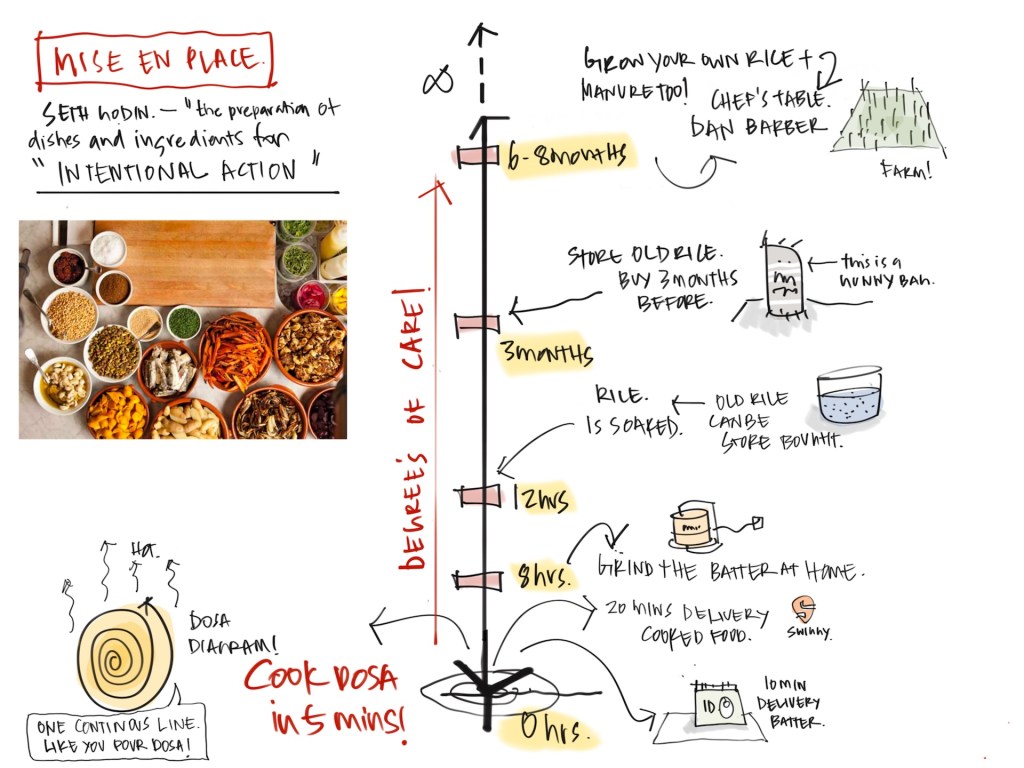
The other day, while speaking with my thesis students, we returned to an earlier post I had written on Mise En Place — on preparation, and on “intentional action.” (It might help to read that piece before reading this post further.) The discussion moved toward thesis topics, the depth of enquiry, and the question of how much time one gives oneself to a thing before it fully appears. They are currently in the thesis preparation stage, where much of the work is still invisible.
I’ve always considered drawings as vessels of care, a quality that can extend to various aspects of life.
As architects, we are always working at a distance from buildings, even though we are deeply involved imagining them. We experience, analyse, and speculate on them through drawings long before they exist physically. Even in practice, there remains a certain separation. We do not make buildings directly; we make drawings, and builders build buildings. In this process, drawings become units through which care is transferred.
The amount of care held within a drawing often depends on how deeply one has prepared before/during making it.
I gave the example of making a dosa. The act of cooking it may take only five minutes, but there are many layers preceding that moment. Each layer reflects a different degree of care.
- 20 minutes — if one want the easier way out – ready-order dosa.
- Buying a good batter on a delivery app. (Honestly, this has made life much easier for people like me.)
- Grinding the batter the previous night, allowing it to ferment under the right conditions. Remembering to soak a few hours before grinding, the usually forgettable first step.
- Choosing and purchasing the right rice.
- Buying rice in season and storing it properly at home.
- Growing your own rice.
That last one sounds excessive, but I was reminded of it while watching Chef’s Table featuring Dan Barber. He goes to the extent of growing his own food — thinking not only about the crop, but also the soil, the manure, the fish, the animals, and even the food that the animals themselves consume. Care extends backward into an entire chain of preparation. In The Third Plate, Barber writes about rethinking food systems entirely — where farming and cooking are not separate acts but deeply interconnected ones. The idea stayed with me because it feels close to architectural work as well. What finally appears on the table, or on site, is only the visible tip of a much larger field of preparation.
Perhaps thesis preparation is similar. One can arrive at a topic quickly and still produce something functional. But depth often comes from extending care backward — into reading, observing, drawing, discussing, collecting references, revisiting intuitions, and sitting with questions longer than necessary.
The final drawing may only take a few hours to produce. But the drawing carries within it all the invisible preparation that came before it. The degrees of care contained in it.
(Text Edited lightly with AI for proofreading and a bit of structuring of flow)


You must be logged in to post a comment.