
Shades of Theory is an umbrella term I have been using for a long time. Theory is often seen as elite and cerebral, which perhaps explains the general distaste around it. But I believe theory exists across a spectrum of shades — from a diagram to a text — each carrying different roles. Through this series, I want to gather fragments that may not intuitively feel like theory at first. As this collection progresses, the meaning of theory might slowly shift into something more palpable and accessible.
There are two notions I completely subscribe to. First: “theory is an organizing tool” (link) (Malcolm Gladwell). Second: “There is nothing so practical as a good theory” (Kurt Lewin). These two ideas anchor my premise of what theory can be. Through this sub-series on the blog, I will collect and share multiple fragments to extend and test this proposition. These fragments may fall within a field formed by two perpendicular axes: dense–light, text–non-text.
Here is the third in the series (Link to first, second)
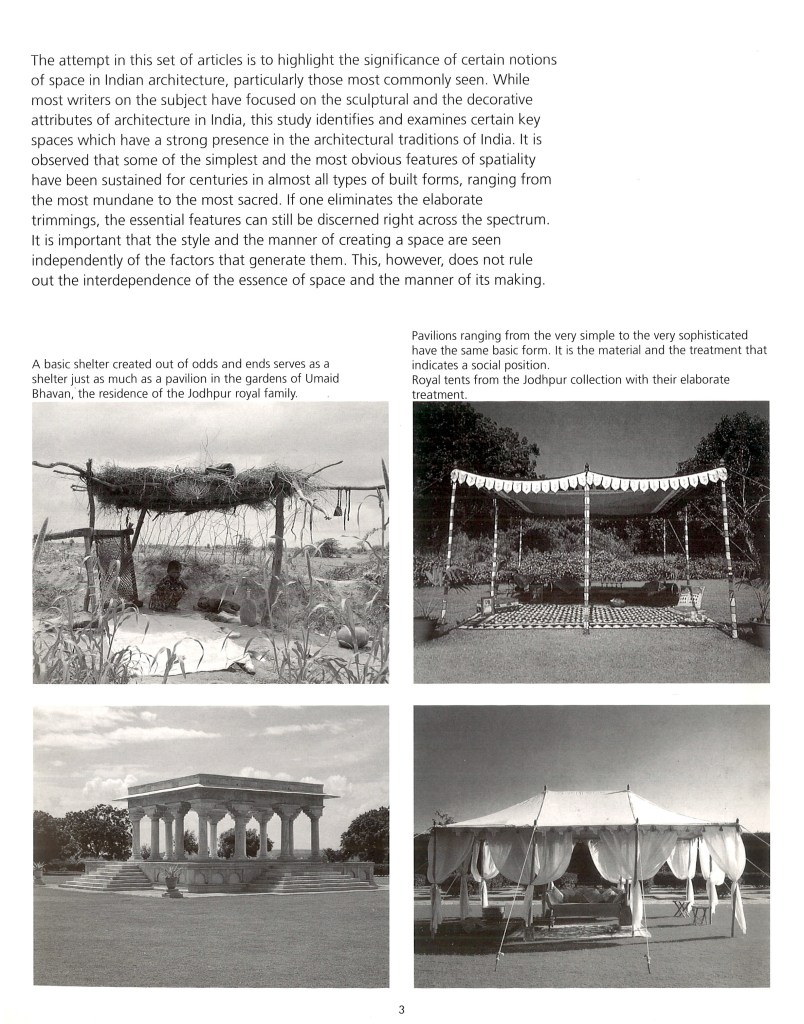
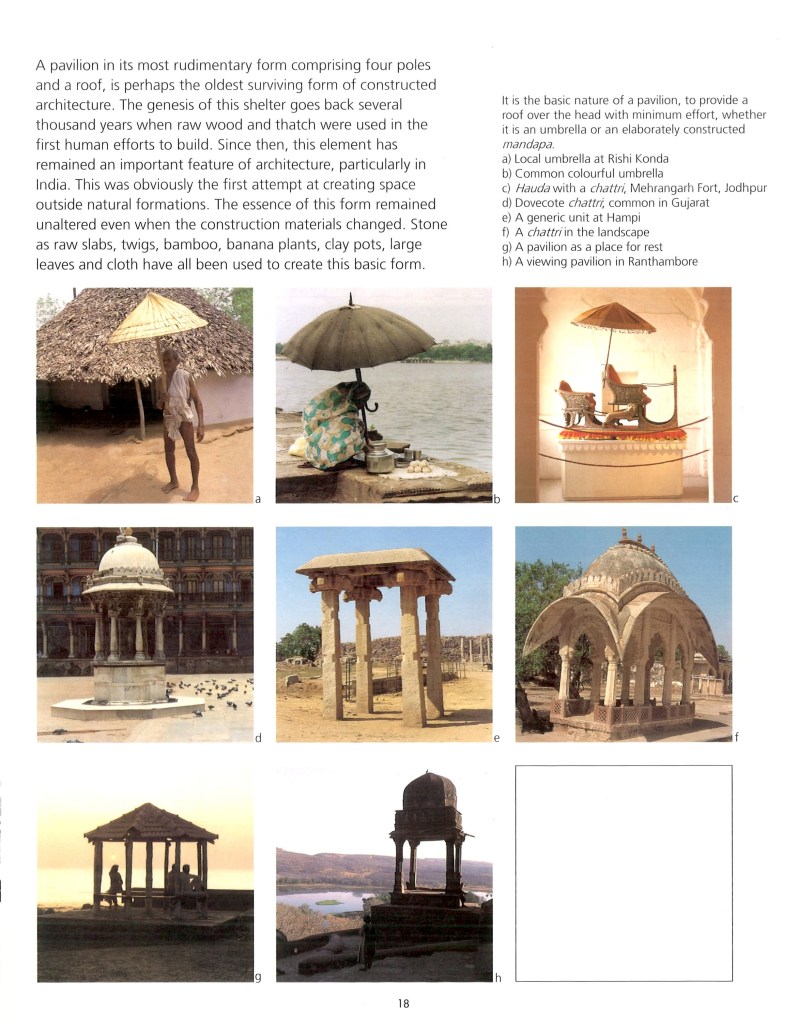
These pages 3 and 18 are from “Thematic Spaces in Indian Architecture” by Kulbhushan Jain. Published in 2002
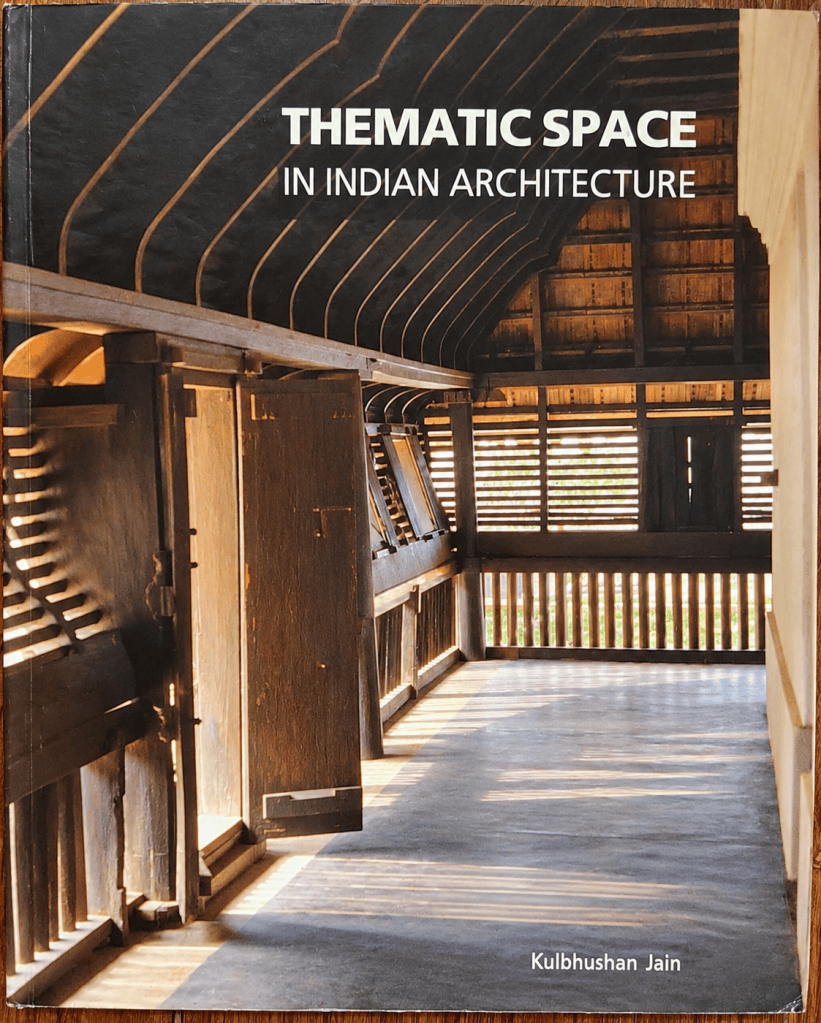
Quote From Page 3 / Introduction chapter authored by Kulbhushan Jain
“The attempt in this set of articles is to highlight the significance of certain notions of space in Indian architecture, particularly those most commonly seen. While most writers on the subject have focused on the sculptural and the decorative attributes of architecture in India, this study identifies and examines certain key spaces which have a strong presence in the architectural traditions of India. It is observed that some of the simplest and the most obvious features of spatiality have been sustained for centuries in almost all types of built forms, ranging from the most mundane to the most sacred. If one eliminates the elaborate trimmings, the essential features can still be discerned right across the spectrum. It is important that the style and the manner of creating a space are seen independently of the factors that generate them. This, however, does not rule out the interdependence of the essence of space and the manner of its making.”
Quote from Page 19 / Chapter on Pavilion authored by Meenakshi Jain
“The essence of this spatial unit lies in its modular character and therefore in its potential for multiplication – in contiguity or as independent units organized in a certain proximity. However, there is no fixed pattern to it. Several permutations and combinations are observed in its application. It is a built space, yet open. It defines and yet extends boundaries and can exist by itself or be part of a group. Despite regional and temporal variations, the power of its manifestation has remained unaffected. It conveys the idea of shelter, but does not enclose; it is built and has a presence, yet it is transparent and ethereal.”
(All the bold emphasis are mine)
My note on this text :
These two sets of images have remained important to me.
The idea of exploring architecture along a spectrum is a strategy I have increasingly used in my teaching and lectures. I came across this book much later, even though I had studied under Prof. K. B. Jain. Seeing this image made me recognise something that had been slowly becoming part of my own way of looking at architecture. At the Master’s course in Theory and Design at CEPT, I do not remember sitting in class and categorically discuss what is theory. What was perhaps more important was being taught an attitude of enquiry — to look at an idea, question it, research it, and find ways of making connections across seemingly different examples.
When I prepare a thematic lecture, say on symmetry, I often begin by collecting multiple examples across a spectrum: vernacular, modern and postmodern; Indian and Western; simple and complex. I might begin with a very direct condition of symmetry, move towards more complex or ambiguous conditions, and eventually arrive at what Nagraj Vastarey calls “denied symmetry.” The intention is not simply to catalogue examples, but to use them to examine what remains constant and what changes when the idea moves across different contexts.
In that sense, the spectrum becomes a way of analysing architecture.
The two images in this book seem to hold precisely that possibility. They do not present a single definition of a spatial idea. Instead, they allow the idea to be observed across variations — from the “mundane to the sacred”, from simple to elaborate, from ‘open to enclosed’, from an ‘individual condition to one that can multiply and form a larger system’.
Perhaps this is what makes these images useful to me. They suggest that an architectural idea can be studied not as a fixed definition, but through its range of manifestations.
The spectrum becomes the method.
Notes:
(My note is slightly AI edited for final proof reading and grammar)


You must be logged in to post a comment.