13 Questions

“A good question is better than the most brilliant answer”
Louis Kahn
.
“My single rule for writing is the same as my rule for science. You cannot know the answer if you don’t know the question. Before I write anything, I ask myself: what is the question that I am trying to answer? When I read a novel, or encounter a poem, or a painting, I will ask myself: what question is the painting, or the novel, trying to answer? This drives my wife and children mad – there are days when the kids refuse to go to museums with me – but it works as a guide to my writing practice. Orwell? He’s trying to answer whether we can build a moral world out of fundamentally immoral people. Sacks: can you inhabit the minds of others who are extraordinarily different from you?”
Siddhartha Mukherjee – My Writing Day/ TheGuardian
.

In an interview with Rajan Gurukkal, Romila Thapar had said “….an enquiry should begin with a question. Questioning is important. I remember a conversation that I had with Sundar Sarrukkai, who said that before you can postulate a question you have a doubt, which is of course a phiosophical way of approaching it. I agree that you may begin with a doubt and that doubt can be tied into a question. The question may be something quite simple, the answer to which will further qualify what you are saying. Or it may be a question that gives you the possibility of looking at the event or the person in history from different points of view. Ant that one question then leads to other questions that reflect these different points of view. So I would say that  that the fundamental approach to any piece of research to what one is working in grows out of a question”
Romila Thapar, Quoted in the Preface to Questioning Paradigms, Constructing Histories

.
In the recent architecture conferences i have attended, i came across some absurd questions asked at the speakers. Most of questions asked have judgements masked inside them.  Some of us who are shy, overwhelmed or overthink the
question (which goes unasked most of the times) are to be blamed on equal note. I just wish they could be little more sensible.
I was reading this amazing interview between Juhani Pallasmaa and Glenn Murcutt (from the book “Local Architecture: Building Place, Craft, and Community”) which is a wonderful way to get into a conversation.These were the questions asked:
  1. What made you to become an architect?
  2. You are not known for rushing through your work. How to decide that a design is finished?
  3. The problem of architecture is the problem of the of the house. Do you agree?
  4. Can you speak about moments in your work where craft springs from culture?
  5. You describe the kind of relationship of mutual respect and friendship between an architect and a builder that is becoming rare today.
  6. If you could make one change in the education of an architect, what would it be?
  7. What is the greatest hope for the future of architecture?
  8. What advice or guidance would you offer for young architects?
  9. When does a building become architecture?
  10. Which building in history would you have been most proud to have designed?
  11. Can you explain the origins and evolution of your architectural language?
  12. Do you think the desire to be closer to nature is expressed through the construction of highly detailed primitive huts?
  13. Can you talk about your approach to the designs set with in the city?
Even though the question are generic, it is interesting to see how probing they are. Interviewers usually quarry intutive maneuvers in design porcess like : Why did you choose  a circular form, why the material is exposed concrete, why the roof is that shape, etc. Questions like this usually get defensive answers.
I also like these questions, because they are elementary.

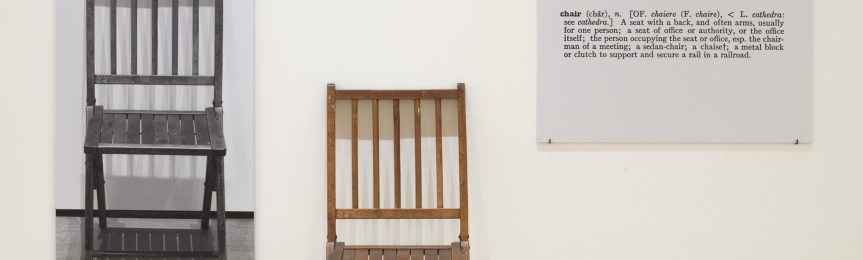
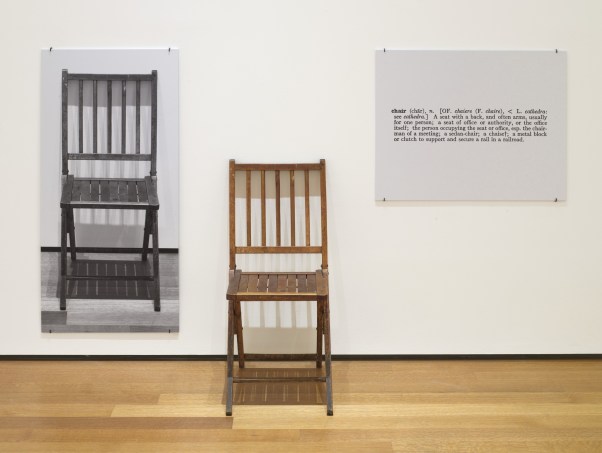
Misreading : One and Three Chairs

cri_000000170331

The description of this art work is described as follows in the MOMA website :

“In One and Three Chairs, Joseph Kosuth represents one chair three ways: as a manufactured chair, as a photograph, and as a copy of a dictionary entry for the word “chair.” The installation is thus composed of an object, an image, and words. Kosuth didn’t make the chair, take the photograph, or write the definition; he selected and assembled them together. But is this art? And which representation of the chair is most “accurate”? These open-ended questions are exactly what Kosuth wanted us to think about when he said that “art is making meaning.” By assembling these three alternative representations, Kosuth turns a simple wooden chair into an object of debate and even consternation, a platform for exploring new meanings”

I thought of extending this notion into architecture. As an architect, i could be naive in misreading an ‘object’ from an other field thus adding a new perspective to it. And that is why the title ‘misreading’.

What is that ‘chairness’ which is formed even before it is manifested in these three forms? And what is contaminated in this process of manifestation, in which ‘chairness’ is trying to become an ‘object’, an ‘image’ and ‘words’. Lets see if we can put it an order of dilution : word-image-object, where ‘word’ being closer to ‘chairness’ because it is still in a form of thought. This dilution is what we have been struggling in the architectural design process. Kahn elegantly puts this concern in his essay ‘Form and Design’ that “the first line on paper is already a measure of what cannot be expressed fully.The first line of paper is less”. It is this dilution i am talking about.

How to make the first line less less? Is it possible by grazing more in the meadows of ‘what an object wants to be’ (borrowing from Kahn again) rather than actual design. I think this delay could help. Any delay,which is rigorous, in this age of information is helpful. But what are the questions one is asking in this delayed time. I think the important question would be the need of architecture itself. It is this intellectual discomfort with one’s own medium itself, has created some of the best art like Marcel Duchamp using a mass-produced urinal as a piece of art or Kosuth using three representations of the meaning of the chair as a platform to debate and explore new meanings. There is a lightness in the execution of this art by just assembling pre-existing things, but asking a very deep question of what is art.

Amit Chaudhri, the writer, puts it nicely saying that he chooses the medium of expression latter only to the incubation of the idea. The idea for him could take any shape – a novel, a novella, fiction, non-fiction or even a song (as he is a musician too). He weighs the ideas against the medium, before indulging into one. Again delaying the first line. In the process of choosing the medium, the idea is already becoming better.

And how does one exercise an idea, in a field, which deals already with space as the medium or one should say commodity. What does this limitation of space as medium bring to us? Or to turn the question around what only can space  add to a manifestation of an idea. Wouldn’t be nice to ask this question at the beginning of every project or at any beginning. What if this question delays the first line? And the first line in turn delays the making of space, which is in any way circumstantial.

So to conclude and to suspend a little more on this naivety , if you are the ‘chairness’, what would you want to be – an image, an object or words.

Reading Minds

By Guest Writer – Madhuri Rao,

Madhuri teaches at RVCE, Bangaluru.

As a culture in general and being academicians in particular we often pine for students/everyone to read and explore the written word for it has empowered us and many of our likes. We encounter many excuses and mostly credible ones to this resistance. Often it is a lack of time or procrastination, which is chronic – partly in our case as well. At the same time, difficulty in understanding and jargon can also be a buzzkill.

Reading in general and reading the thought/s behind the making of architecture/design/art is integral to our thinking, and has decisively sensitized our responses and lent perspective to our thoughts. This post is a step in that direction, to guide and read in a way to interpret better.
e416261d08fa6c067116621020930640During the course of our post graduate program we were fortunate to have had Prof. Sebastiano Brandolini visit and interact with us over the course of a week for an elective. The premise was to discuss prevalent, valid and contesting ideas with respect to seminal texts that represent them (see poster). However, for us the biggest take away from this interaction was Prof. Brandolini’s methodical understanding on how to read theory books – a framework of 19 questions to understand a book better.

Questions generated by a theory book

  1. Why does a theorist make a book rather than something else?
  2. What was publishes just before or just after or during? What was the cultural milieu?
  3. Which travels were made for the book?
  4. Is it primarily illustrated by photos, drawings, sketches, projects or what else?
  5. Who is the book intended for?
  6. Is it a book to read, look, or leaf through?
  7. What is the relationship between words and images?
  8. Does the book contain a polemic?
  9. What importance does the graphic design have in conveying its meaning?
  10. How would you describe its logic?
  11. Can one identify 5 fundamental clue-words?
  12. What does the cover actually say? How do the different editions vary?
  13. Does the theory also presuppose a design method?
  14. Is it possible to spell the differences between: a theory book, a history book, a monograph, a handbook, a catalogue, an illustrated book, an interactive book?
  15. What does a theory need to convey its message and make itself evident?
  16. Can a theory book be without illustrations?  Can it be a narrative?
  17. Might one suggest good synonyms to the word “theory”?
  18. Would it be possible to transfer a theory into a conceptual diagram?
  19. Does such a thing exist, as an anti-theory book?

We have since applied this method and appropriated it to gain structure, perspective and deconstruct books, movies, art, architecture and similar modes of expression. While doing so it shed light on many aspects that remain hidden in the framework unless applied to some set of ideas/ processes or modes of expression. The questions inadvertently form a framework to understand the expression, that is  true to its maker’s intention. It serves as a domain or a specific lens within which the expressed is to be understood in its original context.

The nature of the questions are probing and help create a hypothetical web of influences that the maker was subject to – acquaintances, biases, tradecraft, audience, research, intentions, propaganda, underlying logic and everything that went into setting the stage for creation/expression.

However, this analytical checklist does not limit other forms of interpretation which may not have dwelled in its original premise. In fact, in the process of delving into the questions, it opens up many subordinate issues/matters/ themes for further understanding of the overall subject or to diversify into new territories.

Alternately this model has helped in the conception, development and manifestation of a single idea by the principle of reverse engineering. Working through each of the questions, layers the idea with more value till it in-turn becomes a construct of considerable depth. Also, maybe not in the same order as the framework, these underlying ideas have the ability to give structure to the construct – from part to whole.

Theory is not prescriptive and evidently, this framework is not a foolproof method. It is rather a guide to understand a theoretical stand – implemented by translation of an idea, through different media and its manifestation as a logical conclusion to the process.

Today, we find ourselves on a sticky wicket and the emergence of social media feeds the system. Like/dislike/follow/share, ratings, instant responses, rule the roost and make or break careers/spirit/passions/goodwill. We believe that an idea cannot be validated nor can a value judgment be passed, without having understood it in the domain it is exercised in and with the internal logic that it operates – whether it is a book, movie, art or a nascent idea.


Notes

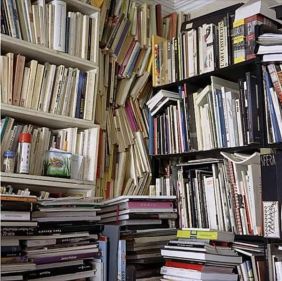
Image Credit : Baudrillard’s shelves by Olivier Roller

10 things I learnt from Ching

[Drawing] is the silence of thought and and the music of sight.

Orhan Pamuk, My Name is Red

Prof. Ching starts one of his online lectures with this quote. He replaces the word ‘writing’ from Pamuk’s writing with ‘drawing’ here. A delightful transfer of meanings. I had the privilege to accompany him on few occasions on his visit to Wadiyar Centre for Architecture, Mysuru (where I teach). So I tried to jot down few things to retain the experience.
.
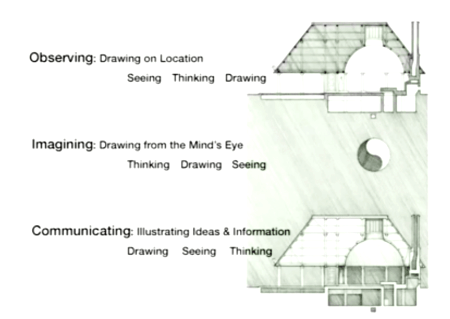
  1. Seeing. Thinking. Drawing. Cyclic nature of these words and their meanings seemed to be framework for his thinking. It is also name of his wonderful blog (https://www.frankching.com/wordpress). A great source to access his ideas and great clips of his process videos of sketching.
    .       

    screen-shot-2018-09-23-at-12-44-34-pm-e1539416857229

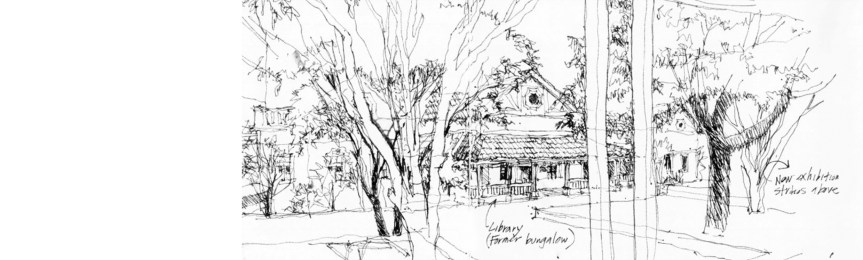
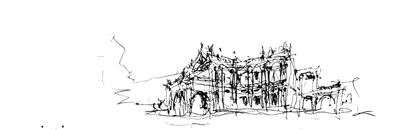
  2. Draw small. Concentrate on essentials. He said five small drawings are better than one large drawing. By drawing small one has to pick what to focus and what to leave out. Both acts equally important in the drawing. The sketch below is of the Jayalakshmi Vilas at Mysore. The actual size is not more than 2″ tall.EPSON MFP image
  3. Draw slow. Allows one to observe things better.
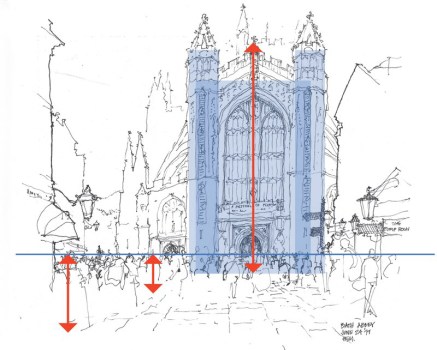
  4. Fundamentals. Gauge the composition by hand measurement. Make sure to get the horizon line right.  Transfer the proportion to paper. Discern the foreground, middle ground and background. Start filling the details in the same order. Never forget the fundamentals of drawing.ToNotice4
  5. Principle of Contrast. In his own words “I want to expand on the idea of contrast—the discernible distinctions in line weight, tonal values, textures, details, and even relative position on a page—that is essential to avoiding blandness and giving life to a drawing. …how the visual tension between the two contrasting elements or areas contribute to the composition of a drawing.” (To read more from his post: link)
  6. Frugality. He spoke less and drew more. His shoulder bag can act as an analogy here. It had an umbrella (when it rained unexpectedly on that day, only he had an umbrella), half litre water bottle, 2 sketchbooks, an I-pad, a golf cap. a tissue paper ( to wipe off the falling rain drops of the sketchbooks). The size of the bag was just enough not to disturb him sketching, even if the bag is hanging on shoulder.
  7. Restraint. He was consciously aware when to stop drawing and how much to draw (like how much details on the tree). I was surprised to see, for expert in drawing like him, to be uncertain in the drawing process.
  8. Abstraction. All drawings are abstraction, as they are all illusions of converting a three-dimensional view to 2D. And diagrams are scaffolding to hang ideas.
  9. Do it. He quoted the Nike ad ‘Just do it’.  He talked about how the ‘Architecture Graphics’ book happened. The collection of handouts which he gave the students of his class had an opportunity to get published. In 2 weeks, with the aid of .7 mm mechanical pencil and eraser shield, he flushed out a full book. The beginning of his publishing career began on by just ‘doing’.
  10. Act without striving. When asked, was he aware how many copies of ‘Form Space and Order’ was sold. He recalled a Chinese quote, which talked about acting without striving. This phrase as well could summarise his personality.
IMG_20180916_173211
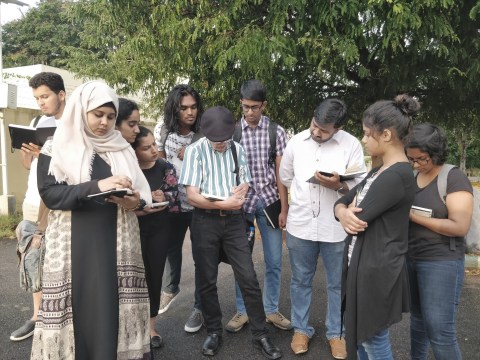
With Prof. Ching and students of WCFA at a sketching trip.  Photo Credits : Toshi Singh

Notes

All the sketches are extracted from his blog. All the credits belong to him

The link to the online lecture he gave at University of Washington from which the first image is clipped  (https://vimeo.com/33296611)

The anti-thesis of the selfie

The essay is more about the ‘axonometric’ than the selfie. But it sounded tempting to start from the notion of a ‘selfie’, as now it is a very important social phenomenon. Even to remain aloof about it, is translated being a misfit.  Sontag says “To photograph is to appropriate the thing photographed. It means putting oneself into a certain relation to the world that feels like knowledge – and therefore like power”. In the light of these words written much earlier before the selfie-era, the selfie keeps re‘appropriating’ the self.

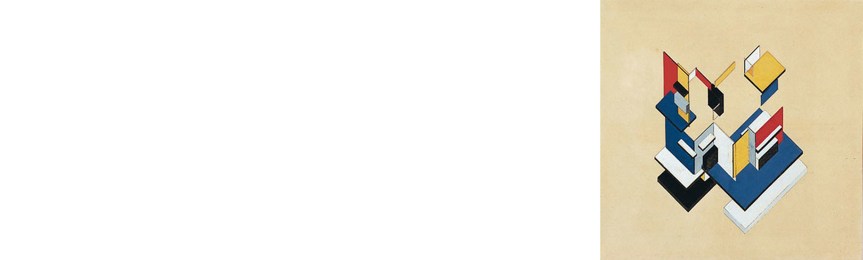
To probe further, lets look at the traditional projection methods of  drawing in architecture – Orthographic, Perspective and Axonometric. Weston beautifully talks about how these three ideas in book 100 Ideas that changed architecture .Simply put the orthographic drawings relays a three dimensional object into a set of two dimensional drawings. A perspective drawing  “invented as a technique to represent the world as we supposedly  perceive it, perspective projection became both a means of design and the catalyst for far reaching doubts that questioned the foundations of classical architecture”. Whereas the axonometric drawings  “one of several means of representing a three-dimensional object on a two- dimensional surface; unlike the more familiar technique of perspective projection it does not suggest how the object might appear to the eye. Lines do not converge to one or more vanishing points but remain parallel, enabling all dimensions to be preserved true to the chosen scale ”

Theo_van_Doesburg_191
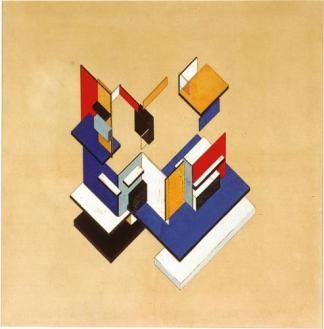
Theo Van Doesberg, Counter-Construction, Private House, 1923.


Only the orthographic and the axonometric are scaled formats. Even the simple ritual of ‘scaled’ set of drawings is as recent as Renaissance. An outcome  of the print technology and artist-builder divide pushed the necessity of scaled drawings.   Post Renaissance the impulse of the scaled ‘orthographic’ drawings (plan,section and elevation) gained importance. “..it was only in the Renaissance that scale drawings came into widespread use. The use of scale promoted an intellectual separation between the drawing and the building, and with it the emergence of the separate roles of the architect and the craftsman”. Weston also remarks “Axonometric projections found favor among early Modernists for two contrasting reasons. To those committed to shaping an architecture for the Machine Age, they evoked the objectivity of science and technology, while to others of a more metaphysical inclination such as Theo van Doesburg, leader of the Dutch De Stijl movement, the rather different “objectivity” of gravity-deffing colored planes floating in an inflnite spatial field was effectively evoked without implying the presence of an observer ”

The variables of three modes of representation being  the thing observed, point of observation and vehicle of observation. But what happens in the viewing the orthographic drawing is the the ‘point of observation’ could be any where in the plane parallel to the cutting plane. It could be any point in that parallel plane, thus a possible objectivity to the drawing (and thus may be in intent too).In the perspective drawing, the point of observation is a definite point in space, thus a very subjective matter of looking at things.Axonometric, an high capacity tool for of several architects, arises and  builds it reputation from its basis of objective methodology.  This absence of the observer  is what intrigues me. And this presence/ absence scenario of the observer, makes both the axonometric and selfie, interesting and opposing phenomenons.

But in the spectrum of a selfie, all the three variables the thing observed-point of observation-vehicle of observation  all collapses into the ‘self’. It collides all boundaries of the traditional projection systems. It creates a very interesting vortex of collapsed social constructions. ‘Appropriating’ the world through ‘the self’. Its so narcotic.


Bibliography : “On Photography” by Susan Sontag and “100 Ideas that changed Architecture” by Richard Weston