
Shades of Ideas : Ramps

In design studios, we generally use the words like notions, ideas and concepts bluntly. Without much caution, we interchange them comfortably. I came across this compelling text on a similar note in the book ’The Art of Looking Sideways’ By Alan Fletcher (p 72)

.“The difference is one of weight, A notion is a small idea, a brain wave, a cute whim, a cockamine thought – something of small consequence and little stamina. It generally confirms to the well known rule that the length of the description is inversely proportion to the amount of illumination.

Real ideas on the other hand are of a different order. They have dimension and are resilient and flexible. Like a genuine panama hat which can be rolled up and passed through a wedding ring.

Ideas with big ideas are concepts. A concept amplifies an idea into a scenario in which all the unrelated bits and pieces dovetail neatly into place. There is an inevitability about what a concept embraces, it has a singular solid spherical shape, it is impossible to knock over.

Concepts tie thoughts together, form bridges between one intelligence and the other, provide a common point of reference. With a concept, explains the Chinese rule of painting, the brush can spare itself the work.”

.So all the three terms exercise in the same zone but with different degrees of spatial operation. I thought of taking forward this idea and testing this premise within Corbusiers projects. I took the condition of the ramp.

.01 – Ramp as a ‘notion’ : In the Mill owners the ramp is just a ramp. It provides an alternate entry to the first floor, which is the primary zone of activity. The ramps also accentuates the publicness of the building by piercing into the first floor from ground level. Without the ramp, the internal order of the plan would not be effected. Only the monumental scale of the entry is diluted. A ‘notion’ is a ‘small idea’ of circulation here..

900x720_2049_595.

02 – Ramp as an ‘idea’ : The ramp in Villa Savoy is also a secondary device, but holds the plan in place. The movement along the ramp is integral to the experience of the building. It acts as a central loop along which the whole house could be experienced. There is a centrifugal effect if you move along the ramp. It is orchestrating a series of experiences : closed- semi open- open. This catches the spirit of the ‘architecture promenade’ a theme which is recurring in Corbusiers projects. An ‘idea’ with dimension and strength.

metalocus_villa-savoye_le-corbusier_montse-zamorano_01_1440_0

03 – Ramp as a ‘concept’ : The ramp in Carpetners Center would be a good example here. It brings order at many levels to the space : the site, orientation, section and program distribution. If you remove the ramp, the building will fail, architecturally . That’s the strength of a concept. The removal of the concept must alter the architecture to its core. ‘Concepts’ is what converts ‘buildings’ into architecture.

900x720_2049_4229

If we are employing ‘ramp’ in our own design as a ‘notion’ thinking it is a ‘concept’, we are underplaying the potential of ‘idea. This delineation of these meanings is not to make academic categories and strife design operations but to identify potentials between the threshold of meanings.

5 analytical moves : House at Pego

The brilliant book Writing Analytically (David Rossenwasser and Jill Stephen), addressed at students of writing course, starts with the chapter : Analysis – What it is and What it does. The book defines writing as “recording our thoughts in search of understanding” and More than just a set of skills, analysis is a frame of mind, an attitude toward experience. It is a form of detective work that typically pursues something puzzling, something you are seeking to understand rather than something you are already sure you have the answers to”. These are the five moves formulated in the first chapter. Below is a very short extract of the same:

Move 1: Suspend Judgment
Suspending judgment is a necessary precursor to thinking analytically because our tendency to judge everything shuts down our ability to see and to think.

Move 2: Define Significant Parts and How They’re Related
Whether you are analyzing an awkward social situation, an economic problem, a painting, a substance in a chemistry lab, or your chances of succeeding in a job interview, the process of analysis is the same : 
Divide the subject into its defining parts, its main elements or ingredients.
Consider how these parts are related, both to each other and to the subject as a whole.

Move 3: Make the Implicit Explicit
One definition of what analytical writing does is that it makes explicit (overtly stated) what is implicit (suggested but not overtly stated), converting suggestions into direct statements.

Move 4: Look for Patterns 
We have been defining analysis as the understanding of parts in relation to each other and to a whole, as well as the understanding of the whole in terms of the relationships among its parts. But how do you know which parts to attend to? What makes some details in the material you are studying more worthy of your attention than others?
Look for a pattern of repetition or resemblance.
Look for binary oppositions
Look for anomalies—things that seem unusual, seem not to fit.

Move 5: Keep Reformulating Questions and Explanations
Analysis, like all forms of writing, requires a lot of experimenting. Because the purpose of analytical writing is to figure something out, you shouldn’t expect to know at the start of your writing process exactly where you are going, how all of your subject’s parts fit together, and to what end. The key is to be patient and to know that there are procedures—in this case, questions—you can rely on to take you from uncertainty to understanding.


I thought applying this in studying architectural precedents in the form of diagramming/analysis for the House at Pego designed by Alvaro Siza. I was familiar this plan for a long time, and kept going back many times. May be it was the accretive nature  that made me incline towards this composition. Then one day i though of just tracing it. It revealed new meanings, which was not visible to me until i attempted  drawing over it.

a
01. Suspend Judgment. Looking for order, in a seemingly intuitive and accretive arrangement
b
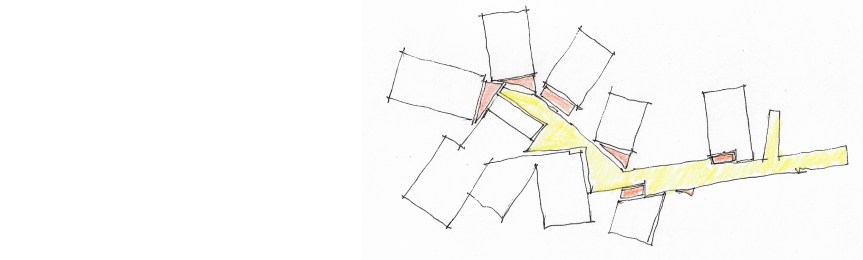
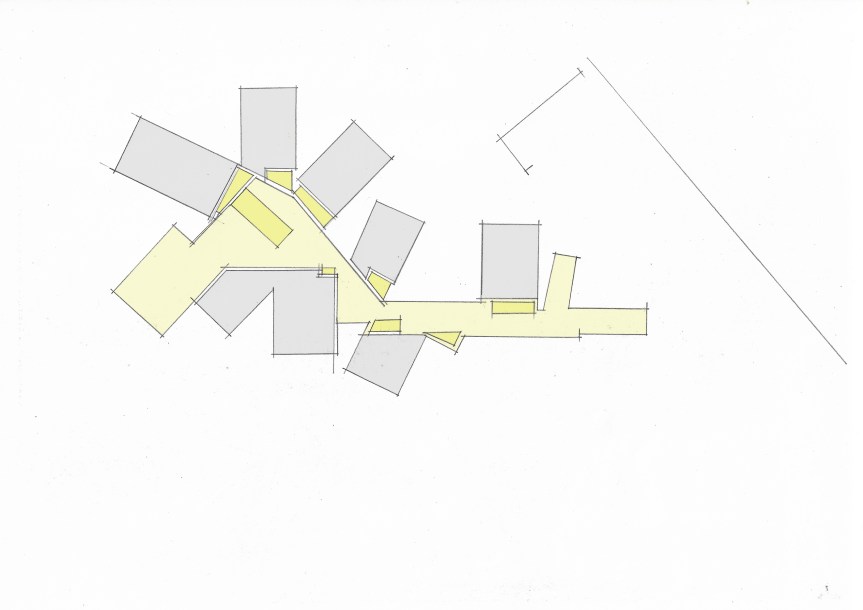
02. Define significant parts and how they are related. It immediately became clear that there were 2 distinct zones : public(yellow) and private(grey).The geometrical shifts of the public axis allowed for informality. But i found a third space too, in between space between the corridor and the room (dark yellow).
c
03. Make the implicit explicit. The plan seemed to be more ordered now. It read as a simple linear organization of space folded multiple times. Every fold credited by a third space.
diagram
04. Look for patterns of repetition and contrast, anomalies. The point of transition between rooms and the corridor is intensified by these anomalies (red) – a tight space negotiating a level difference or change in direction of entry – accentuating the arrival into the private space
diagram1
05. Keep reformulating questions and explanations: Once revealed, the idea has the possibilities to manifest in multiple forms and scales.
All the overlays analytical drawings are drawn by the author.

20 reasons: Why theory is useful.

I have this elaborate lecture, where I introduce architectural theory to second semester students. It might sound a bit misplaced, but necessary. Theory can operate at many levels – practice, academics and research. Even within the academic spectrum there is a variation in the level of enquiry. This subject can act as a connecting tissue between Architectural Design and all the other allied subjects.  I usually overthink these ideas and cease to bring to refined conclusions, hence I am publishing a draft here :
.
  1. Ideas are like virus. To quote Henry Cobb from Inception “An Idea is like a virus. Resilient. Highly contagoius. And even the smallest seed of idea can grow. It can grow to define or destroy you”
  2. Know the intent of the designer/program.- It’s only till late in my childhood I realized that there is ‘director’ behind filmmaking who must be both good at craft and thinking. Similarly buildings are also products of a ‘mind/s’ behind it. It is as much a intellectual process, as much it is a craft.
  3. How others have dealt with the same problem. A sort of reverse engineering the process of design to see and identify the variables which went in space making. These  variables can become new framework and reveal connections which one might have missed.
  4. Don’t see only through eyes, but also the mind.
  5. Flash of Lightning – There is this brilliant Charles Correa quote (A Place in the Shade, 240)  “A 20th century composer – I think Hindemith – was once asked the mind-boggling question: How do you compose your music? To which he gave an astonishingly evocative yet precise answer: It is looking out a window into the black night of a thunderstorm. One cannot see anything, Suddenly there is a flash of lighting, illuminating the entire landscape. In that one spilt second, one has seen everything – and nothing. What we call composition is the patient recreation of that landscape, stone by stone, tree by tree”. Theory just recognises that there is state like this, and one has to be ready.
  6. Only aesthetics ideas are not important. Architecture is synthesis of multiple layers – social, cultural and political. Aesthetics is one among them.
  7. Ideas are like ladders – Steven Holl quotes Wittgenstein in an interview (Architectural Review March 2013) “that ideas are like ladders: they get us to a platform and when we arrive there, we can kick the ladder away” So the ideas which goes in making of the building need not necessarily be part in the experience of the building. Ideas’ responsibility is only to direct design, not necessarily become the object itself. May be only art has that luxury.
  8. Interpretation is key. History is interpretation. E H Carr lucidly states in his seminal text Whats is history?  “The facts are really not at all like fish on the fishmonger’s slab. They are like fish swimming about in a vast and sometimes inaccessible ocean; and what the historian catches will depend, partly on chance, but mainly on what part of the ocean he chooses to fish in and what tackle he chooses to use – these two factors being, of course, determined by the kind offish he wants to catch. By and large, the historian will get the kind of facts he wants. History means interpretation”
  9. Theory is a ‘tool’ – Yes, as plainly as it sounds. It is a tool or a catalyst. Aligning to catalyst in its pure scientific terms – that a chemical which does not alter the composition of the reactions, but only alter rate of chemical reaction.
  10. Recognition of an idea. Most of the times we have lot of ideas, but it will help us recognize the most appropriate ideas for a specific situation.
  11. Every idea has potential. There is no discrimination between ideas. The only question is of appropriation and depth of enquiry.
  12. Adopt/adapt an idea from precedents.
  13. Comparative knowledge/analysis ( but with understanding the domain)
  14. Originality – is it limiting or impending? I align to “Imitation is not the erosion of originality; it is the condition of originality” (A.O.Scott in the book Beyond Criticism)
  15. Nothing comes out of Nothing. (can’t remember the source here)
  16. The relationship between theory and practice is not casual (Kruft, A History of Architectural Theory). Just because one has good ideas, one cannot become good at practice.
  17. Thinking about thinking. Meta.
  18. Dwell between subjective and objective: Point of View to Filed of view.
  19. Built and Unbuit Projects – Theory is democratic is approach to whether a project is built or not. What matters only is the idea behind it. This position of thinking opens so many possibilities. It provides more space and time to ideas mature.
  20. Theory allows one to suspend judgment : Most fundamental and most profound to even accept that every object of enquiry has a potential, without trapping these notions in the binaries of like/dislike.

13 Questions

“A good question is better than the most brilliant answer”
Louis Kahn
.
“My single rule for writing is the same as my rule for science. You cannot know the answer if you don’t know the question. Before I write anything, I ask myself: what is the question that I am trying to answer? When I read a novel, or encounter a poem, or a painting, I will ask myself: what question is the painting, or the novel, trying to answer? This drives my wife and children mad – there are days when the kids refuse to go to museums with me – but it works as a guide to my writing practice. Orwell? He’s trying to answer whether we can build a moral world out of fundamentally immoral people. Sacks: can you inhabit the minds of others who are extraordinarily different from you?”
Siddhartha Mukherjee – My Writing Day/ TheGuardian
.

In an interview with Rajan Gurukkal, Romila Thapar had said “….an enquiry should begin with a question. Questioning is important. I remember a conversation that I had with Sundar Sarrukkai, who said that before you can postulate a question you have a doubt, which is of course a phiosophical way of approaching it. I agree that you may begin with a doubt and that doubt can be tied into a question. The question may be something quite simple, the answer to which will further qualify what you are saying. Or it may be a question that gives you the possibility of looking at the event or the person in history from different points of view. Ant that one question then leads to other questions that reflect these different points of view. So I would say that  that the fundamental approach to any piece of research to what one is working in grows out of a question”
Romila Thapar, Quoted in the Preface to Questioning Paradigms, Constructing Histories

.
In the recent architecture conferences i have attended, i came across some absurd questions asked at the speakers. Most of questions asked have judgements masked inside them.  Some of us who are shy, overwhelmed or overthink the
question (which goes unasked most of the times) are to be blamed on equal note. I just wish they could be little more sensible.
I was reading this amazing interview between Juhani Pallasmaa and Glenn Murcutt (from the book “Local Architecture: Building Place, Craft, and Community”) which is a wonderful way to get into a conversation.These were the questions asked:
  1. What made you to become an architect?
  2. You are not known for rushing through your work. How to decide that a design is finished?
  3. The problem of architecture is the problem of the of the house. Do you agree?
  4. Can you speak about moments in your work where craft springs from culture?
  5. You describe the kind of relationship of mutual respect and friendship between an architect and a builder that is becoming rare today.
  6. If you could make one change in the education of an architect, what would it be?
  7. What is the greatest hope for the future of architecture?
  8. What advice or guidance would you offer for young architects?
  9. When does a building become architecture?
  10. Which building in history would you have been most proud to have designed?
  11. Can you explain the origins and evolution of your architectural language?
  12. Do you think the desire to be closer to nature is expressed through the construction of highly detailed primitive huts?
  13. Can you talk about your approach to the designs set with in the city?
Even though the question are generic, it is interesting to see how probing they are. Interviewers usually quarry intutive maneuvers in design porcess like : Why did you choose  a circular form, why the material is exposed concrete, why the roof is that shape, etc. Questions like this usually get defensive answers.
I also like these questions, because they are elementary.

Misreading : One and Three Chairs

cri_000000170331

The description of this art work is described as follows in the MOMA website :

“In One and Three Chairs, Joseph Kosuth represents one chair three ways: as a manufactured chair, as a photograph, and as a copy of a dictionary entry for the word “chair.” The installation is thus composed of an object, an image, and words. Kosuth didn’t make the chair, take the photograph, or write the definition; he selected and assembled them together. But is this art? And which representation of the chair is most “accurate”? These open-ended questions are exactly what Kosuth wanted us to think about when he said that “art is making meaning.” By assembling these three alternative representations, Kosuth turns a simple wooden chair into an object of debate and even consternation, a platform for exploring new meanings”

I thought of extending this notion into architecture. As an architect, i could be naive in misreading an ‘object’ from an other field thus adding a new perspective to it. And that is why the title ‘misreading’.

What is that ‘chairness’ which is formed even before it is manifested in these three forms? And what is contaminated in this process of manifestation, in which ‘chairness’ is trying to become an ‘object’, an ‘image’ and ‘words’. Lets see if we can put it an order of dilution : word-image-object, where ‘word’ being closer to ‘chairness’ because it is still in a form of thought. This dilution is what we have been struggling in the architectural design process. Kahn elegantly puts this concern in his essay ‘Form and Design’ that “the first line on paper is already a measure of what cannot be expressed fully.The first line of paper is less”. It is this dilution i am talking about.

How to make the first line less less? Is it possible by grazing more in the meadows of ‘what an object wants to be’ (borrowing from Kahn again) rather than actual design. I think this delay could help. Any delay,which is rigorous, in this age of information is helpful. But what are the questions one is asking in this delayed time. I think the important question would be the need of architecture itself. It is this intellectual discomfort with one’s own medium itself, has created some of the best art like Marcel Duchamp using a mass-produced urinal as a piece of art or Kosuth using three representations of the meaning of the chair as a platform to debate and explore new meanings. There is a lightness in the execution of this art by just assembling pre-existing things, but asking a very deep question of what is art.

Amit Chaudhri, the writer, puts it nicely saying that he chooses the medium of expression latter only to the incubation of the idea. The idea for him could take any shape – a novel, a novella, fiction, non-fiction or even a song (as he is a musician too). He weighs the ideas against the medium, before indulging into one. Again delaying the first line. In the process of choosing the medium, the idea is already becoming better.

And how does one exercise an idea, in a field, which deals already with space as the medium or one should say commodity. What does this limitation of space as medium bring to us? Or to turn the question around what only can space  add to a manifestation of an idea. Wouldn’t be nice to ask this question at the beginning of every project or at any beginning. What if this question delays the first line? And the first line in turn delays the making of space, which is in any way circumstantial.

So to conclude and to suspend a little more on this naivety , if you are the ‘chairness’, what would you want to be – an image, an object or words.