Buridan’s Donkey

This is what Nassim Nicholas Taleb writes in his eccentric (I am saying this because he hates academics) and excellent book ‘Anti-Fragile: Things that Gain from Disorder” about interesting thought experiment ‘Buridan’s Donkey’ :

“A donkey equally famished and thirsty caught at an equal distance between food and water would unavoidably die of hunger or thirst. But he can be saved thanks to a random nudge one way or the other. This metaphor is named as Buridan’s Donkey, after the medieval philosopher Jean de Buridan, who – among other, very complicated things – introduced the thought experiment. When some systems are stuck in a dangerous impasse, randomness and only randomness can unlock them and set them free. You can see here that absence of randomness equals guaranteed death” 

If one is aware of this condition, it might make it easier for one to keep a certain momentum in design process. Imagine as a student how many times we have lost steam waiting to make the ‘only right’ choice. As now i am in the teaching boat, i need to be a bit more precise in this articulation, as a student might use this against me to make design decisions. This irrational sounding ‘random nudge’ must be placed in between the ‘whim’ and ‘rational’. The ‘nudge’ (also a nice word to keep in mind for teachers) has to lean towards ‘rational’ side, i guess. I would read the ‘hunger’ in the donkey as ‘rigour’ here. And there are ‘two’ options, so i equate this to more ‘possibilites’ on paper. Then the ‘random nudge’ can be justified, if it ticks both the boxes of ‘rigour’ and ‘possibilities’. If this nudge works, a teacher has to be careful enough not to ask the student to justify that move in design process. 

Here is a nice clip from Big Bang Theory which makes the point. 

Calm / Assertive

Yesterday India won the match against Australia in Melbourne. It was a remarkable win away from home, and that too after the disastrous 36 all out at the first match in Adelaide. One interesting note in winning match was that Rahane was the captain as Kohli is on break. Suresh Menon writes in his column in The Hindu that “It was confirmation of another theory — that you can be a successful captain either in the asser­tive Virat Kohli manner or in the com­posed Rahane manner. “. Menon also adds later “that cricket teams tend to reflect the temperament of their captains.” 

These two approaches – calm and assertive – is applicable to other situations in life too. In particular this is a recurring question for me as a teacher . All of us at some at point of time have  studied under these two types of teachers. We respond to them differently. But i am still unsure which is a better method when teaching, as it also depends on one’s own personal character a lot. I have heard of many teachers who were more assertive when they were young than they were old and vice versa. I prefer and assume to be a ‘calm’ one  but not sure if i behave the same way too. The temperament of the teacher always reflects in the class.

Ron Ritchhart writes in his brilliant book on learning ‘Creating Cultures of Thinking’ about teachers role of modeling in learning environments  “As a culture shaper, modeling operates on both an explicit and an implicit level. Explicitly, we may demonstrate techniques, processes, and strategies in a way that makes our own thinking visible for students to learn from and appropriate. Implicitly, our actions are constantly on display for our students. They see our passions, our interests, our caring, and our authenticity as thinkers, learners, community members, and leaders. Adult models surround students and make real a world that they may choose to enter or reject.” 

Notes : (1) A note of thanks to Aabid Raheem (his blog) to introduce me to Ron Ritchhart‘s book.  (2) Suresh Menon ‘Between Wickets’ column in The Hindu dated 30 December,2020

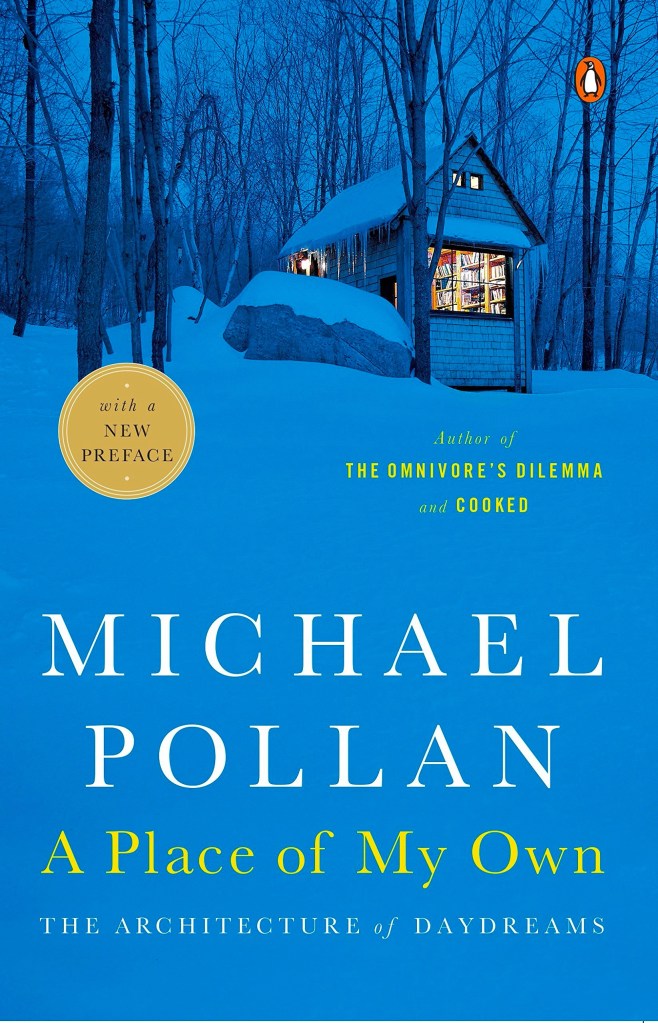
Reading : A Place of My Own

One of my favourite books from this year’s reading.

This is one of the few books where the author, who is not an architect, talks about architecture in a remarkable way. This book is the story of how Michael Pollan built his own ‘writing cabin’ next to his house as refuge to engage in his writing. He is exploring the meaning of architecture by reading texts on architecture and also by actually building it with his own hands. This juxtaposition of reading and building is what makes the structure of the book unique. It feels modest, to read a book on architecture ,where the architect is the other character in the book. 

In one page he page he is talking about cutting wood and in the other page he is talking about Venturi’s meaning of doing a slope roof in the modern era. Pollan says “this is not so much how-to-do-it than how-to-think-about kind of book”. This is what is the anchor of the book.I had earlier this year read his other book ‘Cooked’, which actually led me to this book. Both the books explore the “places where the threads of nature and culture tangle in interesting ways”  One of the best part of the book is that you don’t have to know anything prior about architecture. Pollan’s brilliance is here that he is both discovering architecture (using both the body and mind) and also sharing this tenuos journey through his accessible writing.

The two main characters in the book are Charles Myer, the architect who designed the cabin and Joe Benny, the carpenter who helped Pollan build this cabin over the weekends for 2 long years! The chemistry between these three is one of the staggering strain of the book. The book masterfully and in subtle ways captures the limits of the each of the characters – the skilled craftsmen who is actually constructing the building and the architect who is designing the building and the client who is actually going to live in the cabin. 

My selected notes from the book, which gives an overview of the book, : 

  1. The chapters in the book are simply named after the components of the building. But in each chapter he takes the reader through a wonderful journey through each of these layers – Site, Footings, Framing, Roof, Windows and Finish work. The journey of the book starts from citing the cabin in the landscape to the trim (beading) and the need of it. He engages with each attribute both intellectually (by reading books on each `topic) and physically by making it on site. 
  2. When Charlie, the architect offers to design this cabin for free in extension to the house he is renovating, Pollan takes a crack at architects writing “I didn’t know whether to regard this as an act of generosity from a friend or a particularly flagrant case of the monomania to which the members of his profession seem to be prone”. Monomania – a nice word to describe architects. 
  3. In the ‘Roof’ chapter he writes “To creatures who depend on them (shelters) for their survival, it is perhaps inevitable that roofs are symbols of shelter as well shelters themselves.” and adds later “The traditional gable, for example, meant something very different after modernism than it did before” In this chapter Pollan also sharply discusses Venturi’s house and his writings.  
  4. Pollan writes a nice story of Eisenman taking Philip Johnson to visit House VI. “Eisenman asked the Franks (the clients) if they wouldn’t mind removing the baby’s crib from the house so Johnson could experience the building in its pristine form” He extends the discussion to talk about the role of modernism played in shaping architecture here. 
  5. “The history of architecture is the history of the widening of that gulf, from the time when master builders designed and built buildings themselves ; to the Renaissance, when architects began designing buildings but left decisions about construction and ornament to craftsman on site.”
  6. “Perhaps what makes the experience of space so difficult to describe is that it involves not only a complex tangle of sense information (hard enough to sought out by itself ) but also the countless other threads supplied by memory and association”
  7. Talking about the limitations of theory, particularly postmodernism, “Our bodies are of course what gets left out of a theory that treats architecture as a language, as a system of signs. Such a theory can’t explain the physical experience of two places as different as Grand Central Station and my little shack, because the quality of those experiences involves a tangle of mental and physical, cultural and biological elements that the theory can’t account for, blinded as it is by old western habits of regarding the mind and body as separate realms. “
  8. In ‘Windows’ chapter chapter he writes “Architecture, Le Corbusier had declared, is when windows are either too big or too small, but never the “right” size. For when the window is the right size, the building is… just a building. Viewed from one perspective, Le Corbusier’s dictum is as succinct a confession of artistic arrogance as you could ask for, implying as it did that originality, if not eccentricity, was an end in itself”
  9. In a brilliant subchapter elegantly called “The Metaphysics of trim”. Beading is the local word for us here. Pollan paraphrases here “Mandelbrot suggests that architectural ornament and trim appeal to us because they offer the eye a complex and continuous hierarchy of form and detail, from the exceedingly fine to the massive, that closely resembles the complex hierarchies we find in nature – in the structure of a tree or a crystal or an animal”
  10. Eclectic range of  Bibliography from Vitruvius to FLW to Peter Eisenman to Bachelard to Thoreau. A good book always leaves lot of traces to read further. 

On Balance

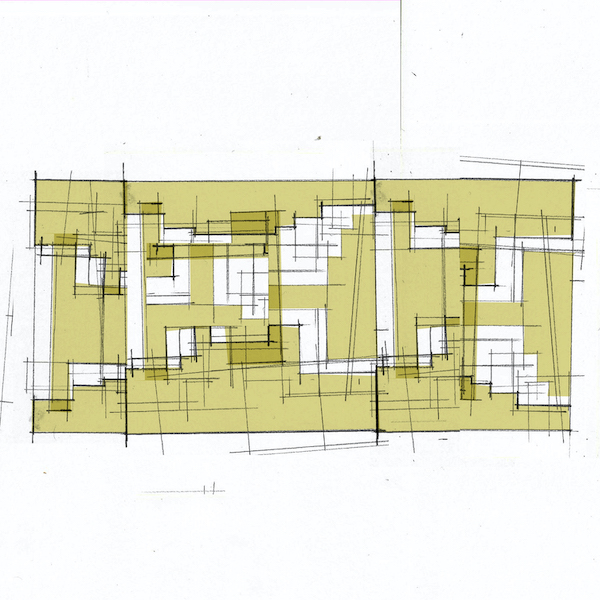
Shubhanshi’s drawing explores the relationship between the vertical and the horizontal in Frank Lloyd Wright’s projects. The assignment was to pick an ‘attribute’ and represent diagrammatically for the theory course for semester 3.

Drawing by Shubhanshi Anand, Sem 3, Batch 2019, WCFA

(click on the image to enlarge)