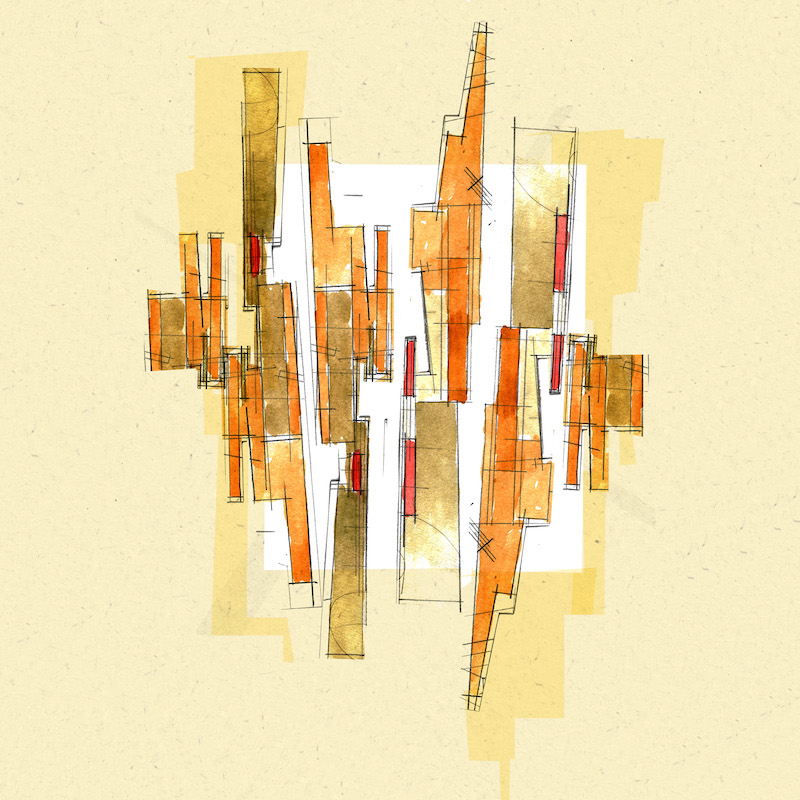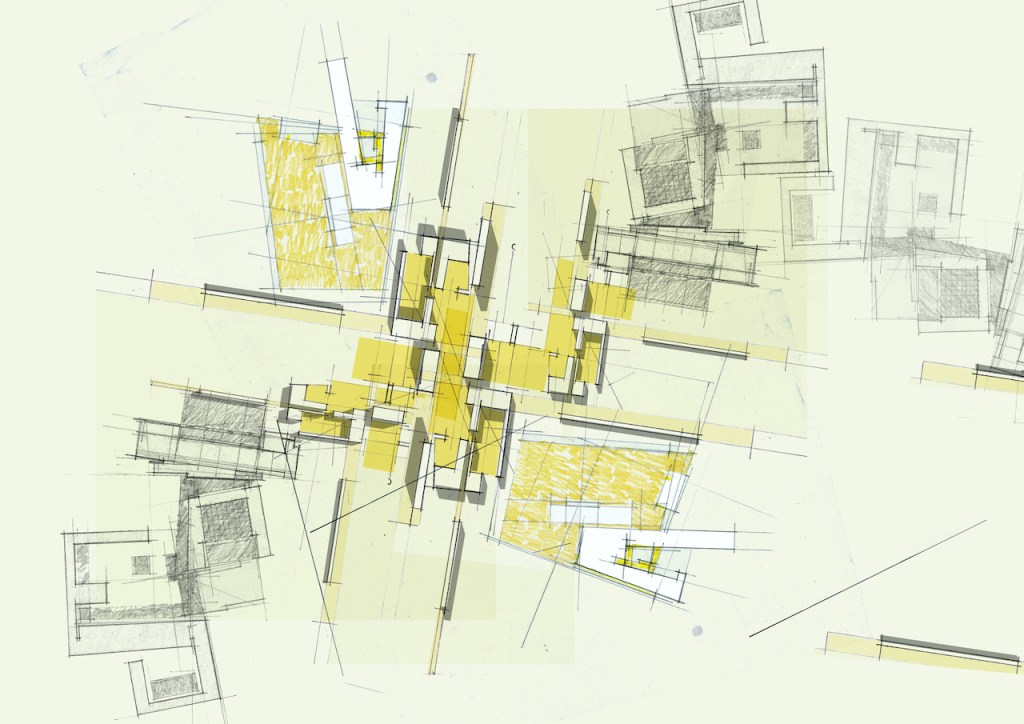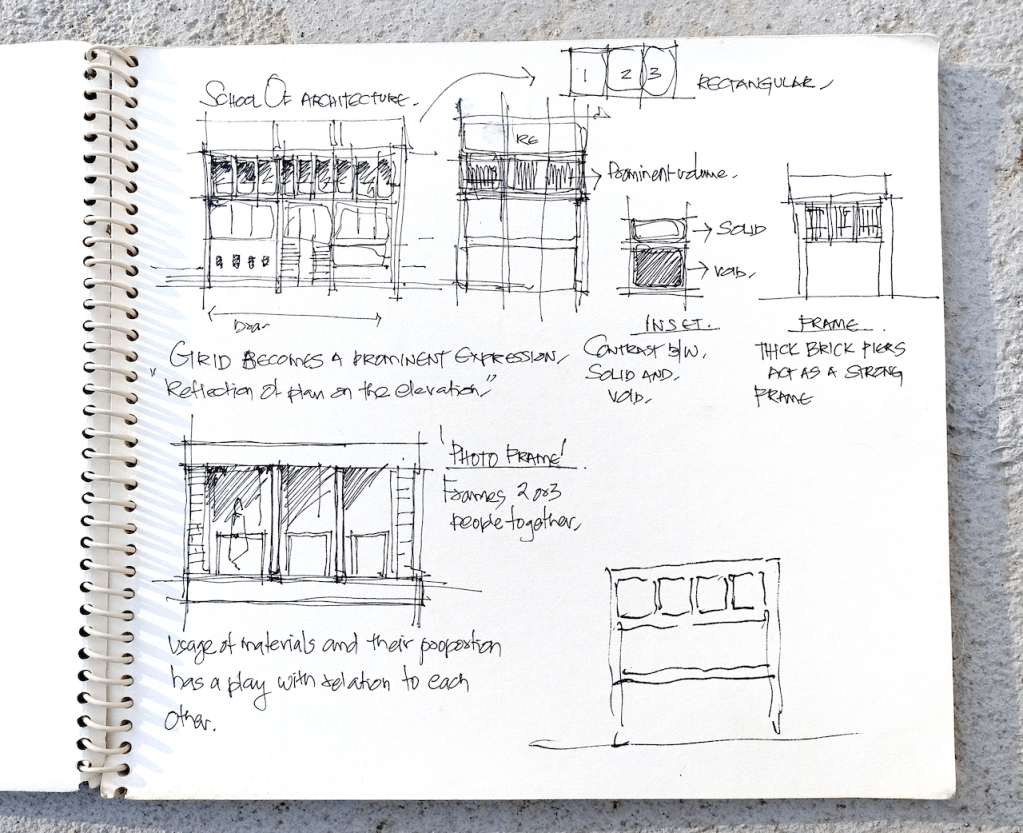
Drawing 27


Note :
At the intersection of teaching and practicing architecture, I come across ‘fragments’ of ideas. These drawing explorations allow ideas to simmer without being concrete and purposeful. It allows me to both inform and escape the everyday grind of teaching. I have been testing these hybrid drawings for sometime now – drawn by hand and digitally recomposed. The hand allows one to meander unconsciously evoking the muscle memory of the ‘thinking hand’ (referring to Pallasmaa’s brilliant book). Whereas the digital allows it to do what it is good at – being precise and allowing repeated quick manipulations of pattern and translucency.
Thank you @_matter for inviting to publish a drawing in formfolio.
Formfolio is a great collection and curation of ‘locally grown’ drawings. I have used lot of drawings as references in my classes. I always had a great admiration for @_mattter for their initatives in research, documentation and curation. Keep going!
Link for the drawing : https://formfolio.in/portfolio/space-fragments-r-kiran-kumar%ef%bf%bc/
Introductory Note
This is an invited post written by Shreyas Baindur . Shreyas and me have been teaching together for few years now. He introduced me to the amazing world of graphic novels. It was through the WCFA Book Club that we became friends. Shreyas used to bring frequently these graphic novels to the discussion and completed them at an alarming rate, when the other members like me were moving at a snail’s pace to complete the books. I had my prejudice then that these books were easy to read as they had a lot of pictures or only pictures . A shallow reading of what graphic novels meant from my side then. Then he introduced us to brilliant book – Unflattening, by Nick Sousanis – a Phd thesis in the form of a graphic novel. This book unfastened my opinion on what graphic novel means. The structure and the format is so suited to architectural thinking – this is thinking in visual from. So I invited him to put together a list of ten books as a starting point for those interested in this genre. Shreyas is well known between students for his sharp observations and the quiet sarcasm in design discussions. You will recognise a similar tint in this text too. Here is a pic of his envious collection of bookshelf (one of them) dedicated only to graphic novels.


By Guest Writer – Shreyas Baindur
(His blog : thinkingtheinbetween.wordpress.com)
As a child, I hated reading. Seeing a book with words on every page brought nightmares. Though I might have exaggerated the scope of the issue, it was crippling enough. To alleviate my aversion to books, my mother introduced to me the Amar Chitra Katha series. Short, manageable and colourful, the graphic format of the books made me feel comfortable and were easy to consume. After reading quite a few of them, my mother found it difficult to find Amar Chitra Kathas that I hadn’t read. With this began my foray into reading graphic novels (though I would discover this joy once again many many years later), and subsequently reading in general.
For a long stint, I didn’t pick up a graphic novel. During this stint, reading was a bit slow. The lethargy to read sank in over many years and I once again grew averse to reading. Rather than reading, I chose to wait for the film adaptation of the same. As part of my architecture undergraduate studies, we were never encouraged to read books other than the standard boring textbook-like manuals. The college had a measly little rack of books for architecture concentrating on filling the shelves with engineering manuals and coffee table picture books. It was only when I got to CEPT, Ahmedabad to do my masters in architecture that I felt stupid for not having read for years. Students there many years junior to me were discussing topics I had no clue about making me feel inferior. I would occasionally pick up a book or two at a bookstore at an airport or a street-side vendor, books that sounded fancy or had colourful covers, something to make me look all intellectual while moving around such places. But the curiosity to read a book never set in until CEPT. I was reintroduced to graphic novels thanks to a friend and housemate in Ahmedabad. The book was Citizens of no place: an architecture graphic novel by Jimenez Lai. And that is where the list begins.
Here are a list of 30 books I picked for an assignment for the second year students for the ‘Theory of Architecture’ class (WCFA Batch 2020) . I have been intending to do a list which could become a sort of a starter set, if at all anyone is (still) inclined to read ‘theory’ books.There is general apprehension of theory being ‘cerebral and elite’ (1), both in profession and academics.This assignment is to soften that apprehension. The structure of the assignment is borrowed from an assignment I did as a student at CEPT under Prof. Sebastiano Brandolini. (Link to the earlier post describing the framework). So I picked up books which fall into a wide spectrum ranging from phenomenology to ‘form’-al to basic analysis and which has the possibility to feed these 20 questions in diverse ways. One could also argue that some of these are not ‘theoretical’ enough – giving an opportunity to discuss in the class first-of-all what is ‘theory’ anyway. I feel ‘theory’ is somehow placed on the opposite deep-end of ‘experience’ in the spectrum of knowledge. Even though the student might not be inclined towards the book initially, the framework allows him/her to explore the overall structure and get an overview by reading parts of it. A sort of ‘case study’ of books.
Question no. 1 begins with a sharp note in that way – “Why does a theorist make a book rather than something else?” When the question is asked to diverse books like – Thinking Architecture and say Complexity and Contradiction – we can have a rich discussion on what made Zumthor and Venturi write a book – when they both practised architecture, in the ideology they intended to. One could argue that if Zumthor’s ‘Thinking Architecture’ is even a theory book at all? To me it is a ‘theory’ book, because it is articulating perception and memories and relaying it across space and time. Zumthor’s book can also be a response to Question 19 “Does such a thing exist, as an anti-theory book? “
Question no. 14 can be revealing, particularly for a mixed range of books we have listed – “Is it possible to spell the differences between: a theory book, a history book, a monograph, a handbook, a catalogue, an illustrated book, an interactive book?”. S,M,L,XL checks all these boxes, and hence radical in a way on what can theory book can do and cannot do. The book weighs 2.7 kgs and is 1376 pages long. An exaggeration on the physicality of a so called ‘theory’ book but still explored its format in eccentric and accessible way.
Question no.12 “What does the cover actually say? How do the different editions vary? reveals some interesting ideas of the different variations of the canonical ‘Modern Architecture : A Critical History’ by Frampton. The final chapter has been evolving till the recent 5th edition (2021) from the original first edition (1980) reflecting the deep and critical reading of Modernism and evolving the proposition of Critical Regionalism. There are dedicated sub chapters to less discussed counties like Peru, Chile and Bangladesh. Mary McLeod observes that “Frampton’s writings – a mixture of history, criticism and analysis – have inspired architects, especially those practicing outside of United States ( in places where the notion of “regionalism” or “locale” may have more resonance and meaning than in the states” (2) . It was this inclination from the beginning made Frampton to explore works of (then) less known works of architects like Siza and Barragan. This thread of thought has evolved fully in the fifth edition by including distinct interpretations of modernism across the world.
In some ways the “the mixture of history, criticism and analysis” in varying proportions has been the DNA of the various books listed. In the class we discussed the multiple possibilites of interpreting architecture though these books. All 20 questions are not equally relevant to all the books. The sub-selection of the 20 questions will already reveal something about the book. The questions and the comparative analysis between the books provides an engaging platform to talk about what is ‘theory’?


Notes :
(1) In the introduction to the book ‘A Primer on Theory in Architecture’, Karen Cordes Spence has a detailed argument on this point
(2) In an essay ‘Kenneth’s Frampton Idea of he “Critical”‘ by Mary Macleod in the book ‘Modern Architecture and the Life World: Essays in Honour of Kenneth Frampton’ edited by Karla Cavarra Britton and Robert McCarter.
You must be logged in to post a comment.