Month: March 2020
10 reasons : Why Corbusier is still relevant
-
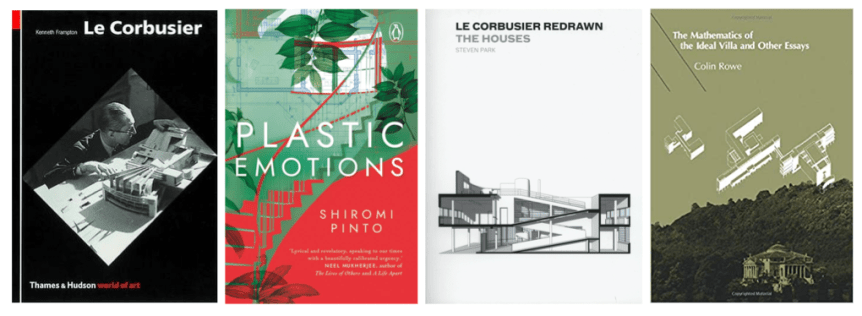
Books written on him. Starting from Kenneth Frampton’s monograph to Colin Rowe’s essay ‘The Mathematics of Ideal Villa’, there are brilliant and engaging lenses to investigate his incredible body of work. My recent favourite is ‘Le Corbusier Redrawn’ by Steven Park, in which 26 of his houses are redrawn impeccably to 1:200 scale. The recent novel ‘Plastic Emotions’ by Shiromi Pinto delicately weaves him into the story of Minnette De Silva and rise of modern architecture in South Asia.
-
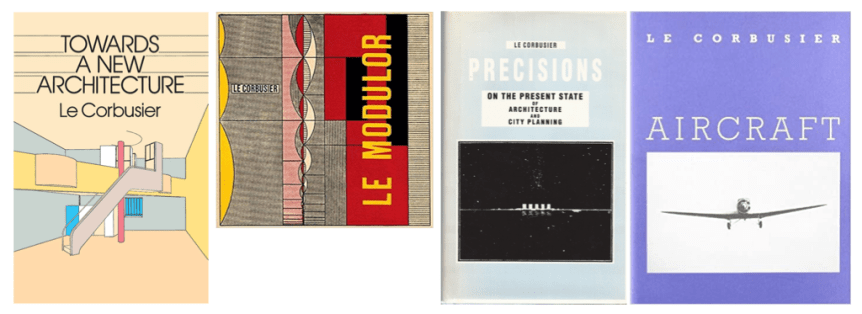
Books written by him : His writings preceded his radical work. He has written close to 40 books. He has been writing continuously alongside his practice, which shows his struggle with ideas. He has continued the line of Vitruvius, Alberti, Palladio to precede theory before practice. His topics are so varied, that one of the books is on ‘Aircrafts’.
-
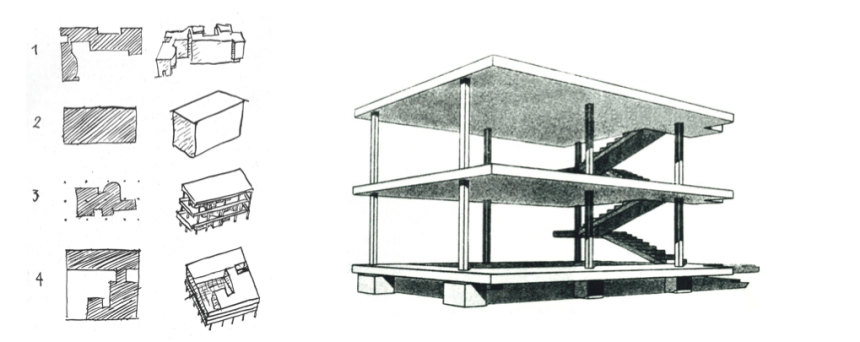
Four Compositions,1929 and Domino House,1914-15. These two diagrams codify and communicate architectural methodology in a precise way.
-
Villa Savoy. I had the privilege to see this house as a student. It is after this project, I discovered Corbusier. My thesis guide Prof. Rajan used the word plastic to describe a key concept of modern architecture. Space was plastic in this house. It was wound around the ramp and held between different degrees of enclosure. It was an orchestrated release from the ground to the sky.
-
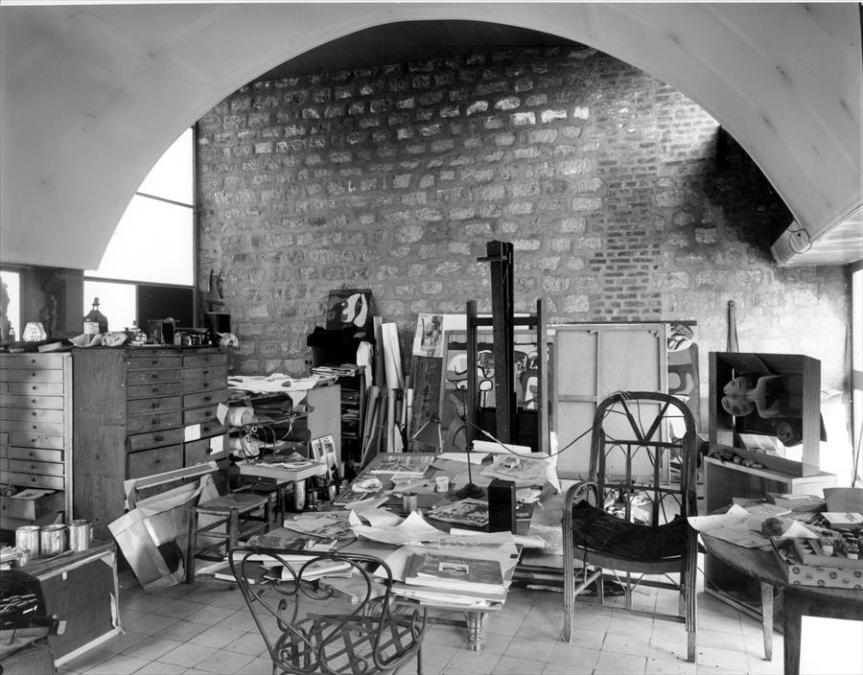
He painted. In his house in Paris the most eloborate space is dedicated to the art studio. The drafting table sits in a quite little corner next to this painting studio.
-
His built in India. He built in India during the end of his career. It is interesting to see the modifications he had to make for his ideas. Sarabhai House is so brilliant and particular.
-
He changed his mind : It is ok to change one’s mind. He broke all the rules he set for himself. He built Ronchamp. What an incredible interpretation of a religious space by an atheist!
-
Scale of the projects. The scale varies from a city to a cabin design done with the same rigor.
-
He traveled. ‘Journey to the East’ is a book which capture his learnings from his travels. His famous sketchbooks are an great sample of his learnings.
-
He drew. Wherever he went. On travels or on his study table.


‘Preparing’ for a lecture

-
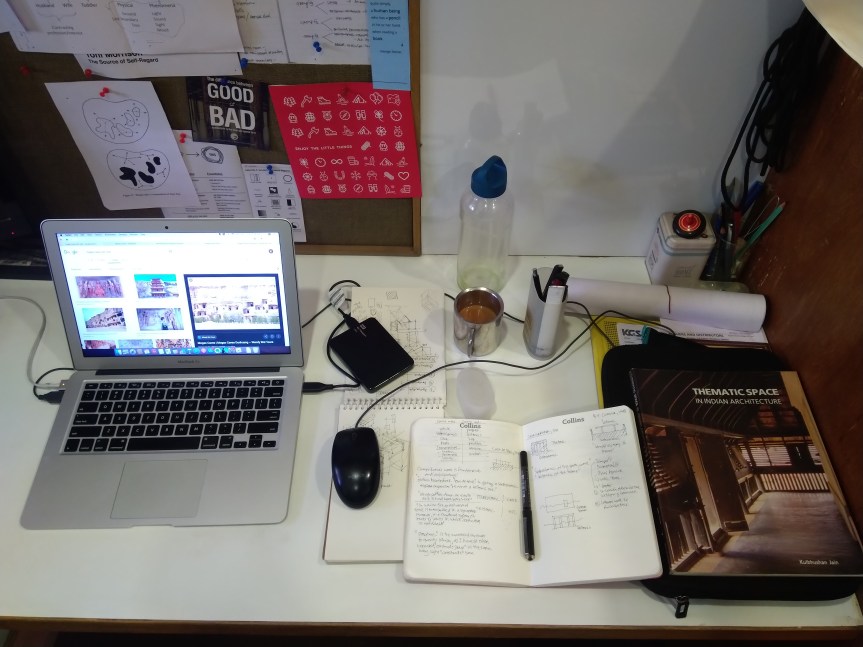
The book ‘Thematic Spaces in Indian Architecture’ by Kulbhushan Jain is an object of pure research. A book which I have from long time but recognised only recently. I am partly aware of the processes/struggles he goes through to publish these book. Dedicating years to each of them. I had the wonderful opportunity to study under him. Hence this book is really important for me. Not only for what is says and but also what it means, to be teaching.
-
A A5 hardbound sketchbook is the core of the thinking process. An anti-dote to the virtual. I try to carry it always. It is a collections of readings, observations, scraps of thought, drawings.
-
A A5 spiral portrait cartridge sketchbook – is what I call the ‘college notebook’ has ideas particular ideas for my classes.
-
A laptop – limitless-overwhelming connection to information. I like to ground/check this virtual platform this with the sketchbook. The mostly minimised PPT file (or the Keynote file for Apple users) in the parallel window.
-
A hard disk – unorganised messy pdf’s of books, old presentations, previous semester works, lesson plans, notes, etc.
-
Coffee – I added it to the scene deliberately to make the mood creative-like ( not to feel left out from the “real” world of “practicing” architects)
-
Soft board – A collage of references, lists, academic notices, schedules, time table.
Nolan’s Drawings

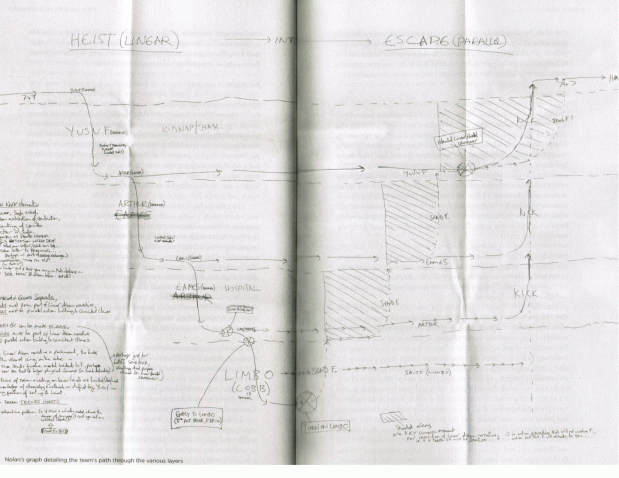
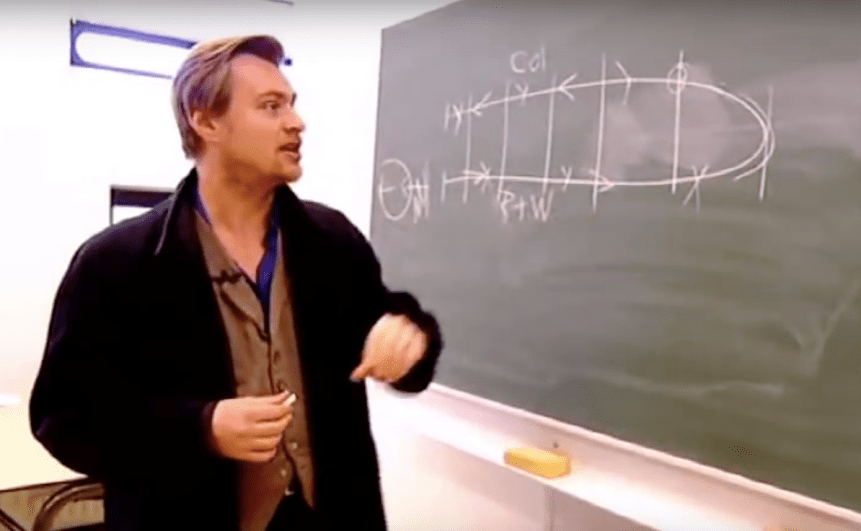
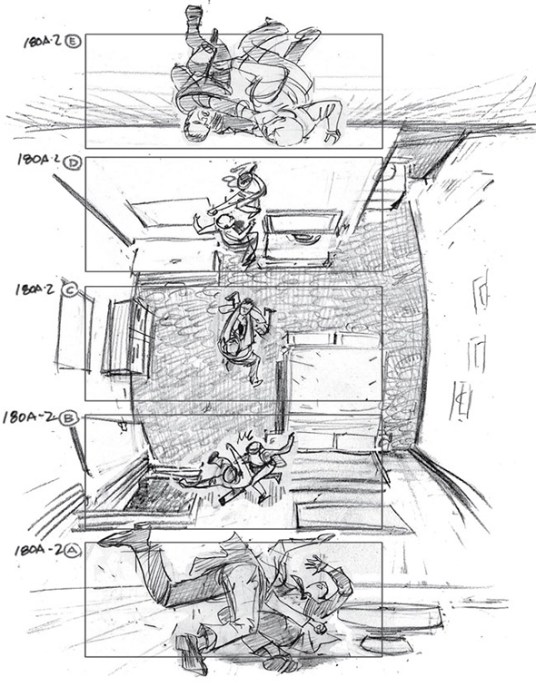
I use this Christopher Nolan’s diagram in my lectures a lot. I end up asking every new batch, if they have seen the movie. Always surprised only few have watched. This is the outline of Inception movie. Whoever has watched the movie will agree with me that it is even difficult to narrate the movie to anyone who has not seen it. There are lot of interesting fan made posters on the web to unravel this complex narrative. Then imagine the trouble Nolan might have had to explain this narrative to his collaborators. I find this diagram (if you can call it one) brilliant. If Nolan make a drawing like this to explain Inception, I don’t think there are any excuses on what a drawing or diagram can not represent ( this tone of exaggeration come the rhetoric nature of teaching). It shows time and space together. A layer underused in architecture, as we deal with static objects most of the time. This another sketch below is from the story board his team made for Inception, which shows movement in a single frame. I found this Youtube video (clip below) where he is discussing and constructing the story of ‘ Momento’. The interviewer prompts him to draw. Even though Nolan says “It’s confusing because I don’t think pictorial/diagramatically” makes this brilliant diagram of ‘hairpin bend’ which is stroke of genius and this gesture cracks the whole narrative of the movie. And looking at the video, Nolan here is ‘extrapolating’ the time-space nature of the screenplay into a single diagram here.
“The only job that was ever of interest to me other than filmmaking is architecture. And I’m very interested in the similarities or analogies between the way in which we experience a three–dimensional space that an architect has created and the way in which an audience experiences a cinematic narrative that constructs a three–dimensional -reality from a two-dimensional medium—assembled shot by shot. I think there’s a narrative component to architecture that’s kind of fascinating.”


You must be logged in to post a comment.