
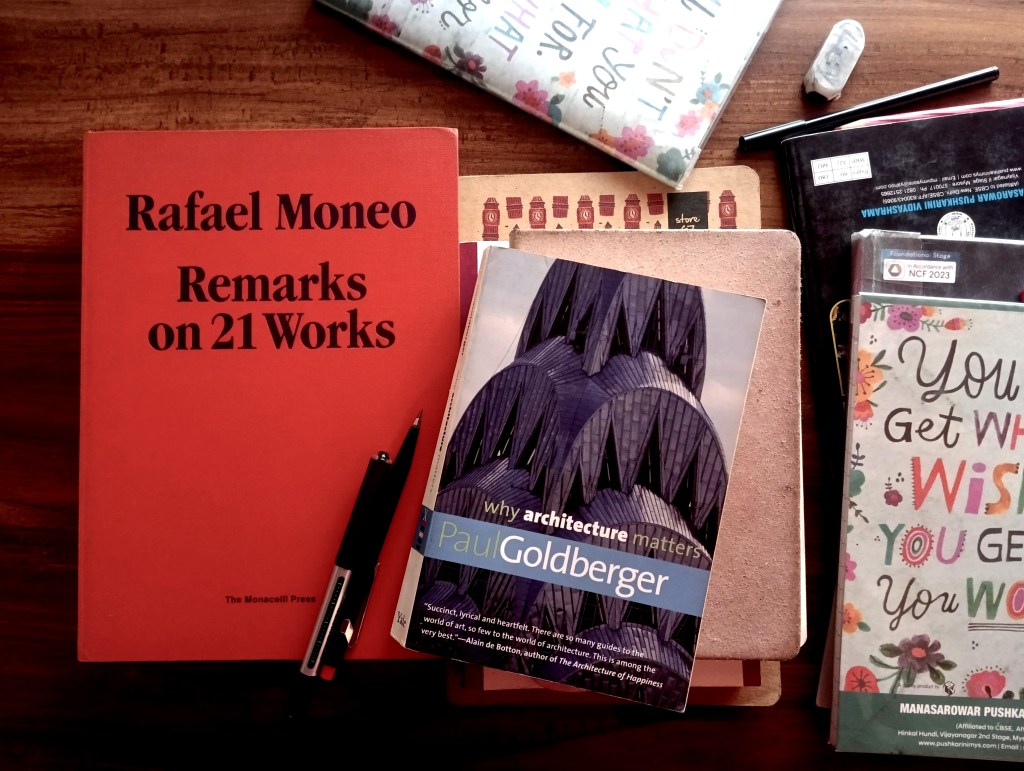
At WCFA, we are entering a new cycle of thesis. As part of this moment, the library marked the beginning by allowing students to borrow three books instead of the usual two—a small but meaningful additional privilege, I feel. I know this is a very optimistic position to take. Snehal Shah, my teacher at CEPT and one of the key figures behind the Theory of Design program, used to constantly remind us that if we didn’t redeem all the seven books we were allowed to borrow as Master’s students, it was almost a crime. That advice has stayed with me, and I keep passing it on to my students. Even though I am usually softly pessimistic about how much students actually pick up and read, something changes when they enter the thesis phase. Their search seems more serious. A book suggestion often turns into an actual borrowing. And it is heartening to see the early phase of thesis research and enquiry being intertwined with books. I remain deeply grateful to Words and Buildings by Adrian Forty (perhaps a longer post on this someday), which became the backbone of my own thesis at CEPT.
Last week, I recommended two books to my students.
Book One: Remarks on 21 Works by Rafael Moneo
The first book was recommended to me by my teacher, and I, in turn, have inherited it through years of reading and teaching. Bijoy often refers to Moneo and his writings, and this lineage of influence continues. This is a sharp book. One of the key things thesis students can take away from it is the idea that each project is embedded with a core architectural question, and each essay is an attempt to answer that question. The book is a unique combination of Moneo himself—a rare mixture of prolific architect, incisive teacher, and elegant writer—writing about his own projects. It carries both the familiarity of the designer and the sharp objectivity of a theorist. Chapter 13 is dedicated to the Kursaal Concert Hall and Convention Centre. The chapter opens with a question:
When singular geographic conditions demand an intuitive architectural response.
The first paragraph of the chapter, where Moneo speaks about the site, goes like this:
“Architecture comes into being and is nurtured in a given place, and the attributes of that place, its deepest condition, become intimately entwined with it. A work of architecture cannot be built just anywhere. It is crucial for the architect to discern those attributes of the site that should be maintained and emphasized, and those that should disappear in the new reality that emerges through the construction process. As a counterpoint, it is important to note that architecture discovers the site, reveals it and makes it evident. The site is where the specific object—the building—acquires its identity and finds its dimension, its unique, unrepeatable condition. The site is also where the specificity of the building becomes visible and can be understood as its most valuable asset.”
Book Two: Why Architecture Matters by Paul Goldberger
The second book is by Paul Goldberger—an incisive book that offers a certain distance while asking what architecture is about and what it means. The book is addressed to a general, non-architect audience, and that distance is precisely what makes it useful. Here is a quote from the chapter “Buildings and Time”, on the comfort of familiarity:
“Because we live with buildings, and see them all the time, our relationship to them is at once more intimate and more distant than our relationship to music or painting or literature or film, things that we experience episodically but intensely. When you are watching a film, your world consists almost entirely of what you see on the screen; when you are in a building, only occasionally do other perceptions and other thoughts disappear from your mind. I spoke in chapter 2 about the extent to which architecture, even good architecture, can encourage complacency; because we see it every day, as a backdrop to our lives, it is easy to stop seeing it with fresh eyes, however closely we interact with it. The complacency that time induces has a purpose: it lets us tolerate things that would be intolerable if we continued to feel them intensely. Thus you numb yourself to that awful shopping mall on the way to work, or you no longer grit your teeth when you see the ugly new storefront that replaced the beloved old soda fountain on Main Street. But such tolerance comes at a price—there is a high tariff to the comfort of familiarity, for it encourages us to stop seeing.”
For students standing at the threshold of thesis, these books offer two complementary positions: one from within architectural practice, grappling with site, form, and intention; the other from a reflective distance, reminding us how easily architecture fades into the background of everyday life. Both, in their own ways, are invitations to look again—and to look carefully.

 mofussillab
You must be logged in to post a comment.