Nolan’s Drawings

inception-flowchart-by-nolan

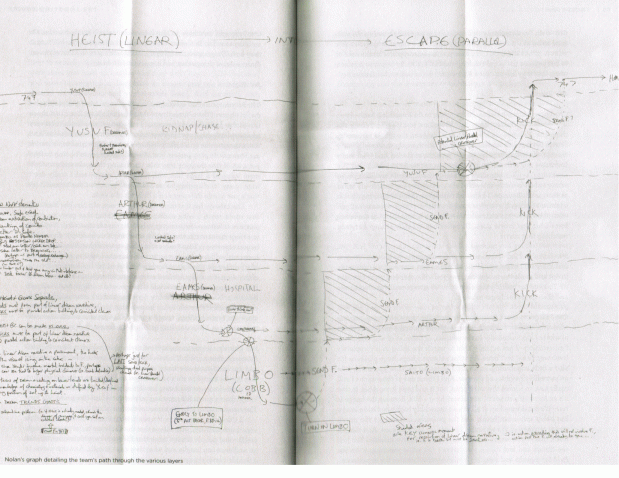
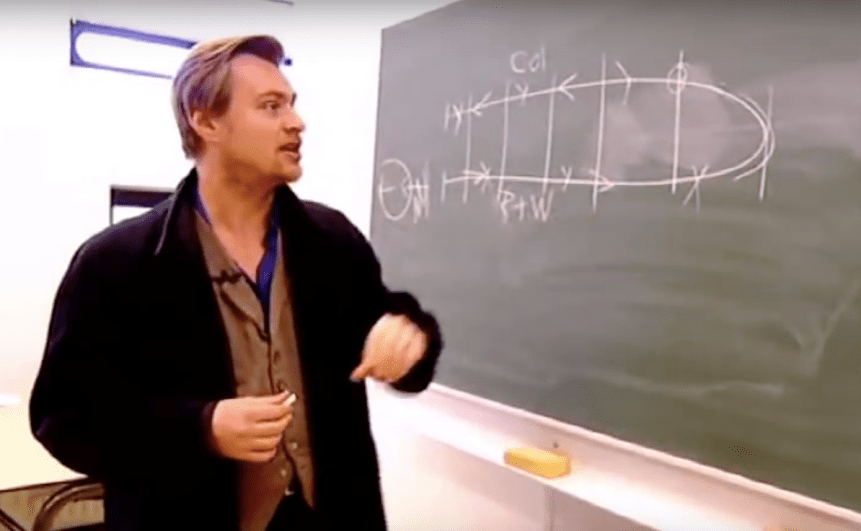
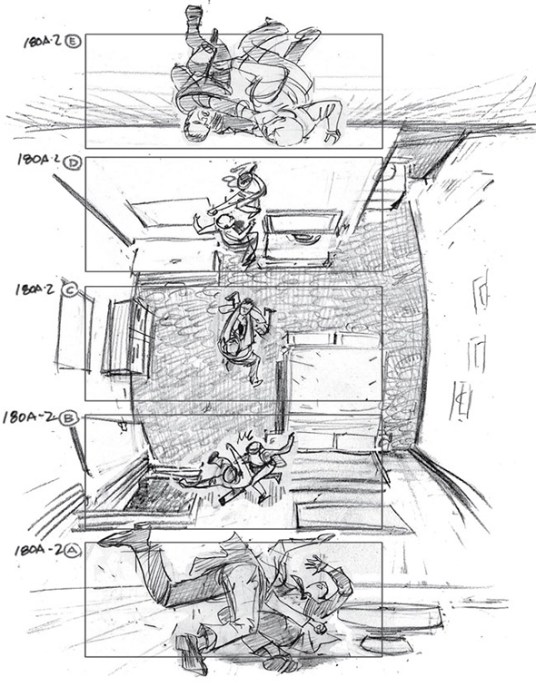
I use this Christopher Nolan’s diagram in my lectures a lot. I end up asking every new batch, if they have seen the movie. Always surprised only few have watched. This is the outline of Inception movie. Whoever has watched the movie will agree with me that it is even difficult to narrate the movie to anyone who has not seen it. There are lot of interesting fan made posters on the web to unravel this complex narrative. Then imagine the trouble Nolan might have had to explain this narrative to his collaborators. I find this diagram (if you can call it one) brilliant. If Nolan make a drawing like this to explain Inception, I don’t think there are any excuses on what a drawing or diagram can  not represent ( this tone of exaggeration come the rhetoric nature of teaching). It shows time and space together. A layer underused in architecture, as we deal with static objects most of the time. This another sketch below is from the story board his team made for  Inception, which shows movement in a single frame. I found this Youtube video (clip below) where he is discussing and constructing the story of ‘ Momento’. The interviewer prompts him to draw. Even though Nolan says “It’s confusing because I don’t think pictorial/diagramatically” makes this brilliant diagram of ‘hairpin bend’ which is stroke of genius and this gesture cracks the whole narrative of the movie. And looking at the video, Nolan here is ‘extrapolating’ the time-space nature of the screenplay into a single diagram here.

In an interview he gave to the Wired magazine he talks about the importance of
“distinct undercurrent about the importance of architecture” in his movies. Nolan answers :

“The only job that was ever of interest to me other than filmmaking is architecture. And I’m very interested in the similarities or analogies between the way in which we experience a three–dimensional space that an architect has created and the way in which an audience experiences a cinematic narrative that constructs a three–dimensional -reality from a two-dimensional medium—assembled shot by shot. I think there’s a narrative component to architecture that’s kind of fascinating.”

Nol
A clip from the Youtube Video
Storyboard
From the story board of ‘Inception’

Notes from ‘Theoretical Practice’ 

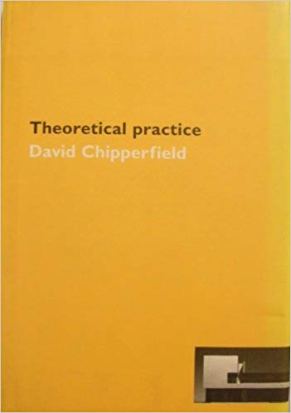
I was cleaning my old notes and found a paper where I had noted these from the book ’Theoretical Practice’ by David Chipperfield. One of the few texts written by Chipperfield. This was when I was a student and had just discovered Chipperfield. I was intrigued then by the title of the book, as one would always associate with the likes of Tschumi and Eisenmann for architects inclined towards theory. This tone of the text felt different for ’theory’. It was more crisp and basic. I could understand what I read for a change (which was unusual compared to other theory texts). I am so thrilled to see these notes for two reasons. My interest in Chipperfield is still very alive, reminding the ideal-seeking-mindset of college days. The second reason is the much needed reminder “architecture is (only) the backdrop of our life” (only added by me). I always refer to this another quote of Chipperfield that ’scale’ and ’time’ are our enemies, but was never  able to place the source. It is a relief now. This book has been out of print for sometime. This piece of note and what it articulates is important reminder for me. I am delighted that I had written this down around a decade back and reassures the need for reading and writing.
.
“Once we accept that architecture is capable of changing little, we can consider it as real power. The questions architecture can pose are limited, and architecture cannot, by definition, provide answers. Architecture is the backdrop of life and has, as such, the possibility of influencing the way we act. It can make our lives much easier and can offer a vision of order in the world of chaos. It can remind us of simple values. It can make our world more material and bring us in touch with the very elements it shelters us from. It can heighten our senses, our anticipation and experience”
.
“Its modest ambition is to make the spaces we inhabit more beautiful and the thing we touch more meaningful. The power of architecture is to be silently profound”
.
“We need to find ideas and clues in the resolution of the simple and everyday problems, to avoid the spectacular in order to make the everyday special. In this vision the simple decisions become the most critical, the margins become more central, in making architecture in which, while questioning the way we act, affirms values and resolves contradictions”
.
“Our enemies are ‘scale’ and ‘time'”
.
.
31dfb3S2zyL._SX349_BO1,204,203,200_

Spaces between buildings

Sitting in a recent review for campus design, I kept using the phrase ‘space between buildings’ repeatedly. After the review i was just wondering if I overemphasised this notion, as we know how teachers can hold to only few things dearly. Just to cross check myself, I tried to think of two examples to support my own thought.


01.

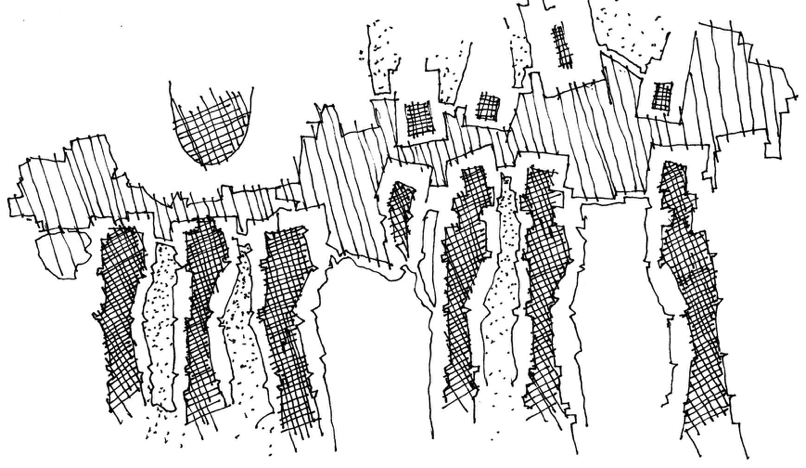
The drawing below was part of early process for the proposal for Nalanda University Competition. I was a member of the Hundredhands team which participated then. The particular intent of the drawing is to take the figure/ground drawing to the next level. Different density of hatches depict different types of in-between-unbuilt space in the project. The parallel line hatch depicts the central spine along which the faculty buildings and the major public buildings (library, dining, etc) were organised. The cross hatch highlights the intimate space within each faculty department zone (academics + hostels + faculty housing) .

01

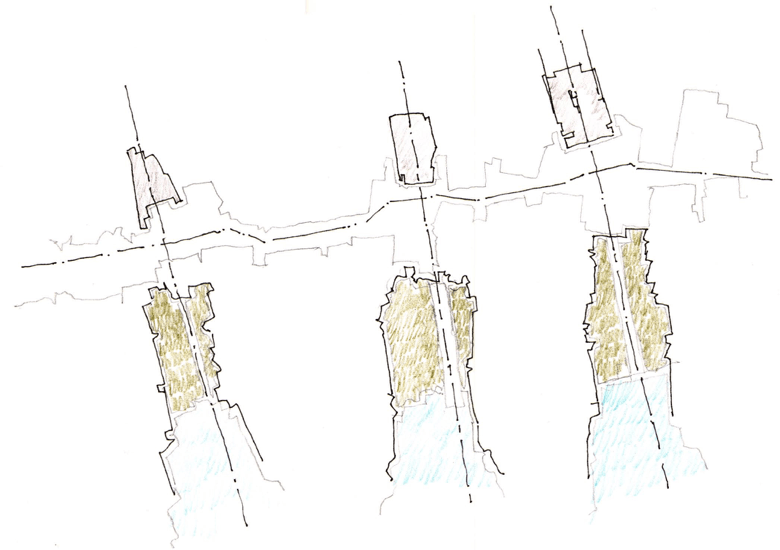
In this other drawing below for the competition, I tried to mark the public buildings ( library, dining, etc) along the spine, which would release to a large vista of open space. A strategy to both control and establish the scale of the campus and also to interrupt the length of the spine to articulate its linear experience.
02

02.
I am sharing an extract here from Paul Goldberger’s impeccable explanation of the University of Virginia’s central lawn and the buildings around it. This is from the book “Why Architecture Matters”, a must read anyway. The point to select this piece is not only for the relevance, but also for the delicate and precise description of an architectural space, which is so difficult to describe because of its tectonic nature.
.
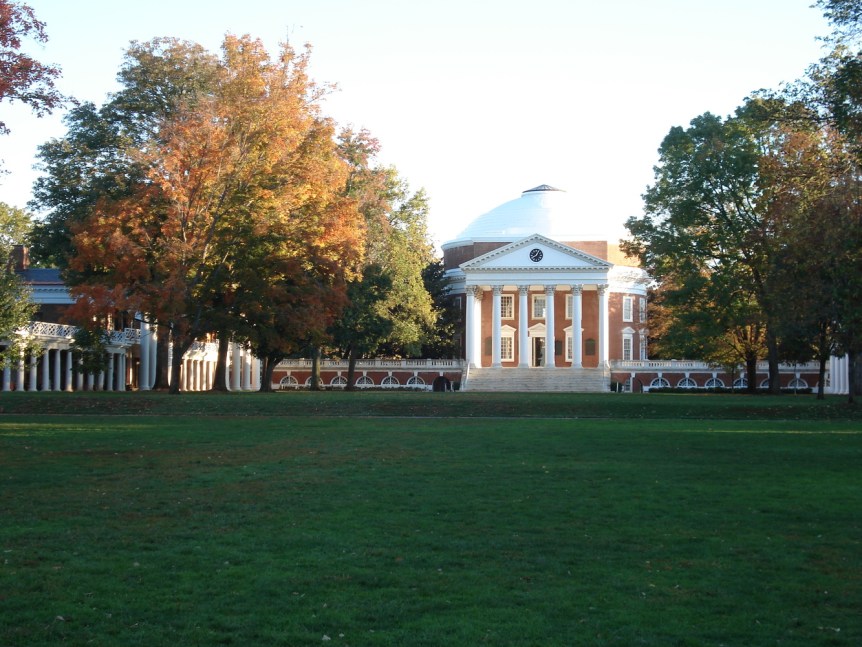
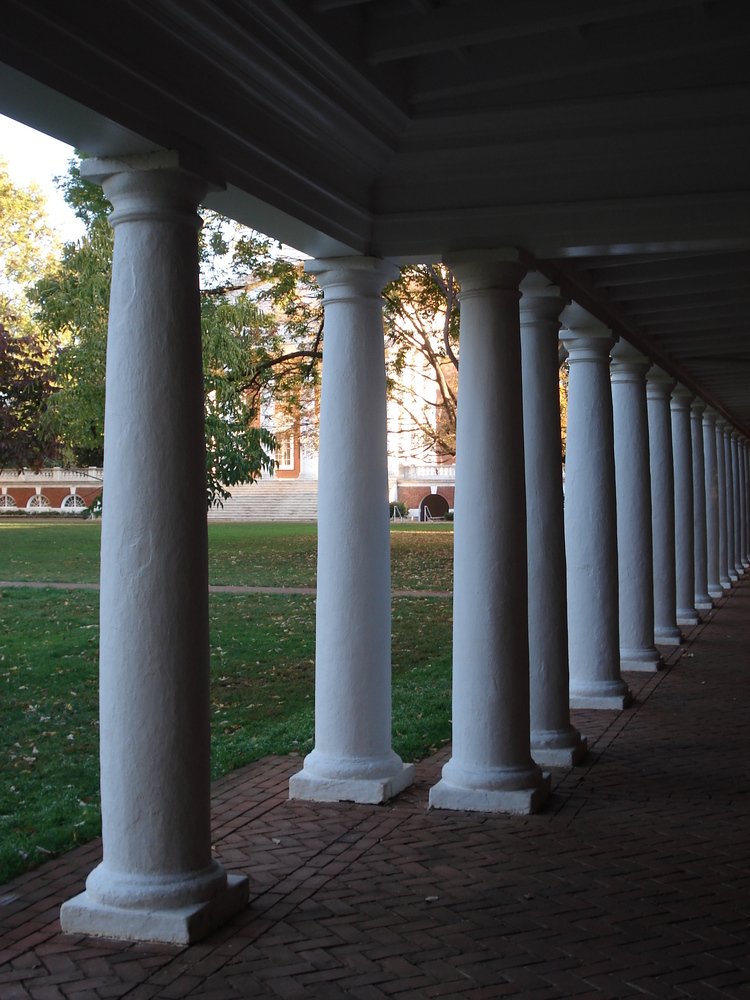
“Designed when (Thomas) Jefferson was seventy four, the “academic village” as he liked to call it, consists of two parallel rows of five classical houses, called pavilions, connected by low, colonnaded walkways, which face each other a wide, magnificently proportioned grassy lawn. At the head of the lawn, presiding over the entire composition, is the Rotunda, a domed structure he based on the Pantheon in Rome.
The whole place is a lesson, not just in the didactic sense of the classic orders, but in a thousand subtler ways as well. Ultimately the University of Virginia is an essay in balance – balance between the built world and the natural one, between the individual and the community, between the past and the present, between order and freedom. There is order to the buildings, freedom to the lawn itself – but as the buildings order and define and enclose the great open space, so does space makes the buildings sensual and rich. Neither the buildings nor the lawn would have any meaning without the other, and the dialogue they enter into is a sublime composition.
The lawn is terraced, so that it steps down gradually as it moves away from the Rotunda, adding a whole other rhythm to the composition. The lawn is a room, and the sky is the ceiling; I know of few other outdoor places anywhere where the sense of architectural space can be so intensely felt.
In Jefferson’s buildings, there are other kinds of balances as well, between the icy coolness of the white-painted stone and the warm redness of the brick, between the sumptuousness of the Corinthian order and the restraint of the Doric, between the rhythm of the columns, marching on and on down the lawn, and the masses of the pavilions. In the late afternoon light all this can tug at your heart, and you feel that you can touch that light, dancing on those columns, making the brick soft and rich. There is awesome beauty here, but also utter clarity. It becomes clear that Jefferson created both a total abstraction and a remarkably literal expression of the idea. Architecture has rarely been as sure of itself, as creative, as inventive and as relaxed as it is here” ( Pages 13-15)
.
Some images for below for reference ( Source Archdaily Classics, Photo Credits : Larry Harris)
.DSC09373
.
DSC09354
.
DSC09376
.
DSC09377

Wall Sections

On the similar line of thought Ruskin saying that “If you can paint one leaf, you can paint the world”, i believe if one can draw a careful wall section, you can take care of the whole building.
.
RUSKIN
Study of Spray of Dead Oak Leaves (detail; 1879), John Ruskin. © Collection of the Guild of St George/Museums Sheffield
13
click on the image to enlarge
Wall Section, Kamala House, 1959 , BV Doshi
This section reveals
1. the attitude of the built form towards the ground by slightly extending the plinth outside casting a shadow
2. folded RCC chajja-cum-parapet as an instrument to allow diffused light
3. rat trap bond as insulator
4. reveal plastered and exposed surfaces
5. tectonics and materiality of the facade
.
detailed wall section
click the image to enlarge
This drawing (1: 20 scale part sections) below is a drawing I made for my UG thesis (Public Library) at USD Mysore in 2008. It captures all the edge conditions of the building. It was my professional training at Apurva Amin Architects in Ahmedabad trained me to look at a building this close. And it was Bijoy Ramachandran, my thesis guide then, insisted to look carefully at the tectonic quality of the building.
Since then, for me this drawing ( and scale of noticing) has been a very important method and tool to read and build architecture .

Notes : The wall section of Kamala House is a scan from a booklet published on this house from Sangath.

10 Books : On Drawing

I teach a course on drawing (drafting – to be precise) for first year students here at WCFA (we call it Architectural Graphics here and it is taught for a year). When I studied, it was called TRD (Technical Representation of Drawing) and we did this course for 2 years. The objective of the course is to know the fundamentals of drawing and practice drafting as a skill to support design and construction drawings. Normally the course is looked as skill development. My attempt has been to place this skill, in the larger context of what drawings can do. I have put down a list of ten books, which helps me to build this narrative of drawing and the list could be a good companion to this introduction course.

51BOYBZAkqL01. Architectural Graphics – Francis D K Ching

Great book to start with. Covers all the fundamentals of drafting – instruments, types of drawings (orthographic, isometrics and perspectives)


51mZrjLdPxL02. Design Drawing – Francis D K Ching

This less familiar Ching’s book is also a must read. The chapters fall under three broad topics – Drawing from Observation , Drawings Systems and Drawing from Imagination. This last topic has chapters on Speculative Drawing, Drawing Composition, Diagraming and Presentation Drawings.


Euclid's Window by Leonard Mlodinow03. Euclids Window : The Story of Geometry from parallel lines to Hyperspace – Leonard Mlodinow

From the back cover “Euclids Window takes us on a brilliantly entertaining journey through 3000 years of genius and geometry, introducing the people who revolutionized the way we see the word around us”. This book gives a broad understanding of the role of geometry in understanding space starting from Phythagoras “little scheme” to “employ mathematics as the abstract system of rules that model the physical universe” and “this was the birth of abstraction and proof”


f2fc243d57bcecf10fa26630e6e814e3.jpg

04. Drawn to Design : Analysing Architecture Through Freehand Drawing – Eric J Jenkins

A brilliant book which moves into analysis and design. From the cover “The conceptual goal of this approach is to use drawing not as illustration or depiction, but exploration….The main component is a series of chapters that constitute a typology of fundamental issues in architecture and urban design; for instance, issues of “façade” are illustrated with sketch diagrams that show how façades can be explored and sketched through a series of specific questions and step-by-step procedures. This book is especially timely in an age in which the false conflict between “traditional vs. digital” gives way to multiple design tools, including sketching. “


page_105. Manual of Section – David J. Lewis, Marc Tsurumaki, and Paul Lewi

Extract from the book ” This book represents the means for understanding the complex and important role that section plays in architectural design and practice. Discussion and debate of a particular building’s section are common in the study and practice of architecture. Yet there is no shared framework for the determination or evaluation of section. What are the different types of section, and what do they do? How does one produce those sections? Why would one choose to use one configuration of section over another? This book explores these questions and provides a conceptual, material and instrumental framework for understanding section as a means to create architecture”

This books analyses 63 projects through sections (drawn with one point perspective backgrounds) under seven themes – Extrusion, Stack, Shape, Shear, Hole, Incline, Nest

61p8XTeC96L._SX461_BO1,204,203,200_06. Drawing for Landscape Architecture: Sketch to Screen to Site – Edward Hutchinson

In extension to brilliant illustrations, the author also mentions what exact tools were used to make each drawing, the paper and the time it took to draw it. It varies from 3 minutes to 2 hours to 2 days. Its very revealing to duration of each drawing. A reminder that good drawings take time.


978178067272407. 100 years of architectural drawing : 1900-2000 – Neil Bingham

A chronological survey of how the drawing has transformed over the century


?collid=books_covers_0&isbn=9780262525480&type=08. Why Architects Still Draw – Paolo Belardi

A book about drawings without any illustrations inside. Intelligent structure to write a book on drawing. The only drawing used on the cover is my by Lebbeus Woods, my favorite architect and the reason i picked up the book.  It is in this book i came the word ‘disegno’, an Italian word for both drawing and design.


415c0n3lebl.jpg09. Steven Holl : Written in water

I had to add this from Steven Holl, my personal favorite who makes this 5″x7″ beautiful and naive watercolor drawings. Holl considers this sketchbook and watercolor format as the crux of his architectural thinking.


414VdZegS7L._SY398_BO1,204,203,200_10. Louis Kahn Drawing to Find out Designing the Dominican Motherhouse

One unbuilt project. 3 years of iterations.  An amazing collection of drawings and great reminder architecture is a patient search.