10 years of reading

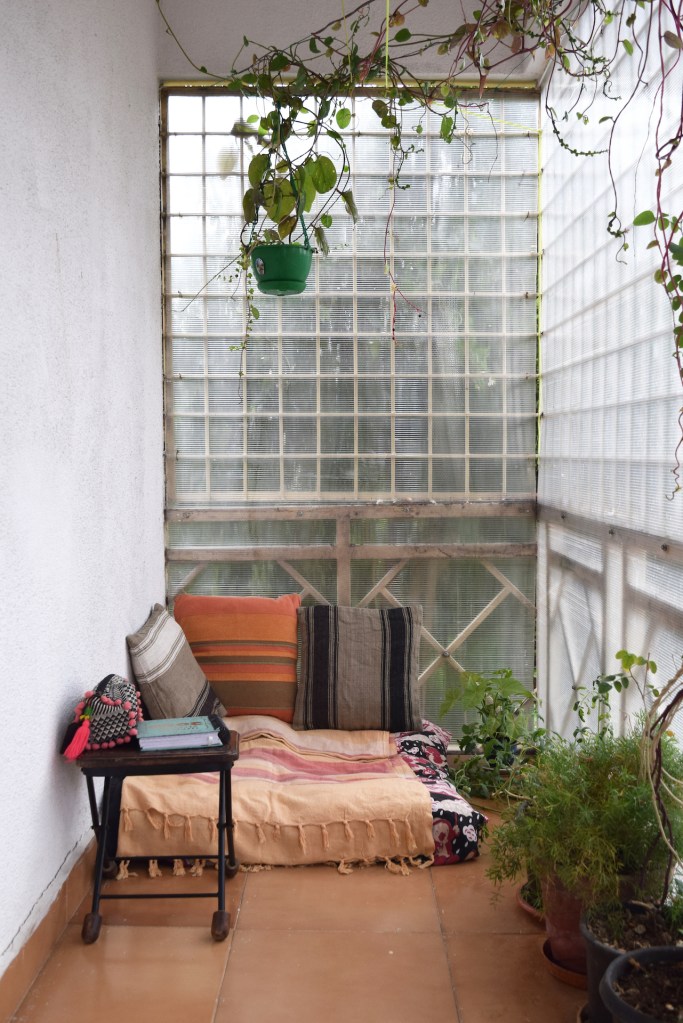
I thought of quietly making an event for myself in these strange times, to remain hopeful a bit.  I realised that it has been ten years since I started reading seriously and independently.
.
I am deliberately marking 2010 as the starting point, because it coincides with the intellectual void of leaving an institution (and the wonderful access to the library at CEPT) and carving one’s own journey into the profession. It was in 2010 I finished my post graduation at CEPT. The two years before 2010 at CEPT had been a substantial deep exposure to reading. I was barely catching up with the architectural reading I had to read as part of the curriculum. In comparison, I had read too little during my under graduation in USD Mysore, due to lack of exposure to the value and discipline of reading. But I was fairly familiar with the 4-5 cupboard of books at our library in USD. I remember reading the Architectural Record regularly, which the library used to subscribe to. This was the only portal to know a bit about contemporary architecture, before the norm of Archdaily-Dezeen days. In CEPT, most of the books were derived suggestions from wonderful teachers. Prof K.B. Jain, used to say to reflect on any problem in life, one could either look at cricket or read Hesse’s Siddhartha. I bought that book as soon as he said that. Snehal Shah used to continuously remind how it was a crime not to use the full potential of library card, which allowed a PG student to loan 7 books. My other teacher, Bijoy Ramachandran introduced to me the world of Richard Sennet and Rafael Moneo.( I remember how Moneo was delighted to know, that Bijoy carried two of his heavy books to get signed in an event in Goa) It is not only that teachers introduce and make the books visible, they also allow to look at ideologies of Moneo, Hesse, Sennet through their perspective. This borrowed lens of viewing the world is of immense importance to my education.
.
2010 also marks an important moment. I could buy a book online! Flipkart stated to deliver books (only books then). Actually Amazon also started as a book delivery company. This ability to buy books online marked a huge change. It democratised access to knowledge. I remember when studying in Mysore, it was extremely difficult to stumble/discover new authors or books.  I am still grateful, though it was still limited, to our wonderful small collection which was made possible by Prof. Daroga . This was early days of everyday internet and phones were not smart yet. One had to travel to KD road ( like 2 kms from where is stayed) for a decent internet connectivity . Was expensive too. I remember a teacher then who used get to get some really interesting books, but share it only with his favourite student/s. Used to envy them a lot, as I was not under his radar in UG. It was then a liberation to be in CEPT library.  Even when I recently visited ( almost after a decade) the new CEPT library, most of the old staff and the graceful main librarian Tejaswaini Ben remembered me from my college days. I was delighted to know they recognised me even now. Moving from loaning books to buying books is an important threshold in reading. So this casual everyday act of getting a book delivered to your door is a privilege, one which I would like to recall everytime a book gets delivered.
.
I also discovered Pico Iyer in 2010. I vividly remember reading a essay on Pico Iyer in Pradeep Sebastian’s book ‘The Groaning Shelf’. I remember picking up the book from the Crossword store near SG Highway. Actually I visited the store because, it was designed by Apurva Amin, whom I had trained under. I picked up Pradeep Sebastian book, because I remember him from some articles he wrote in the The Hindu. The significant minor (major now) reading habit I had picked up from my father. I used to subscribe to the Chennai print edition of The Hindu paper in Ahmedabad ( as they was no local edition), which used to arrive by air, a day late sometimes. A habit which is still the most disciplined reading I am engaged in. The Hindu has a huge impact on my reading habit. In school the only books I read were Tinkle and Sherlock Holmes and started reading the paper then. So only after reading Pico Iyer, I have considered my self as a serious and independent reader. I can be flamboyant in saying that I have all (almost) of his books. Since then I have been seriously reading and discovered Amit Chaudhri, Amitava Kumar, Austin Kleon. It has take taken almost ten years from me to find my own ecology of reading and family of writers who keep shaping my ideas and world views.
.
I am happy my reading has become very eclectic today. I am currently reading a brilliant book ‘Cooked: A Natural History of Transformation’ by Michael Pollan. Actually the trigger to write this piece is how surprised I am of myself to be reading a book on cooking with such pleasure (even though I don’t cook much or am neither a foodie ). It is the shear pleasure of accessing ideas and minds of these wonderful writers. I was introduced to Pollan by a self help book on time management and productivity ‘Make Time : How to Focus on what Matters Every Day’ by Jake Knapp and John Zeratsky. I am rereading (second reading in 2 years) Pico Iyer’s ‘Autumn Light: Season of Fire and Farewells’  on the side. Recently pending unfinished books are ‘The Library Book’ by Susan Orlean and ‘The Art of Thinking’ by Alan Jacob. The two books in quarantine are Amitava Kumar’s collection of Essays ‘Lunch with a Bigot : The Writer in the World’ and Tim Parks ‘Pen in Hand : Reading, Rereading and other Mysteries’. I did not imagine to be in a landscape like this ten years before and I am conscious and grateful to all the connections which led me to this terrain of reading.
.
It has taken years for this to happen. Earlier, whenever I went to a bookshop, I used to go the architecture section and may be to fiction. Now I ambulate the whole bookshop. My biases of books on spirituality and inabilities to read poetry are also breaking slowly. To share my interests I also started book club at WCFA, around 4 years back. I envy the students in the club who have already read more than me even before they joined college. I have completely missed the natural track of reading i.e. Classics – Fiction – Non Fiction – Poetry – Philosophy . I am yet to read the classics. To be involved and develop an ecology of reading, one also has to be aware of all the fragile connections that led to a particular book or a writer.  Even though I started reading very late, I consider it a huge privilege to have read whatever I have read till now. This piece is just a reminder to myself ; to keep reading.
.

Rereading : Inception

Inception 1
.
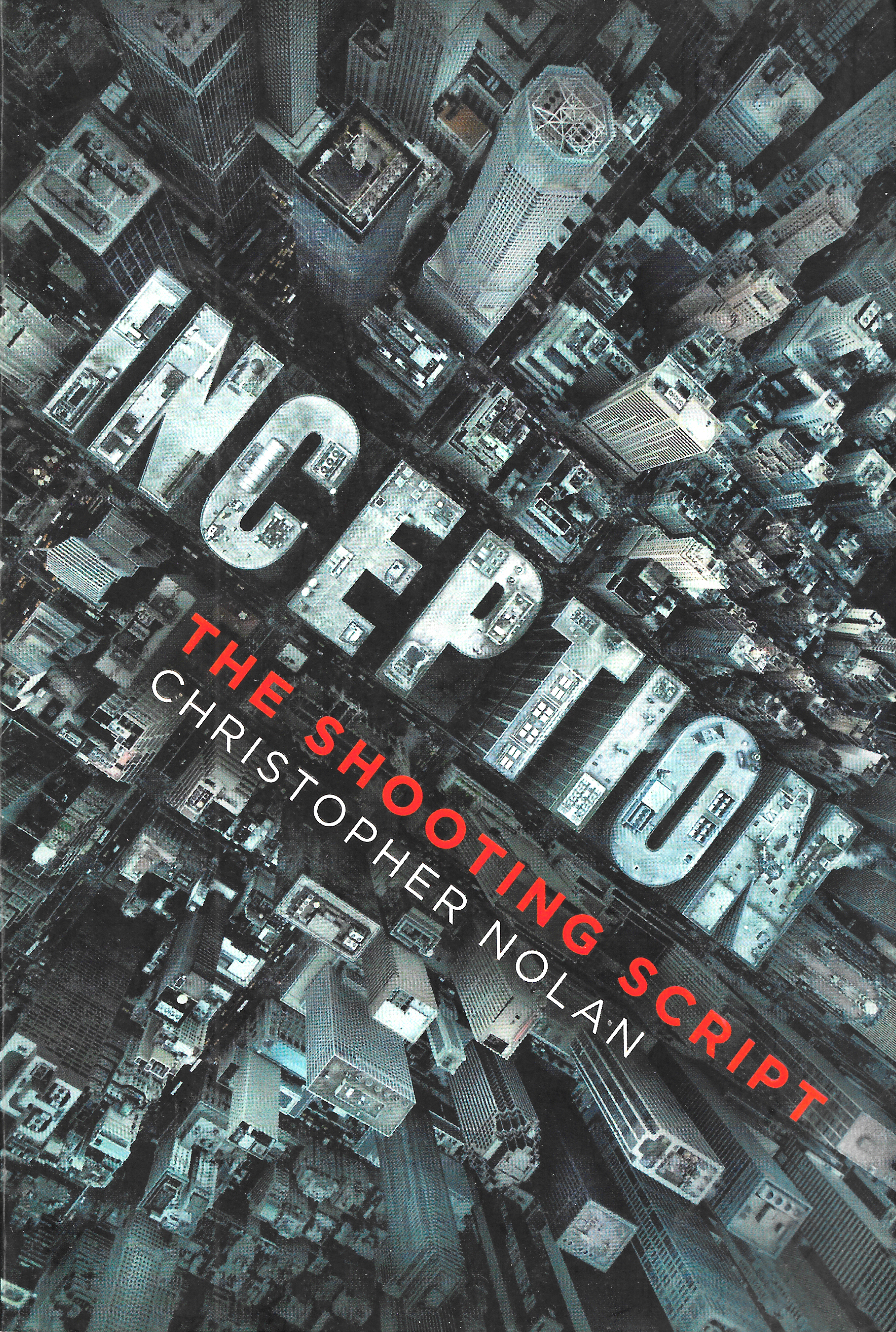
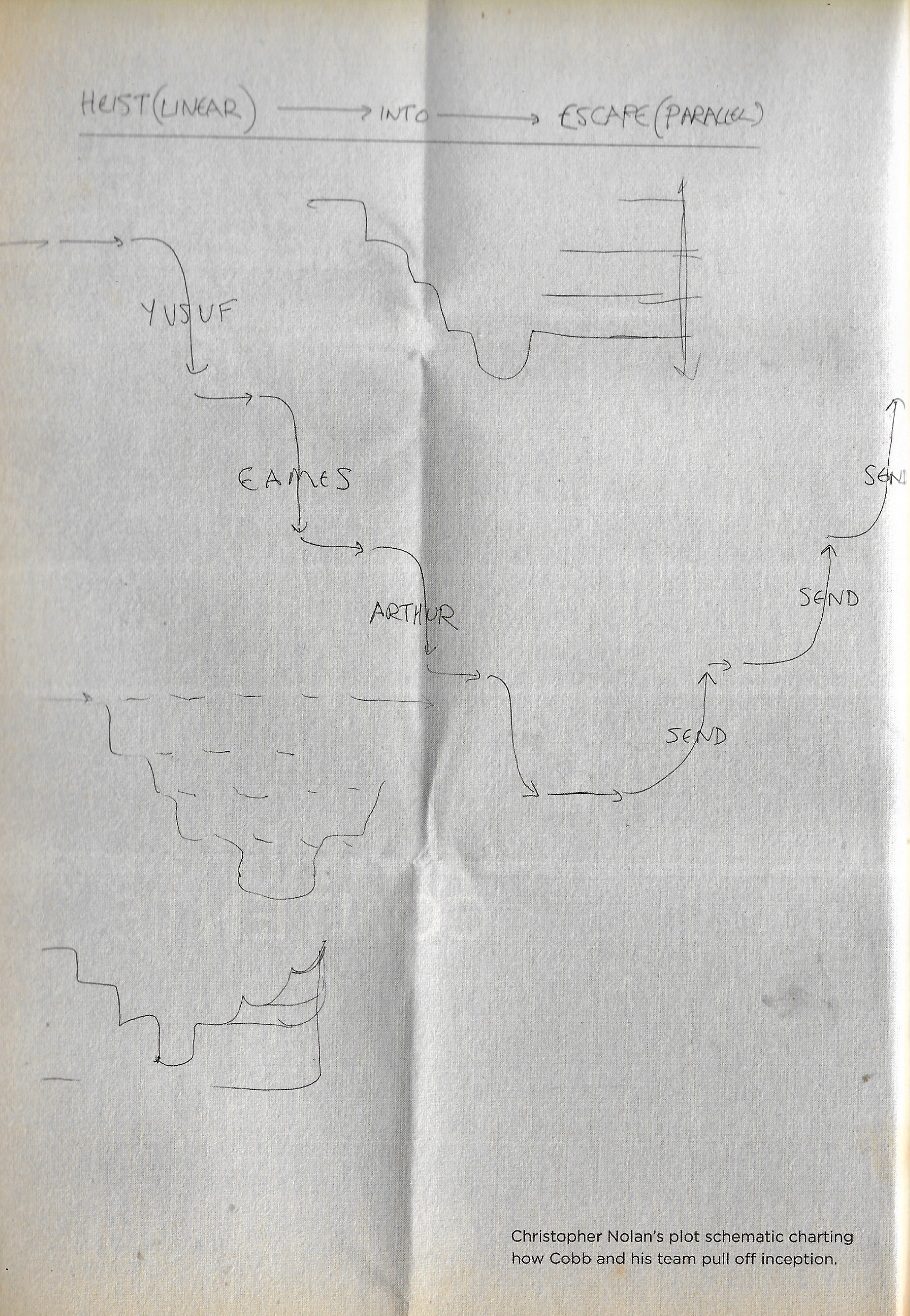
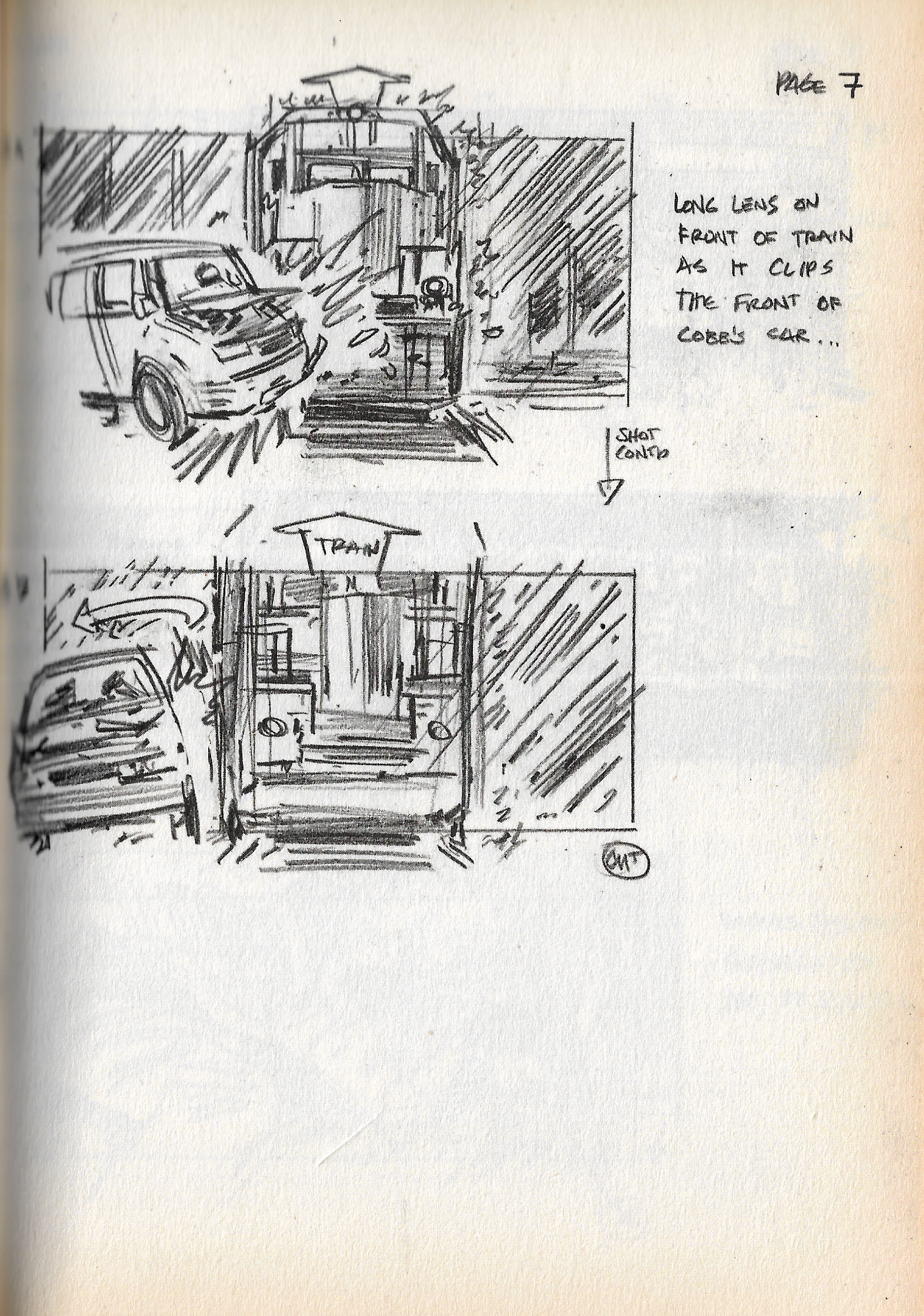
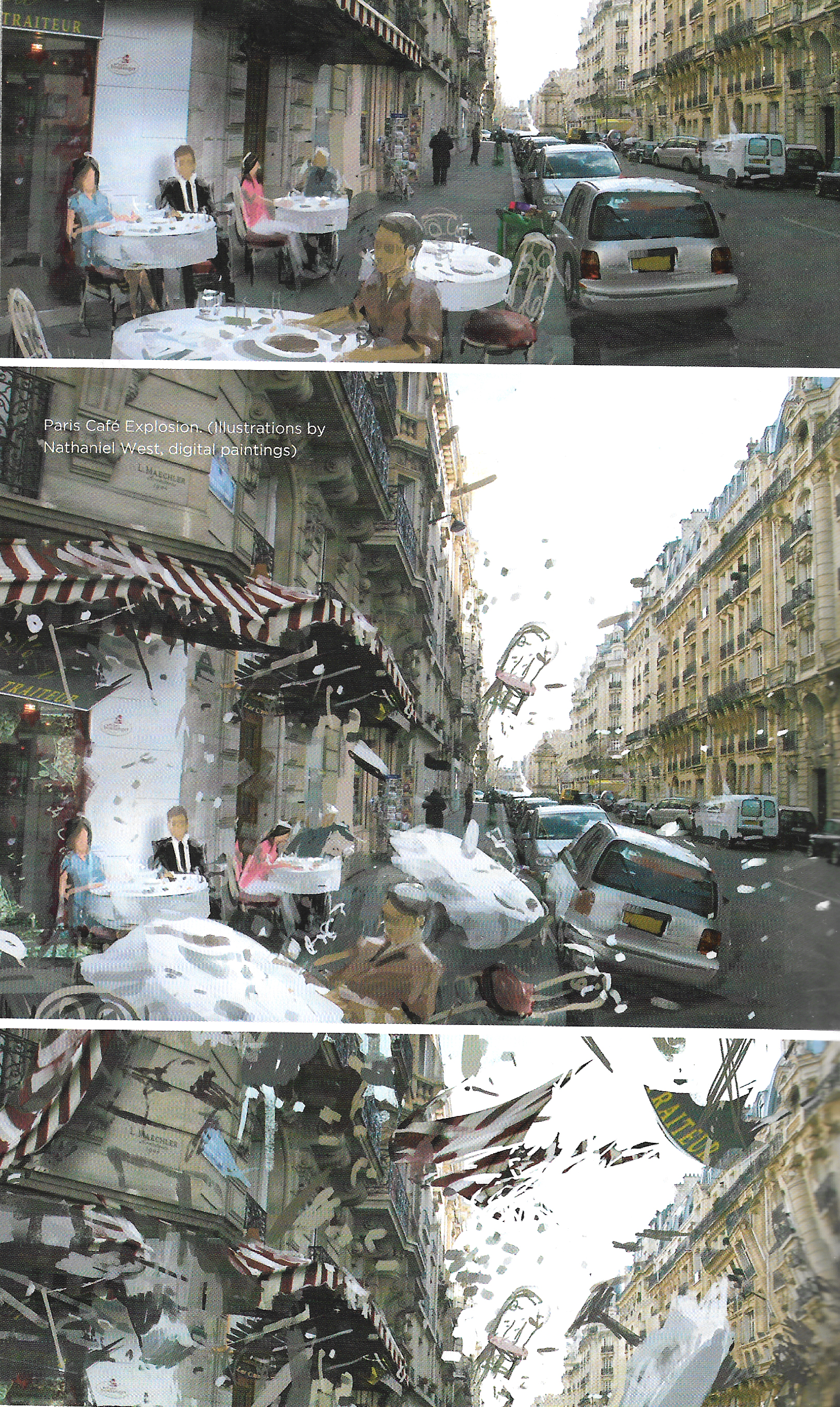
I have this book on Inception for a few years now. Whenever i pick this book, i usually flip through the drawings only. I have written earlier about my fascination towards Nolan’s drawings. Below are some brilliant sketches from the storyboard. This time when I rewatched the movie, which i have done a few times already, i also read the shooting script of the movie. It was a unique experience of reading the script of a movie, that already i am well aware of. But still, the script revealed subtleties which i missed in the movie. For example, the heavy rain happened in the train-in-the-road scene, because Yusuf had a lot of champagne in the plane (the parallel reality) and he had to pee. I know it is a trivial detail, but my fellow fans would agree with the brilliance.
.
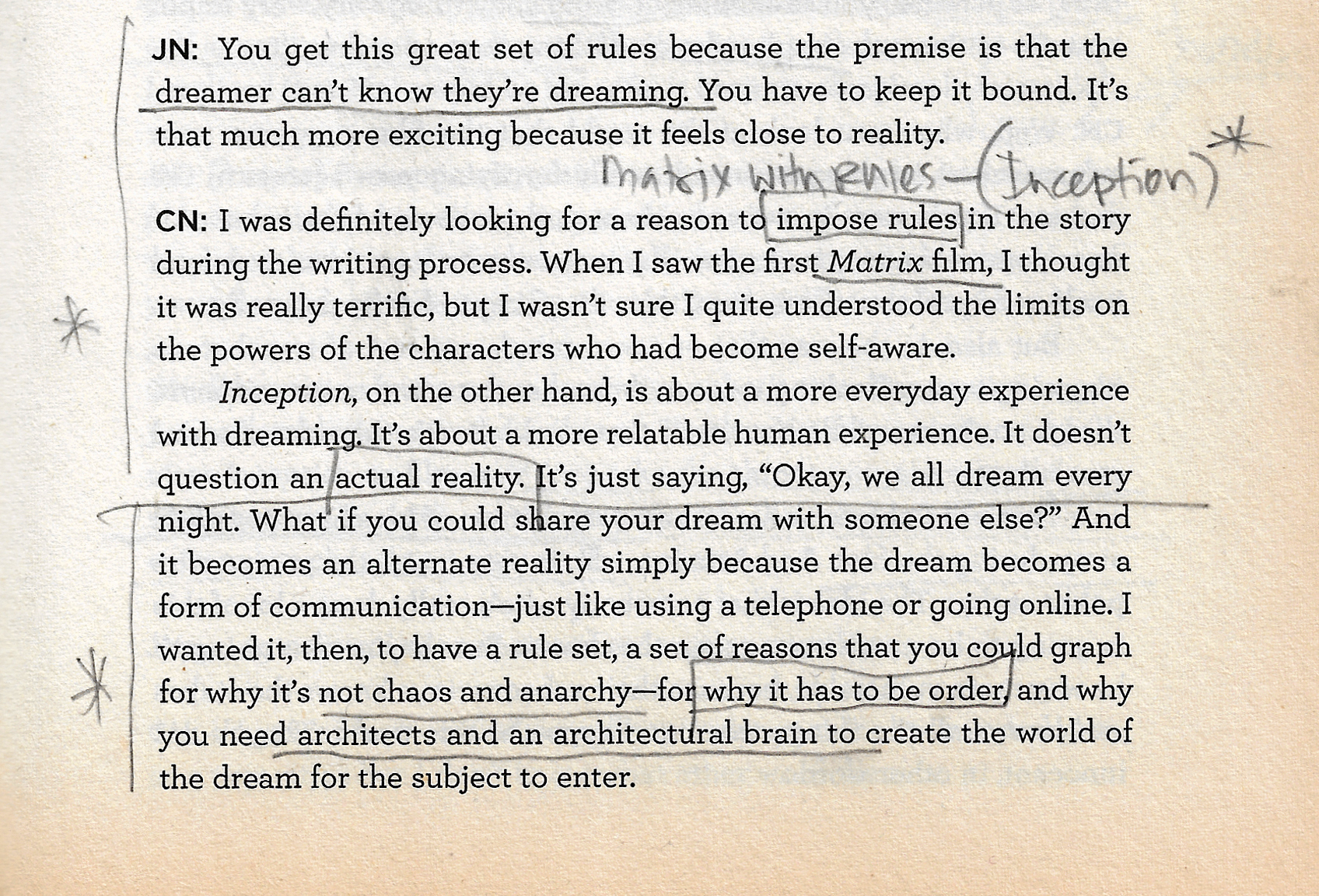
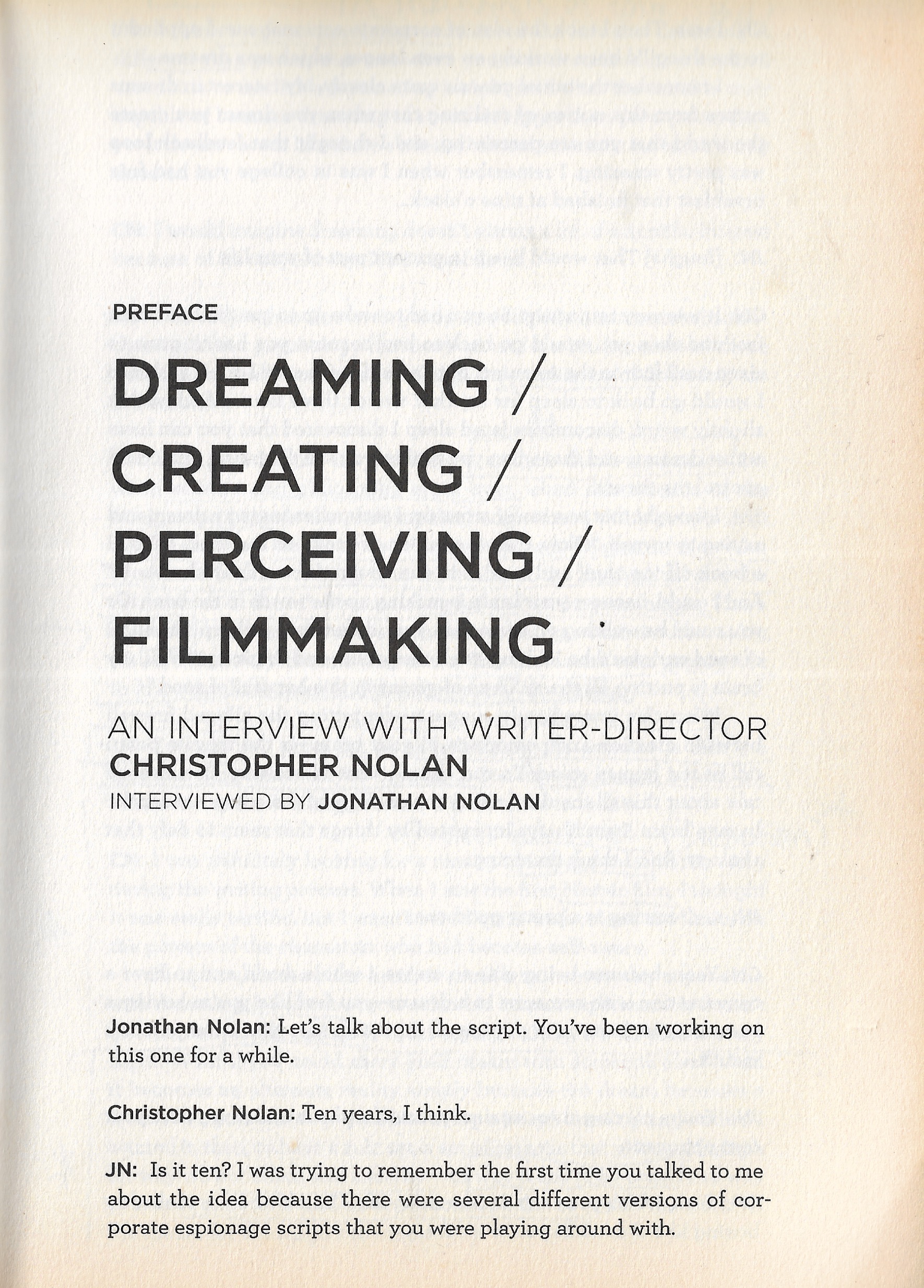
Reading the script, i understood the conceptual distance between the idea (the script) and the actual movie. Like architecture, film-making relies on collaboration. The collaborative journey from an initial idea to the final manifestation (film/building) is a fragile one, conceptually speaking. Imagine getting people on board to imagine such a complex idea of a movie which is even difficult to summarize after watching. Imagine the creative process of making an idea like this tangible.  This book starts with an interview discussion between Christopher and Jonathan Nolan. Below is an extract from the discussion.
.
Inception Text crop
.
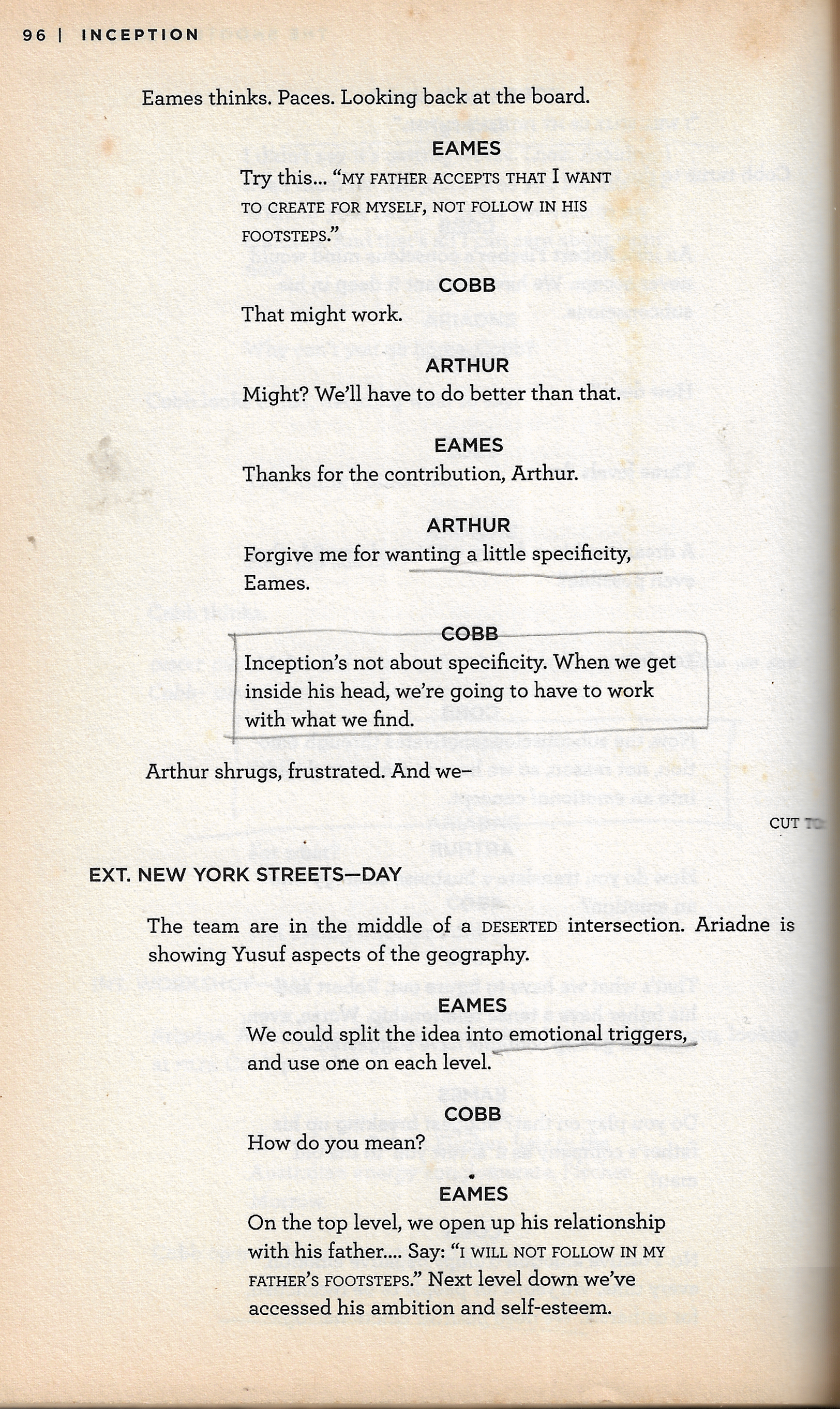
It is this trait to ‘impose rules’ and create ‘order’, that makes Nolan’s thinking simultaneously architectural. Once you starting looking this way, the movie becomes something more. It is evident in these dialogues :
.
Cobb : What is the most resilient parasite?….An idea…..Resilient, highly contagious. Once an idea’s taken hold in the brain it’s almost impossible to eradicate. A person can cover it up, ignore it – but it stays there.
Saito : But surely  – to forget..?
Cobb: Information, yes. But an idea? Fully formed, fully understood? That sticks (taps forehead).. In there, somewhere.
.
From now on this will be my cool job description for teaching. Isn’t that what we do or we should be attempting to do in teaching. We are all aware of the crisis of the classroom because of the internet. Actually what the internet can’t automatically do is the delivery on a regular basis of a fully formed, fully understood ( I will add the word relevant here) idea. Imagine this reply from a teacher, when asked what do they do. “My job is to implant fully formed, fully understood and relevant ideas into fleeting-state-minds” A little delight in otherwise dull (as usually misread) teaching job. Cobb also says “No idea is simple when you have to plant it in someone else’s mind”  In this another scene that happens in Mombasa between Cobb and Eames, Eames says “If you’re going to perform inception, you need imagination”. He adds “It’s not about depth. You need the simplest version of the idea – one that will grow naturally in the subject’s mind. Subtle art”. Again, Eames could easily be talking about teaching here too.
.
Even the emphasis – idea, understood – in the dialogue are from the script. There is specificity (this word is also borrowed from the script) in the thinking. In one of the earlier scenes, Mal “studies a painting by Francis Bacon” and Cobb replies “Saito is partial to postwar British painters” In an another scene, Saito realizes that he is dreaming, only when he figures out that the carpet was actually “stained and frayed in such distinctive ways.. but very definitely made of wool. Right now i am lying on polyester”.
.
In this dialogue with Ariadne, Cobb says an architect’s mind “creates and perceives a world simultaneously” and it is how one “imagines a building”. When you “build a bank vault or a jail, something secure, and the subject’s mind will fill it with information he’s trying to protect”. Ariadne says in an another scene “I love the concrete sense of things – real weight, you know? I thought a dream space would be all about the visual, but its the feel of  the things” Note the emphasis – feel – here in the script by Nolan, like someone who had read Pallasmaa would do it. This tactility is emphasised again in the scene where they are discussing about the totem – a key component in the movie. Arthur says “You need something that a has a weight or movement that only you know”. Like Lewerentz handling bricks.
.
This is my first experience of reading a script. So it was amazing to know what a ‘script/screenplay’ does to do a ‘story’. It is this transition that marks the uniqueness of film-making. It is this trait of screenplay that makes film-making distinct from other forms of storytelling. As an architect, i always carry the question “What is that only thing that architecture can do that other fields can’t”. This question has always kept me on the edge – both in professional and academic practice.
.
I am simply amazed every time i watch Inception that how well thought and architectural the movie is – in terms of how the ideas are ordered. Looking forward to discover more details the next time i watch. I am going to end here with this line by Cobb “.. the subconscious motivates through emotion, not reason, we have to translate the idea into an emotional concept”.
.
Few pages from the book :
.

Inception 3 3

Inception 3 5

Inception 4 1

Inception 3

Inception 3 6

Inception 3 4

Inception 3 2

Inception 3 1

On tracing

The act of tracing is an elemental part of me being able to practice architecture. One needs to know only how to trace well, capacity to draw (non-tracing kind) will tag along. In the process of tracing, one is joining the act mid-way, hence there is no pressure to face a blank paper. Here is brilliant quote from Jessica Helfand from her brilliant article from Design Observer.

“Tracing, it turns out, is more than an involuntary narrative delivered by a relaxed mind: it’s a process and a practice, a verb as well as a noun, and a flexible, foundational material that functions, in the studio, as a kind of connective tissue. Tracing allows for a new idea to be layered upon another, or sketched over in such a way that new and old can be viewed together: the magic here is that drawing on a diaphanous surface provides the opportunity to both refine and deviate from visual thinking in real time. It’s a membrane that exposes the underbelly of an idea—a way to think in stages—and seeing those stages pulls you along in your thinking…Trace, on the other hand, is a revelatory material, a conceptual hinge shepherding you from what was, to what is, to what could be….In the act of tracing, the past is in view, the process is revealed, and the journey is powerfully exposed”

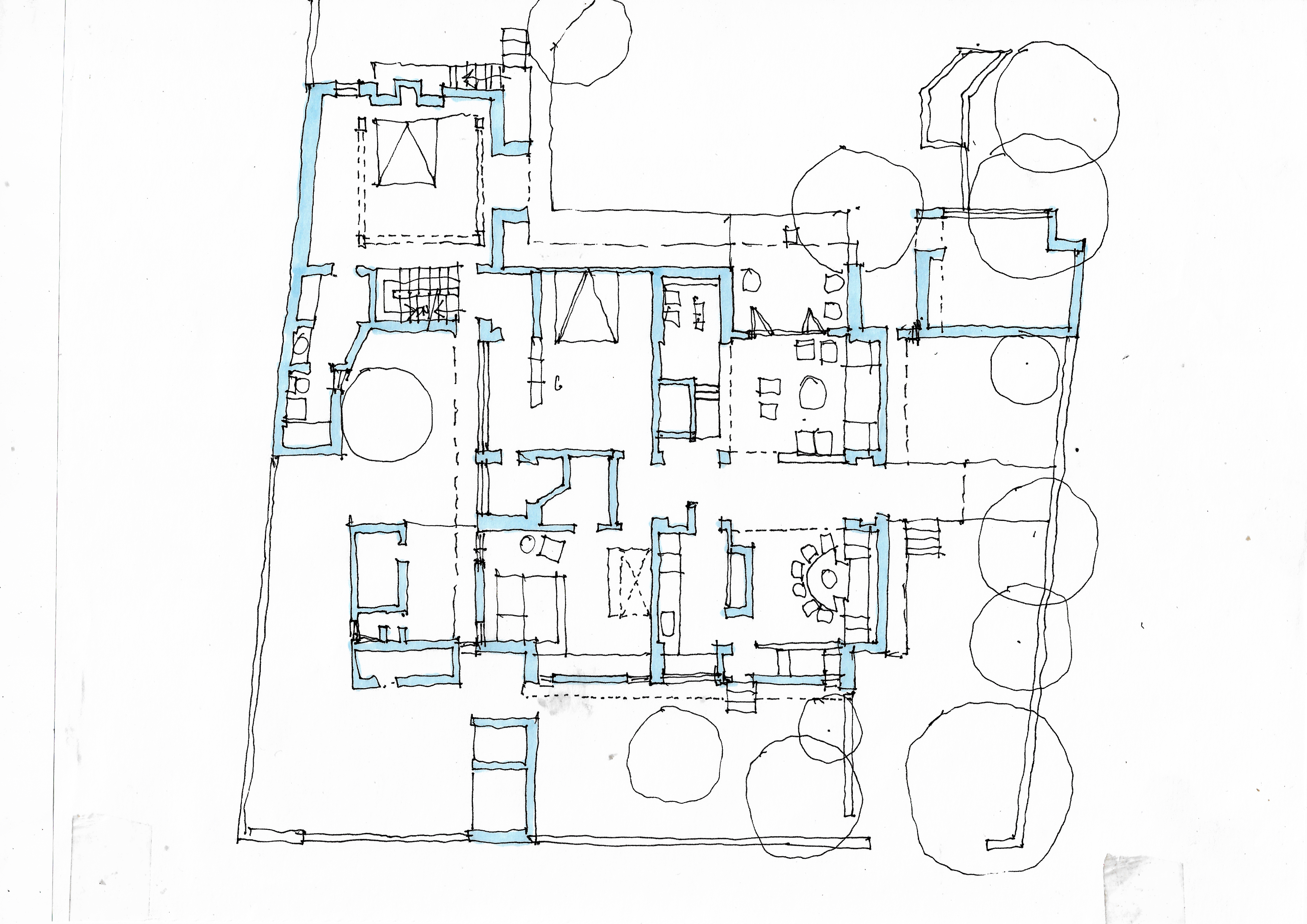
Below is tracing of Kamala House – Doshi’s own house. One of his brilliant projects but under-discussed. I have traced it a few times. The act of tracing not only allows me to look closely the order of the house, but also to recover fragments of memory of visiting the house. I was part of a group of students who visited. He personally showed us around the house. A rare privilege. In this process of tracing, both the memory and the order of the house are remembered. One starts noticing the subtleties of the plan – the extended landing of the staircase becoming an aedicule, the consistency of  the grid and also its deviations, the thickness and thinness of the wall, recalling the memory of the peacock playing and the sound of water in the garden, noises from the kitchen, the soft light from the clever skylight, the idiosyncratic dining table he loved showing us and how it folds and unfolds and how one can sit cross-legged and reach the table.  I always refer back to this house as a reminder that good design can be sharp superimposition of simple and precise ordering principles – cadence of the grid, minimal material palette, articulation in sections, distinct play of smaller and larger rooms – to name a few.

Kamala House

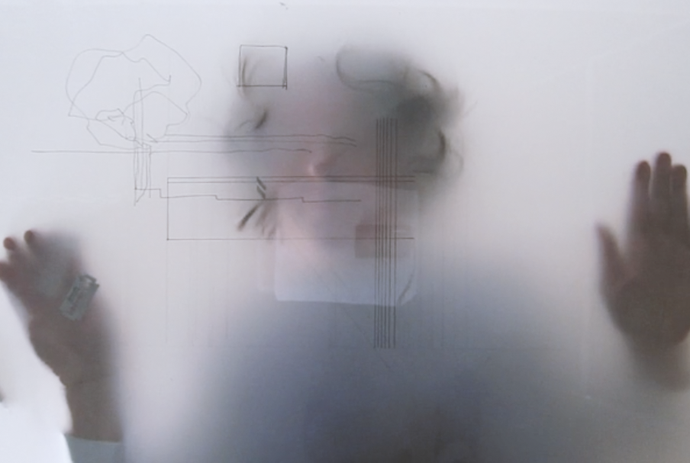
Tracing is taken to another conceptual level by Niall McLaughlin in this installation/experiment Losing Myself. A note from the website says : “The mind is in constant flux: it observes, remembers and projects in multiple and unpredictable ways; constantly shifting and distorting the reality it encounters. To explore this kind of experience, we employed hand-drawing where the act of drawing valued as much as the final outcome. We created an analogy between inhabiting the world and inhabiting the page. We found parallel associations between the mind wandering in rooms and the hand sketching on sheets of paper” .

DBE7F794-35A4-47EE-8E31-B8F3BA39BC71

This above image (link to the complete page) from the installation gives us an unfamiliar chance to look at the drawing from below, and to look at the maker through the drawing. As if an idea/thought is tracing the mind of the maker, inverting the creative association between them.

Stereotomic and Tectonic : 02

Extending the enquiry from Part 01, these are some of the drawings i tried to make the readings on the ‘cave’ and the ‘pavilion’ a bit more palpable. Different configurations on the similar theme. 


The terms ‘stereotomic’ and ‘tectonic’ came much later into my vocabulary and helped to make the notions of the cave and the pavilion more precise. In a series of posts I am planning to share this enquiry, which led me to sharper readings of space and thus perception of it. 

Stereotomic and Tectonic : 01

“These virtues of shelter are simple, so deeply rooted in our unconscious that they may be recaptured through mere mention, rather than through minute description. Here the nuance bespeaks the color. A poet’s word, because it strikes true, moves the very depths of our being”

Gaston Bachelard, The Poetics of Space

In the process of teaching second semester design studio, i have had the opportunity to revisit some of the fundamental ideas in architecture. In a table discussion with a student, once i casually used the analogy to imagine a ‘cave’ like space to talk about a room which looked inwards . And this word led me to the term ‘pavilion’ to mark the other end of the spectrum in the ‘degree of enclosure’. The remembering and recognizing of these two terms ‘cave’ and the ‘pavilion’ marked an important transition in articulation about space for me. It was a small moment of clarity.  In teaching process one is constantly in search of such didactic devices to illuminate ideas about architectural space. In speech, we use the phrase going into ‘cave’ mode, when we want to focus intensely on some given activity. To look inwards. These two ‘phrases’ led to interesting directions in the second semester studio. The students had to choose particular professions for their user groups (say like writers or painters). So in the design discussions, we had the opportunity to speak through these analogies better. Would the painter or the writer would like to work from a ‘cave’ or a ‘pavilion’ like space. Would this preference of enclosure say something about the character? Or add value to his working environment?Talking about a ‘cave’ like space leads to discuss further conditions of openings, views and light. The ’pavilion’ idea leads to the conditions of privacy, translucency and boundaries  Enquiring the dialectics of the ‘cave’ and the ‘pavilion’ allows one to investigate the conditions of the interior – exterior relationships in a palpable manner .

In later extension to Kamala House, Doshi adds a ‘cave’ like bedroom which extends itself into the garden in the back. And he adds a ‘pavilion’ on the top of the bedroom. These two situations of the enclosure demonstrate well the extreme conditions in the spectrum of degrees of enclosure. From the maximum enclosure of the ‘cave’ – the phenomena of light, view and weather can be precisely framed. This condition is emphasized by the load bearing brick walls punctured by the doors and windows allowing precise connections to the garden. Wherein in the case of the ‘pavilion’ the singular concrete ‘frame’ marks the boundaries of implied ’space’. Sitting on an elevated level, the ‘pavilion’ pronounces the vantage angle of viewing the garden from the terrace. 

Image Source : From Iwan Baan’s portfolio on Doshi

The terms ‘stereotomic’ and ‘tectonic’ came much later into my vocabulary and helped to make the notions of the cave and the pavilion more precise. In a series of posts I am planning to share this enquiry, which led me to sharper readings of space and thus perception of it.