Yesterday India won the match against Australia in Melbourne. It was a remarkable win away from home, and that too after the disastrous 36 all out at the first match in Adelaide. One interesting note in winning match was that Rahane was the captain as Kohli is on break. Suresh Menon writes in his column in The Hindu that “It was confirmation of another theory — that you can be a successful captain either in the assertive Virat Kohli manner or in the composed Rahane manner. “. Menon also adds later “that cricket teams tend to reflect the temperament of their captains.”
These two approaches – calm and assertive – is applicable to other situations in life too. In particular this is a recurring question for me as a teacher . All of us at some at point of time have studied under these two types of teachers. We respond to them differently. But i am still unsure which is a better method when teaching, as it also depends on one’s own personal character a lot. I have heard of many teachers who were more assertive when they were young than they were old and vice versa. I prefer and assume to be a ‘calm’ one but not sure if i behave the same way too. The temperament of the teacher always reflects in the class.
Ron Ritchhart writes in his brilliant book on learning ‘Creating Cultures of Thinking’ about teachers role of modeling in learning environments “As a culture shaper, modeling operates on both an explicit and an implicit level. Explicitly, we may demonstrate techniques, processes, and strategies in a way that makes our own thinking visible for students to learn from and appropriate. Implicitly, our actions are constantly on display for our students. They see our passions, our interests, our caring, and our authenticity as thinkers, learners, community members, and leaders. Adult models surround students and make real a world that they may choose to enter or reject.”
Notes : (1) A note of thanks to Aabid Raheem (his blog) to introduce me to Ron Ritchhart‘s book. (2) Suresh Menon ‘Between Wickets’ column in The Hindu dated 30 December,2020
One of my favourite books from this year’s reading.
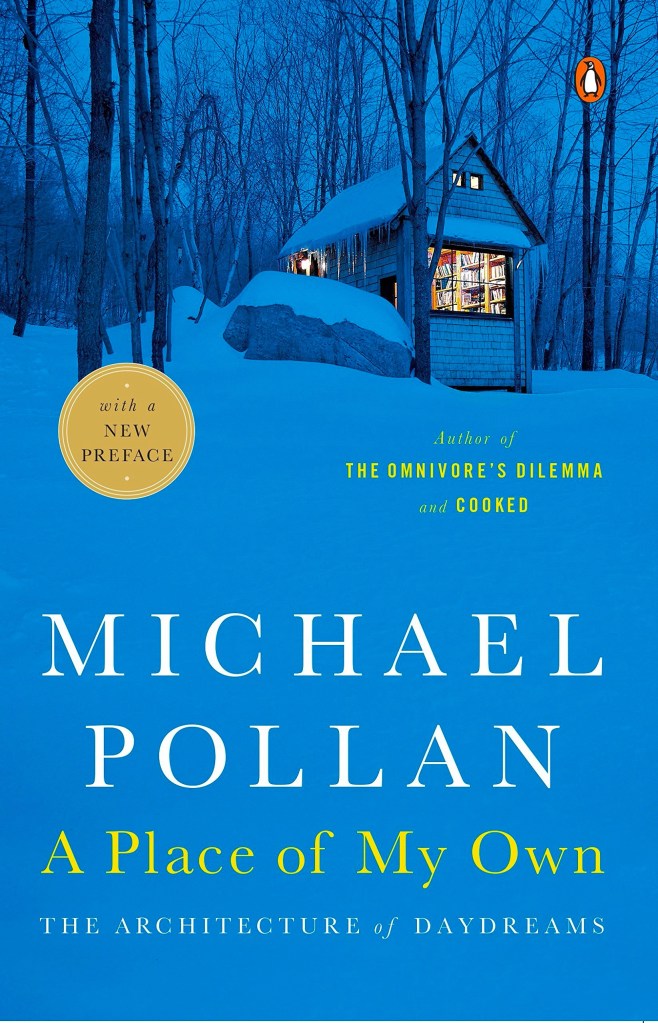
This is one of the few books where the author, who is not an architect, talks about architecture in a remarkable way. This book is the story of how Michael Pollan built his own ‘writing cabin’ next to his house as refuge to engage in his writing. He is exploring the meaning of architecture by reading texts on architecture and also by actually building it with his own hands. This juxtaposition of reading and building is what makes the structure of the book unique. It feels modest, to read a book on architecture ,where the architect is the other character in the book.
In one page he page he is talking about cutting wood and in the other page he is talking about Venturi’s meaning of doing a slope roof in the modern era. Pollan says “this is not so much how-to-do-it than how-to-think-about kind of book”. This is what is the anchor of the book.I had earlier this year read his other book ‘Cooked’, which actually led me to this book. Both the books explore the “places where the threads of nature and culture tangle in interesting ways” One of the best part of the book is that you don’t have to know anything prior about architecture. Pollan’s brilliance is here that he is both discovering architecture (using both the body and mind) and also sharing this tenuos journey through his accessible writing.
The two main characters in the book are Charles Myer, the architect who designed the cabin and Joe Benny, the carpenter who helped Pollan build this cabin over the weekends for 2 long years! The chemistry between these three is one of the staggering strain of the book. The book masterfully and in subtle ways captures the limits of the each of the characters – the skilled craftsmen who is actually constructing the building and the architect who is designing the building and the client who is actually going to live in the cabin.
My selected notes from the book, which gives an overview of the book, :
The chapters in the book are simply named after the components of the building. But in each chapter he takes the reader through a wonderful journey through each of these layers – Site, Footings, Framing, Roof, Windows and Finish work. The journey of the book starts from citing the cabin in the landscape to the trim (beading) and the need of it. He engages with each attribute both intellectually (by reading books on each `topic) and physically by making it on site.
When Charlie, the architect offers to design this cabin for free in extension to the house he is renovating, Pollan takes a crack at architects writing “I didn’t know whether to regard this as an act of generosity from a friend or a particularly flagrant case of the monomania to which the members of his profession seem to be prone”. Monomania – a nice word to describe architects.
In the ‘Roof’ chapter he writes “To creatures who depend on them (shelters) for their survival, it is perhaps inevitable that roofs are symbols of shelter as well shelters themselves.” and adds later “The traditional gable, for example, meant something very different after modernism than it did before” In this chapter Pollan also sharply discusses Venturi’s house and his writings.
Pollan writes a nice story of Eisenman taking Philip Johnson to visit House VI. “Eisenman asked the Franks (the clients) if they wouldn’t mind removing the baby’s crib from the house so Johnson could experience the building in its pristine form” He extends the discussion to talk about the role of modernism played in shaping architecture here.
“The history of architecture is the history of the widening of that gulf, from the time when master builders designed and built buildings themselves ; to the Renaissance, when architects began designing buildings but left decisions about construction and ornament to craftsman on site.”
“Perhaps what makes the experience of space so difficult to describe is that it involves not only a complex tangle of sense information (hard enough to sought out by itself ) but also the countless other threads supplied by memory and association”
Talking about the limitations of theory, particularly postmodernism, “Our bodies are of course what gets left out of a theory that treats architecture as a language, as a system of signs. Such a theory can’t explain the physical experience of two places as different as Grand Central Station and my little shack, because the quality of those experiences involves a tangle of mental and physical, cultural and biological elements that the theory can’t account for, blinded as it is by old western habits of regarding the mind and body as separate realms. “
In ‘Windows’ chapter chapter he writes “Architecture, Le Corbusier had declared, is when windows are either too big or too small, but never the “right” size. For when the window is the right size, the building is… just a building. Viewed from one perspective, Le Corbusier’s dictum is as succinct a confession of artistic arrogance as you could ask for, implying as it did that originality, if not eccentricity, was an end in itself”
In a brilliant subchapter elegantly called “The Metaphysics of trim”. Beading is the local word for us here. Pollan paraphrases here “Mandelbrot suggests that architectural ornament and trim appeal to us because they offer the eye a complex and continuous hierarchy of form and detail, from the exceedingly fine to the massive, that closely resembles the complex hierarchies we find in nature – in the structure of a tree or a crystal or an animal”
Eclectic range of Bibliography from Vitruvius to FLW to Peter Eisenman to Bachelard to Thoreau. A good book always leaves lot of traces to read further.
I learnt a new word today – mise en place. I came across the word in the brilliant book ‘The Practice : Shipping Creative Work’ by Seth Godin. The dictionary meaning is ” the preparation of dishes and ingredients before the beginning of service.”
Seth Godin writes in the book : “A skilled chef will be certain to arrange her cooking supplies before firing the stove. All the ingredients will be chopped, measured, and laid out. This prevents last-minute urgencies, but even more than that, it gives her a chance to visualize what’s to come. Seeing the tools and ingredients, ready to go, prepared with care, opens the door for intentional action.” This is a very important culinary skill, which is fundamentally linked to the process of cooking. Melissa Gray, a senior at the Culinary Institute of America. “It really is a way of life … it’s a way of concentrating your mind to only focus on the aspects that you need to be working on at that moment, to kind of rid yourself of distractions.” (1)
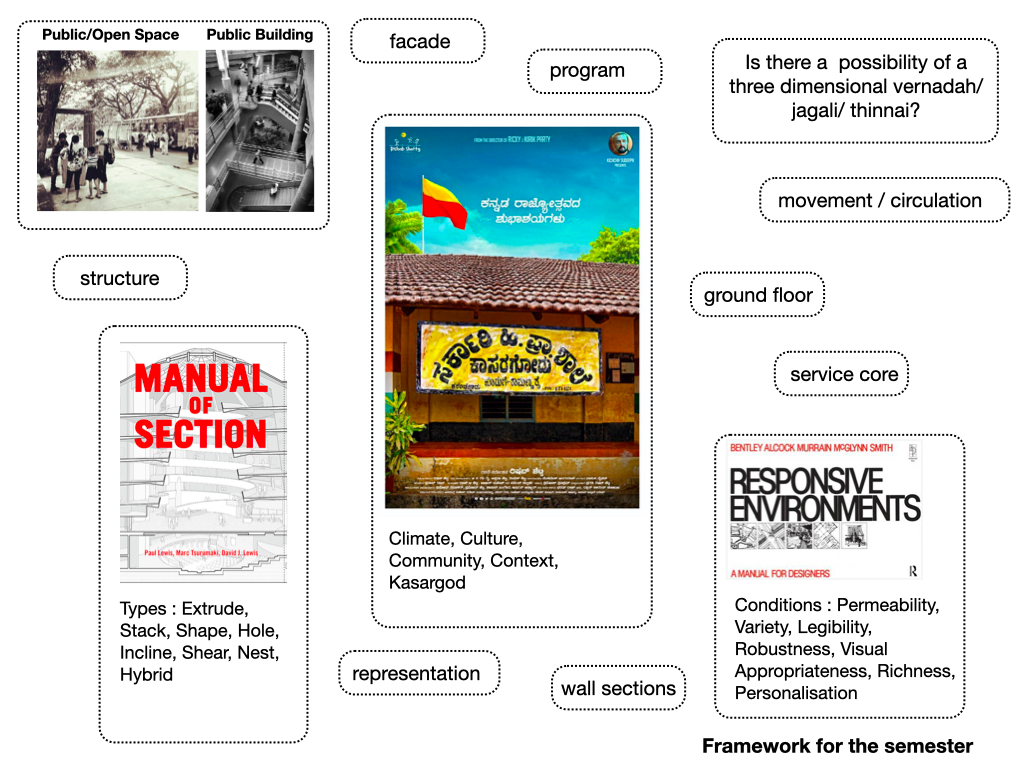
I could relate this ‘intentional action’ with the design framework (above image) we are working for semester 5 design studio at WCFA. Shreyas Baindur (his blog) and me are teaching this course together. The online format pushed us to be more precise with the planning of the learning outcomes of the semester. This is our mise en place for the design of a public building. It looked a lot messy before it reached this stage. It contains the key questions, context of the project, methodology adopted, layers addressed, readings, readings morphed into methods (like the book Manual of Section)
But after we made this framework lot of things are falling in place for us. Like the input lectures, sequencing the design process, revisit/remind the students of the framework during the mid reviews. The biggest help is that it is keeping us focussed – both at macro level outcomes and micro level table discussions. Even the students find it comfortable to know what they are expected from the semester. Once the ingredients are in place, we can focus on the cooking. So through this framework, we can demonstrate how a certain set of ingredients will produce a certain dish. Students can take the structure, change the ingredients and cook their own dish as they move ahead. With the mise en place – starting point is clear, thus one can trace and evaluate the process for further improvement. This mise en place could be a great tool for the thesis students in particular (and also the guides, including me), as so many of them have the whole store room on their table 🙂
‘Architecture is not about form’ – Peter Zumthor (1)
‘Architecture is the result of the forming’ – Roy Lichtenstein (1)
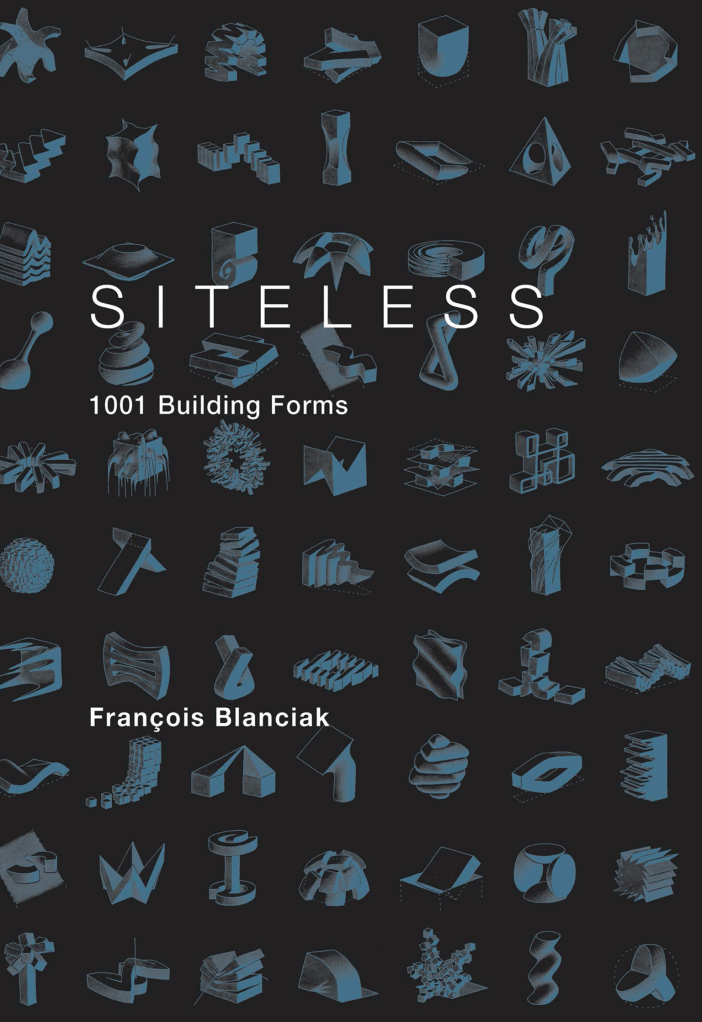
Talking directly about form is generally frowned upon in architectural circles (particularly in academics). I think we loose a lot of time in design process, just because we don’t prefer to discuss about form ‘directly’. We do a lot of intellectual manoeuvres to talk about form ‘indirectly’ – space, type, typology, etc. Even though the point is valid, i feel we could find more room to talk about form in a more upfront ‘direct’ way. We could capture in the discussions both its limitations and advantages. I understand the present debate on architecture becoming a ‘visual’ medium, and how form is manipulated to only please the eye and not the other senses. Yes, that is first layer to acknowledge. Once we overcome this layer, we can talk about ‘form’ through more channels . I found this book ‘Siteless : 1001 Building Forms’ by Francois Blanciak very apt to engage in the discussion of form is a democratic way. This subtitle ‘1001 forms’ might sound rude and cheeky to the ideal-academic-ear.
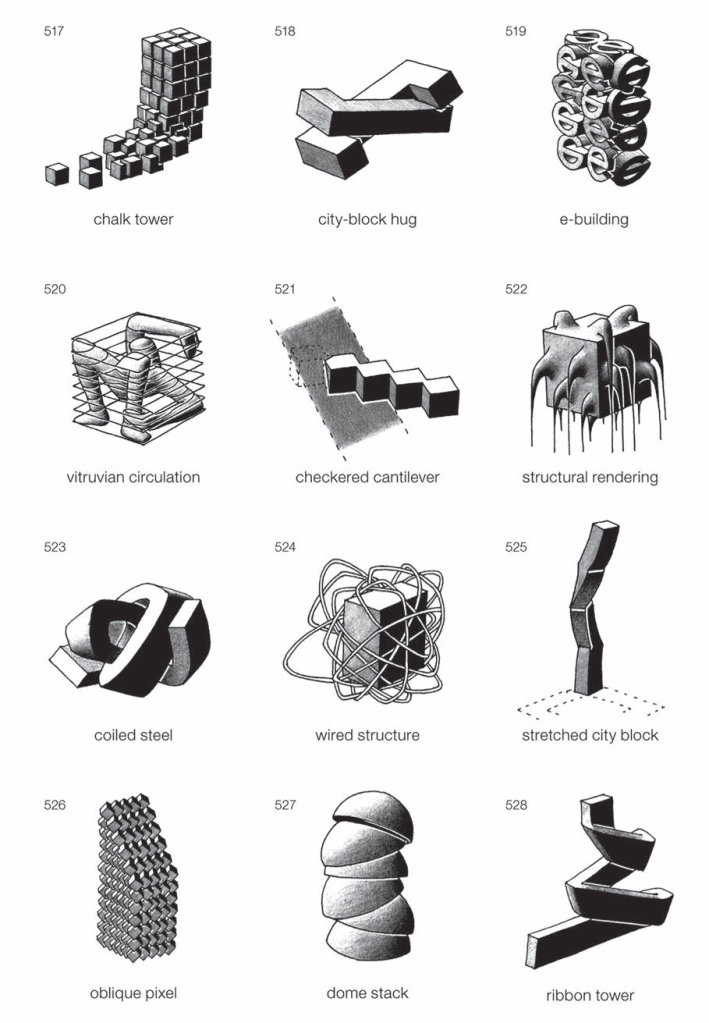
I feel not discussing directly about ‘form’ in architecture is like not mentioning about ‘rice’ when talking about cooking biriyani. When i just casually flipped through the book, initially it seemed to be a very generic collection of computer generated forms. When i was able to ‘suspend judgment’ for sometime and looked a bit deeper, the book became so revealing. All the drawings in the book are hand-drawn, which intrigued me a lot. The book has 1001 forms – each a little bigger than a stamp accompanied by a phrase. The book is “essentially meant to be more of a tool to trigger the imagination of the reader, a way to store one’s creative impulses, rather than a means to display an array of morphological ideas to be copied, as some architects might have misinterpreted” and Blanciak critically understands limitation of the ‘form’-al approach saying “there was also this desire to somehow exhaust the potentialities of architectural form, in order to transcend this very issue, not only for architecture, but also for me, in order to be able to focus on other points of interest within this field.” (2)
The book sharply starts with this text below. ( A note for ‘readers’ who are put off by too much ‘text’, this book has a lot of ‘drawings’ (not colourful though!) and only has only 3 pages of text! ). A sort of a theory book with almost no text.
“The body of work that follows aims to fill the expanding gap between a profession that glorifies morphological originality through media exposure and a more secluded field of architectural research which, unlike its scientific counterparts, paradoxically neglects experimentation and the manipulation of form through its sole focus on writing. Proposing a creative alternative to critical academic literature, this study develops a prospective series of forms that focuses on the nucleus of architecture, the building as a unit (whether touched by others or left aside), and on the clarity of expression of its generative idea. As a result, in the coming chapters, text has radically been replaced by form. In order to multiply the range of potentialities in architecture, this study accepts the physical aspect of buildings as its primary component (the periodic denial of which proving vain) and proceeds by trial and error. ” (3)
Below are some of the images from the book :
Talking in an interview to WAI Thinktank about the book, Francois Blanciak, articulates brilliantly about ‘form’WAI :
Do you see pure form as a medium or a goal?
“Well, in this particular instance, it’s a medium. If we understand pure form as a set of forms that originates in Euclidian geometry, such as spheres, pyramids and cubes, the inherent capacity of these forms to contain, rather than to divide, makes them particularly appropriate as receptacles for site-specific programs. If we understand the design of an architectural project as a process of adaptation of form to external dynamic forces, these can be catalyzed by the use of pure form as an outer shell for the project. On another hand, pure form is merely of interest for its capacity to be eroded, to be affected by those forces. In a dialectic process of definition, this fixed outer shell helps determine the program, and reversely, the program reveals and distinguishes morphology. So the reversion to pure forms comes from an intention to operate a sort of tabula rasa on architectural expression. It’s almost the negation of form itself.” (4)
One of the another consequential questions from the interview gives us a lot to ponder on :”Can an open acknowledgement in which form is no longer a taboo change the discipline up to the point in which even architectural education is changed?” (5)
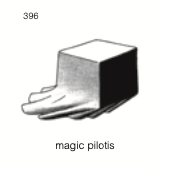
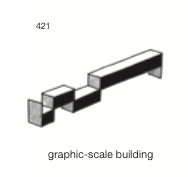
There is an academic lightness to the book like the drawings ‘magic pilotis’ or ‘graphic-scale building’ which takes a lighter tone on its own content, which makes ‘reading’ (or looking) of the book more absorbing.
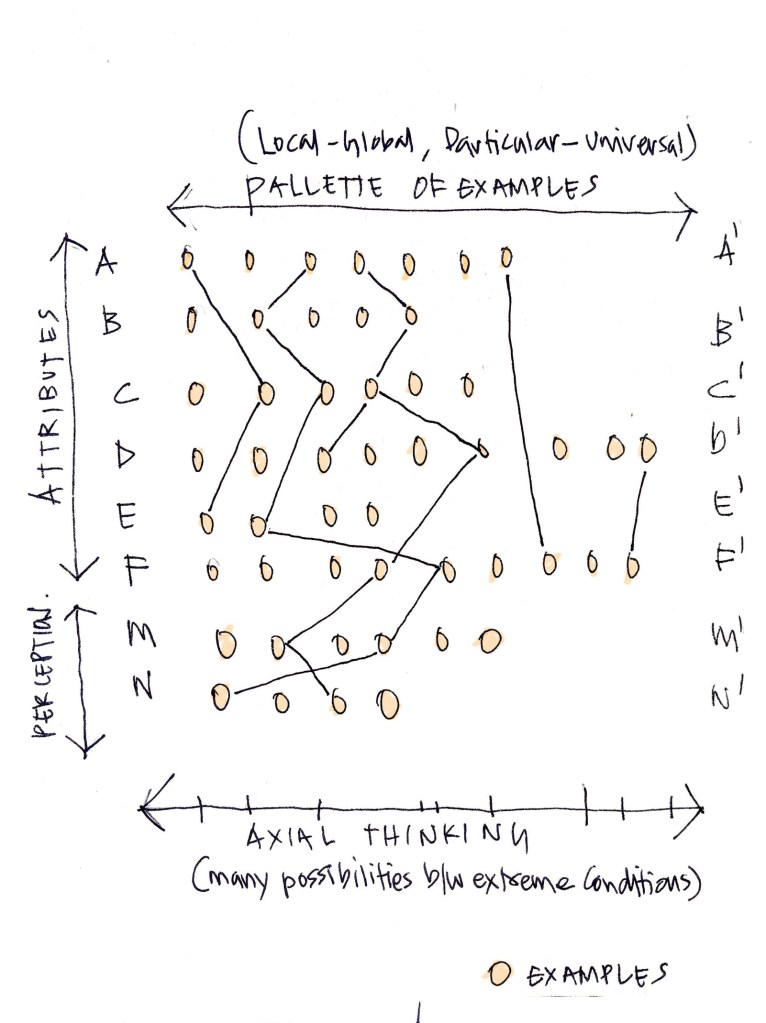
Here I am making a deliberate attempt to make the process of teaching ‘visible’. This above sketch is a plan to teach ’theory’ for the third semester students under VTU university. The syllabus mainly focusses on teaching architectural attributes (axis, rhythm, hierarchy, grid, etc). A structure similar to the chapters of Ching’s canonical ‘Form, Space and Order’. A very structured approach to teach ‘theory’. Surprisingly Ching mentioned, when he was at WCFA campus, that how this book does not fall under ‘theory’ category in most schools in US, as it was too ’simple’. I use this book as the point of departure to teach this course. Recently I read the brilliant ’The Geography of Thought’ by Richard Nesbitt, which made me relook this approach to teach theory. This book also a brought a lot more clarity to ever present anxiety to the notion of making ‘Indian’ way of thinking explicit. This text by Nesbitt might be as well as summarising Ching’s methodology “Greek philosophy started from the individual object – the person, the atom, the house – as the unit of analysis and it dealt with the properties of object. The world was in principle simple and knowable: All one had to do was to understand an object’s distinctive attributes were so as to identify its relevant categories and then apply the pertinent rule to the categories” But for the Taoists “The world was complicated, events were interrelated, and objects ( and people) were connected “not as pieces of pie, but as ropes in a net”. The Chinese philosopher would see a family with interrelated members where the Greek saw a collection of persons with attributes that were independent of any connection with others”
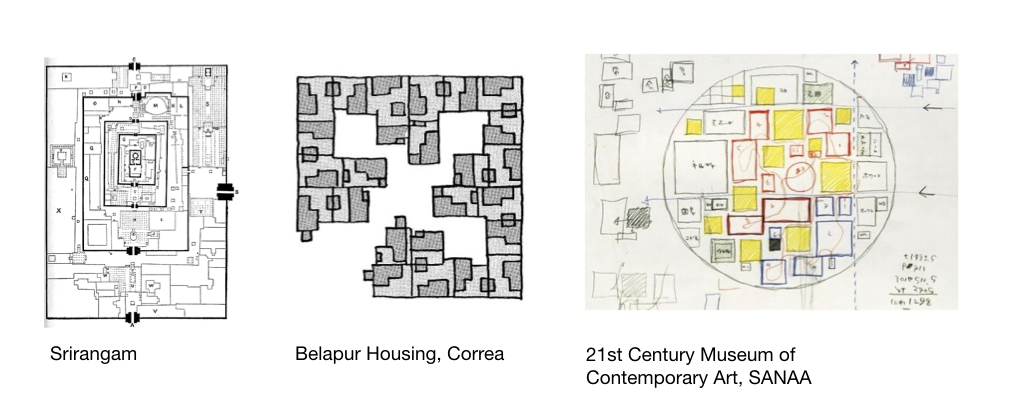
It is this “mental difference” of “pieces of pie-ropes in a net” in the ‘geography of thought’ between the west and the east a revealing thought for me. Chings methodology aligns with the ‘pieces of a pie’ approach. It is because of ‘pieces of pie’ attitude to thought I think, Indian mind has an aversion for anything ’theoretical’ in ‘categorical’ form. The ‘rope in the net’ approach seeks for “complexity” and “interrelation”. This reading is making me revisit the approach I generally take to teach this course. The ‘rope in the net’ approach makes it a bit challenging to talk about the cognitive quality of all-the-times-interrelated qualities of architecture. The diagram above is an attempt to attend to this fracture in the ‘geography of thought’. The plan is to take a certain attribute, say ‘hierarchy’, and then explain them through a palette of examples comprising local-global, particular-universal examples. The range of spectrum includes examples from graphic design, medieval town fabrics, Correa (Belapur Housing, Bharath Bhavan), Srirangam, etc. A’ – represents an example from the other end of spectrum – a project like Museum of Contemporary Art by Sanaa, which employs the idea of ‘non-hirerachy’ as an ordering principle. Brian Eno talks about ‘axial thinking’ where “a stable duality dissolves into a proliferating and unstable sea of hybrids”. So idea is to build a possible spectrum of hybrids between the end conditions of this spectrum. And also the lines connecting the various rows-columns will be an attempt to use the same example to talk about various attributes. Like one can take Fatehpur Sikri to discuss all the attributes at the same time. Hence the overall attempt here is to find a middle ground between ‘pieces in a pie’ and ‘ropes in a net’ routes of thinking



 mofussillab

You must be logged in to post a comment.