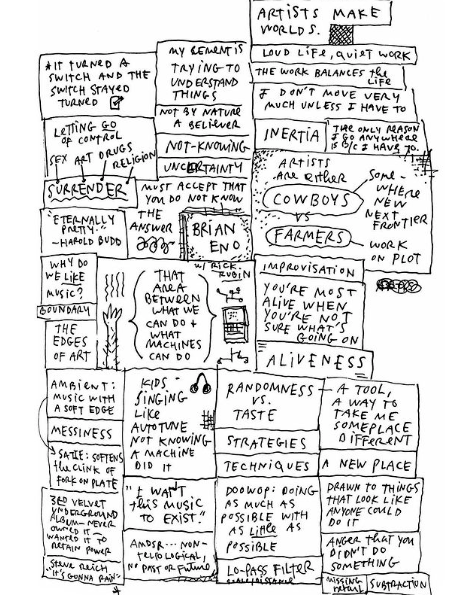
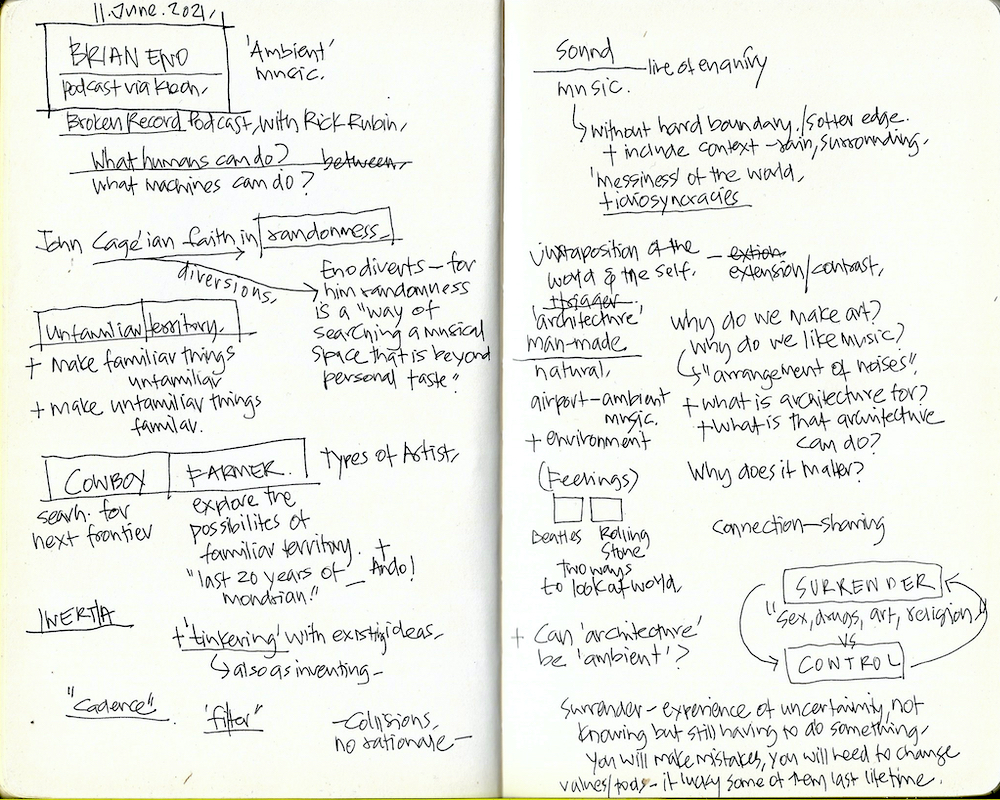
Austin Kleon (a big fan of his blog and books on creativity) posted these notes from listening to Brian Eno speaking at this Broken Records podcast. I have also been recently reading on Eno. So I made my own notes below just to extend Kleon’s notes. It was interesting for me how I added my own words ( marked with a ‘+’ symbol) triggered from hearing / mis-hearing / swaying / misunderstanding from what Eno was saying. Note-taking is such a simple wonderful tool to record and play with thoughts.
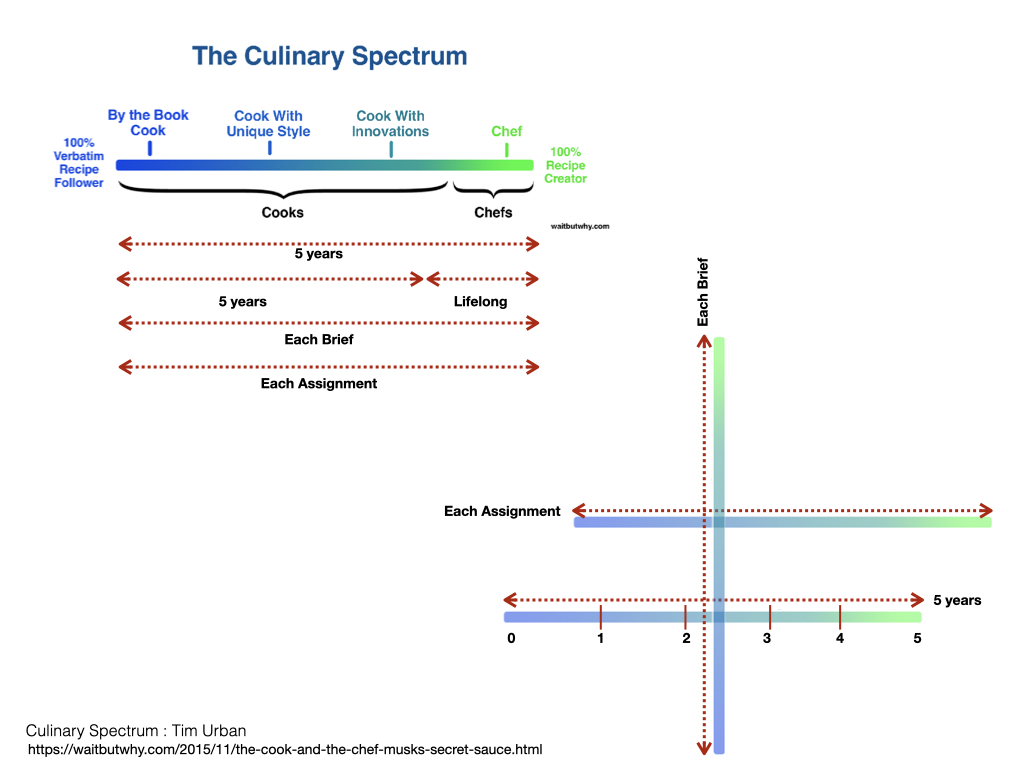
Again, in preparing for a talk on pedagogy, I made this slide below. It extends on Tim Urban’s wonderful analogy of ‘The Culinary Spectrum’ in explaining Elon Musk (Link to the piece). I have just picked up a fragment here, and extrapolated it on learning curves. Tim Urban writes
“Cooks span a wide range. On one end, you have cooks who only cook by following a recipe to the T—carefully measuring every ingredient exactly the way the recipe dictates. The result is a delicious meal that tastes exactly the way the recipe has it designed. Down the range a bit, you have more of a confident cook—someone with experience who gets the general gist of the recipe and then uses her skills and instincts to do it her own way. The result is something a little more unique to her style that tastes like the recipe but not quite. At the far end of the cook range, you have an innovator who makes her own concoctions. A lamb burger with a vegetable bun, a peanut butter and jelly pizza, a cinnamon pumpkin seed cake. But what all of these cooks have in common is their starting point is something that already exists. Even the innovative cook is still making an iteration of a burger, a pizza, and a cake At the very end of the spectrum, you have the chef. A chef might make good food or terrible food, but whatever she makes, it’s a result of her own reasoning process, from the selection of raw ingredients at the bottom to the finished dish at the top.” (emphasis mine)
My general reading in academics is that, we expect all our students to be ‘chefs’ all the time in all subjects we teach. So may be instead of expecting ‘chefs’ from every course we teach, we could aim at the ‘already existing starting point’ for cooks at the left end of the spectrum and give the students a datum to become a ‘chef’ on her own terms. We could also imagine this learning spectrum at different scales – 5 years, each brief, each assignment. There is another wonderful statement from Bauhaus, that guides me a lot : “The basic teaching error of the academy was that of directing its attention towards genius rather than the average” I think they mean the French Academy – the prevalent institution for architectural education before Bauhaus. I am borrowing from Correa (from an earlier post), to support this argument :
“Each semester these unhappy students are presented with brand-new problems, often in complicated and subtle contextual situations, and then asked to come up with new and brilliant responses, possibly expressed in an architectural syntax of their own invention. In the entire hisory of our profession, very few architects have managed to pull that one off— even once in their lifetime! Yet we demand this of each student, in each design studio. The result: dismay and frustration (and at several universities, among the highest stress rates of all departments)”
I made the diagram on the right bottom corner (in the tradition of academics making things look more complex than it actually is ) to overlap these spectrums. We could imagine them sliding both horizontally and vertically to chart different possibilities of the learning curve.
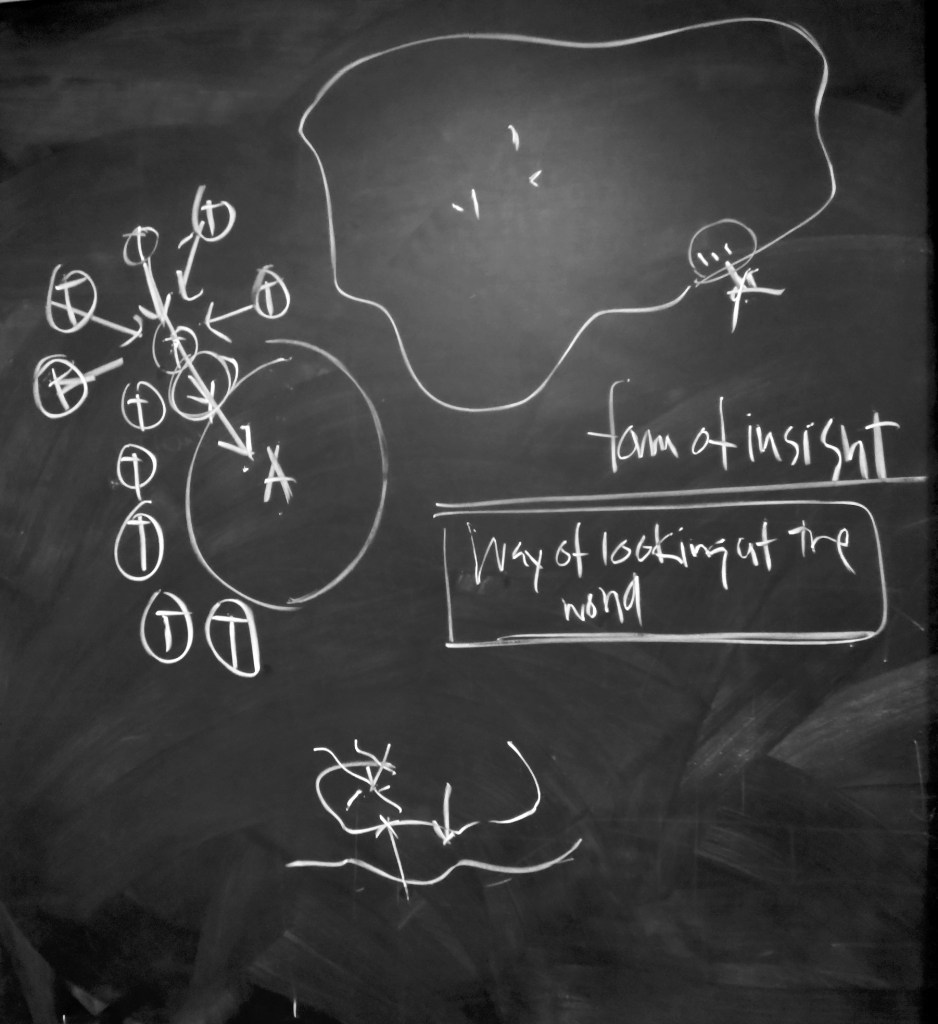
This is a moment in class (Feb 2020) where i was introducing architectural theory to second year students. Some say it is early to teach theory in second year or some say it is never early to teach theory. This insight is helpful, if at all we agree what is theory. If you had ‘theory’ in your postgraduate title, like me, it is a different game as it comes with some amount of anxiety. I used these two brilliant definitions in this first class and quickly illustrated as above.
(Top right)- “The facts are really not at all like fish on the fishmonger’s slab. They are like fish swimming about in a vast and sometimes inaccessible ocean; and what the historian catches will depend, partly on chance, but mainly on what part of the ocean he chooses to fish in and what tackle he chooses to use – these two factors being, of course, determined by the kind offish he wants to catch. By and large, the historian will get the kind of facts he wants. History means interpretation” E H Carr, What is History?
My argument is that we have only very few fisherman in the east (compared to the west) , but a lot fishes to catch. Side note : Are academics fisherman or cooks?
(Bottom right) – “The word ‘theory’ derives from the Greek ‘theoria’, which has the same root as ‘theatre’, in a word meaning ‘to view’ or ‘to make a spectacle’. Thus, it might be said that a theory is primarily a form of insight, i.e. a way of looking at the world, and not a form of knowledge of how the world is.” David Bohm. Wholeness and Implicate Order
(Left)- The sketch happened serendipitously on the board, as an overlapping of the thoughts triggered by the two quotes. And since then this has been my go to diagram to the recurring and useful question ‘What is theory?’ – There are various positions (labelled as ‘T’) to look at architecture ( One can argue that ‘A’ should be ‘a’). Then there are theoreticians / critics have various positions on how to read these positions itself. These relationships form the premise of theory.
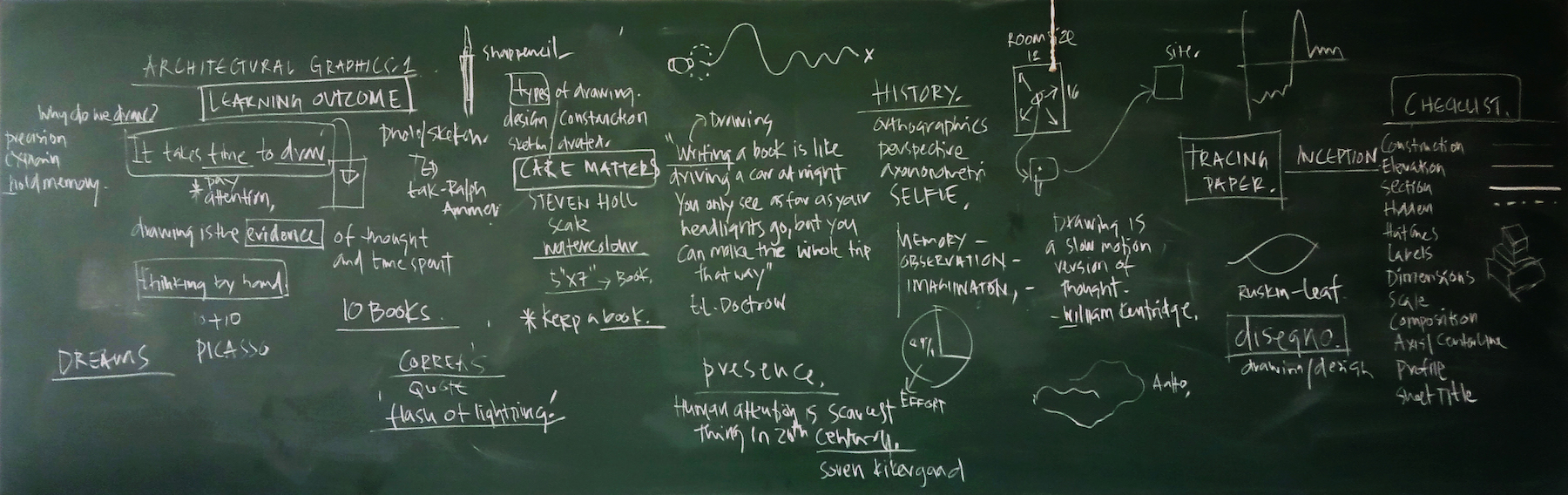
After a cycle of teaching online, i am rediscovering the nuances of the blackboard. It has a certain slowness, and allows to grow thoughts collectively as the class proceeds. It traces the emphasis and the hesitations of the teacher, simultaneously. It is an evidence of overlapping thoughts and time, unlike a digital presentation which displaces time. Here the attempt was to summarise the learning outcome of the first semester drawing course. It traced all the things we spoke about the need to ‘draw’. There is a certain pleasure to look at the final mess, like the one we have when we cook our own food.

 mofussillab
You must be logged in to post a comment.