10 Books : With lenses

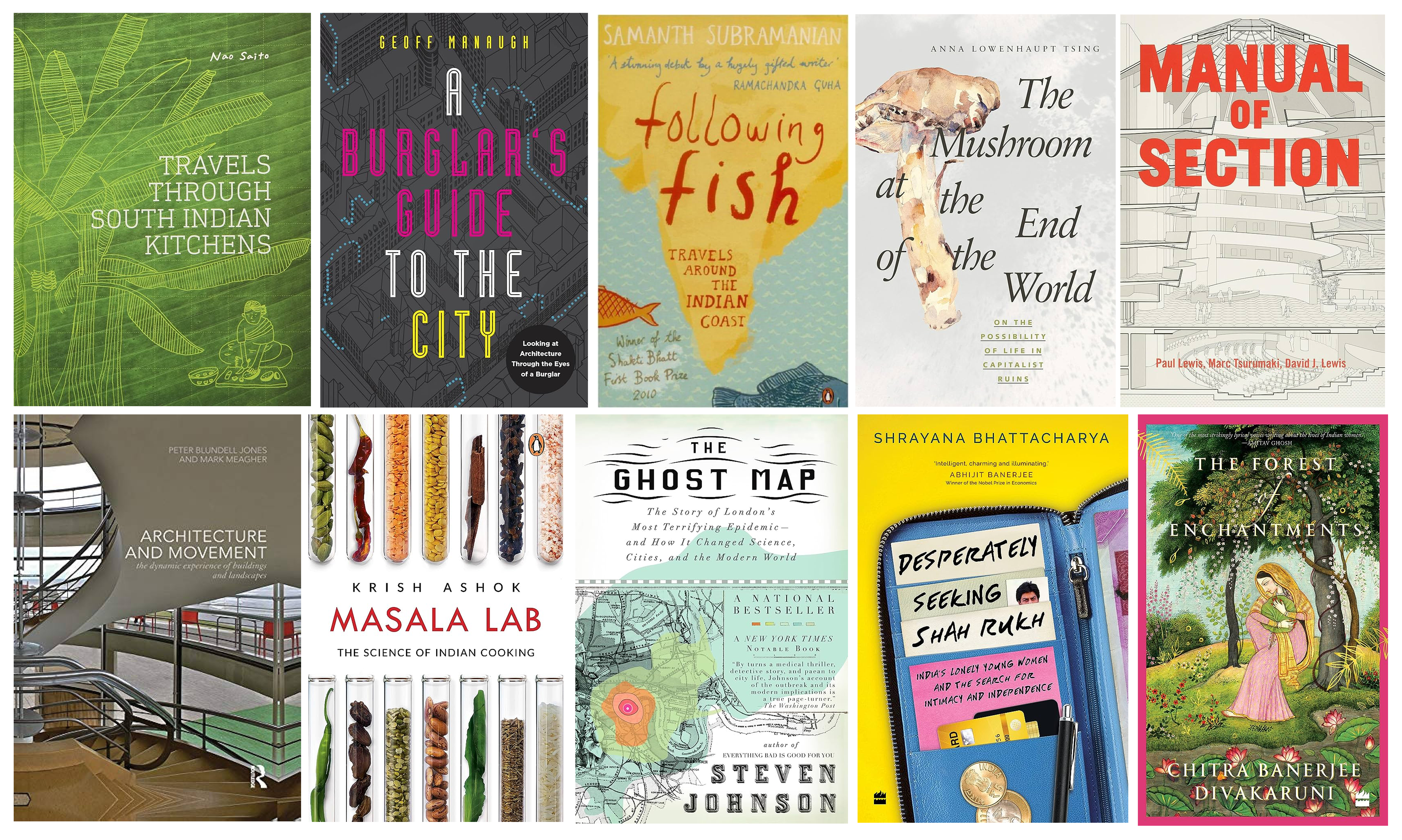
10 books, each with a lens. (Click on the image for a larger view)

For this post I have put together a list of 10 books, which from my point of view, have a distinct lens in each of them. (I am hoping somebody will get the pun) Looking at the world through a lens is a softer way to interact in an ever-growing opinionated landscape. It is accommodative and one can stand firm in the way one is looking at the world, simultaneously considering that there are equally engaging ways to view the world. Lenses can help us to write an essay or a book, do a research thesis or a phd, put a lecture together or have a meaningful discussion with a friend. It can work at different scales. I think this trait I carry comes from my training as a student of history and theory. This approach did not arrive in a straightforward and obvious manner but in a gentle and laboured way. Here I am sharing a list of books which have distinct lenses which hold the structure of the book. The lens has allowed the author to engage with their field (many a time across many disciplines) with an oblique and absorbing approach.

As a disclaimer this list contains books I have read many times, read once, yet reading and yet to read. Putting the list is openly committing myself to finish reading all these books soon.

Here is short description / extract from the book, which give a quick glimpse of the book (all emphasis mine) :

1. Travel Through South Indian Kitchens, Nao Saito :In this book the lens of the kitchen becomes a wonderful point of entry into insightful cultural study. Nao Saito uses her architectural training to draw the kitchens she visits. The kitchens become a portal for the author to understand a contrasting culture, which is very different from her own. Nao Saito blends texts, drawings, photos. She writes of her experience of being in the kitchen with the person cooking. The book also contains the recipe of the dish which was made during her visit. The photos are sort of a collage of the event of cooking. The beautiful drawings capture the mood of the place.

Extract from the Introduction:
“This book is the result of that three month stay. In these pages, I’ve tried to capture the air I breathed during that time, but through a particular lens: the kitchen. The idea to focus my experience around kitchens arose serendipitously, when I walked into the cooking area of my apartment in Chennai. It was familiar, but also quite strange. I’ve always been interested in food and kitchen tools and this, combined with my interest in architecture and people, gave rise to the idea behind this project: I wanted to travel through a place not by exploring its public spaces, but through the heart of people’s homes -their kitchens. I wanted to focus not only on architecture, but also capture a lived sense of space, cooking, people and conversation. For a traveller, a household kitchen in an alien land is a remote place, something she rarely encounters. Yet each of us has a kitchen at home, and we associate it with distinctive scents, tastes, conversation, laughter, and perhaps also solitude. And this makes it possible for us to actually reach out and try to understand what is going on in a kitchen in a faraway land. “

2. A Burglars Guide to the City, Geoff Manaugh : This book has a delightful structure : architecture and city seen through the eyes of a burglar. If you are an architect + fan of heist movies (like me), this book is a perfect companion.

From the Back Cover:
Studying architecture the way a burglar would, Geoff Manaugh takes readers through walls, down elevator shafts, into panic rooms, and out across the rooftops of an unsuspecting city. At the core of A Burglar’s Guide to the City is an unexpected and thrilling insight: how any building transforms when seen through the eyes of someone hoping to break into it. Encompassing nearly 2,000 years of heists and break-ins, the book draws on the expertise of reformed bank robbers, FBI Special Agents, private security consultants, the L.A.P.D. Air Support Division, and architects past and present. Whether picking locks or climbing the walls of high-rise apartments, finding gaps in a museum’s surveillance routine or discussing home invasions in ancient Rome, A Burglar’s Guide to the City ensures readers will never enter a bank again without imagining how to loot the vault or walk down the street without planning the perfect getaway.

3. Following Fish; Travels Around in the West Coast, Samanth Subramaniam : This is the key book which led to the curating this post. A book with a seemingly simple title. It starts with eating fish and i assumed the whole book will be about eating fish. But then the book deviates into more delicious territories. It gives a cross section of costal culture in India. As a creative process too, this book gives me so much hope. The hope to grow a rich and layered narrative from a seemingly undemanding and elementary start with a fish.

Extract From the Publishers Note :
” In a coastline as long and diverse as India’s, fish inhabit the heart of many worlds – food of course, but also culture, commerce, sport, history and society. Journeying along the edge of the peninsula, Samanth Subramanian reports upon a kaleidoscope of extraordinary stories. In nine essays, Following Fish conducts rich journalistic investigations: among others, of the famed fish treatment for asthmatics in Hyderabad; of the preparation and the process of eating West Bengal’s prized hilsa; of the ancient art of building fishing boats in Gujarat; of the fiery cuisine and the singular spirit of Kerala’s toddy shops; of the food and the lives of Mumbai’s first peoples; of the history of an old Catholic fishing community in Tamil Nadu; of the hunt for the world’s fastest fish near Goa. Throughout his travels, Subramanian observes the cosmopolitanism and diverse influences absorbed by India’s coastal societies, the withdrawing of traditional fishermen from their craft, the corresponding growth of fishing as pure and voluminous commerce, and the degradation of waters and beaches from over-fishing. Pulsating with pleasure, adventure and discovery, and tempered by nostalgia and loss, Following Fish speaks as eloquently to the armchair traveller as to lovers of the sea and its lore.”

4. The Mushroom at the End of the World: On the Possibility of Life in Capitalist Ruins, Anna Lowenhaupt Tsing : In this book the anthropologist Tsing weaves a narrative on the challenges of capitalism through the story of the surviving trade of single species of the mushroom.

From the cover
” Matsutake is the most valuable mushroom in the world—and a weed that grows in human-disturbed forests across the northern hemisphere. Through its ability to nurture trees, matsutake helps forests to grow in daunting places. It is also an edible delicacy in Japan, where it sometimes commands astronomical prices. In all its contradictions, matsutake offers insights into areas far beyond just mushrooms and addresses a crucial question: what manages to live in the ruins we have made? A tale of diversity within our damaged landscapes, The Mushroom at the End of the World follows one of the strangest commodity chains of our times to explore the unexpected corners of capitalism. Here, we witness the varied and peculiar worlds of matsutake commerce: the worlds of Japanese gourmets, capitalist traders, Hmong jungle fighters, industrial forests, Yi Chinese goat herders, Finnish nature guides, and more. These companions also lead us into fungal ecologies and forest histories to better understand the promise of cohabitation in a time of massive human destruction. By investigating one of the world’s most sought-after fungi, The Mushroom at the End of the World presents an original examination into the relation between capitalist destruction and collaborative survival within multispecies landscapes, the prerequisite for continuing life on earth.

In another place : Anna Tsing writes “My favourite thing about anthropology is its ability to go back and forth between what you rightly identify as ‘ordinary, lived detail’ and ‘abstract frames of intelligibility’. To me, it’s the best gift of the discipline, the feature I am most passionate about sharing with my students. The best anthropology does not merely add scraps of information to the stockpile of scholarly knowledge; it asks big questions. At the same time, abstract thought alone is not enough. It is in the encounter between the details of life and the big questions that anthropologists find their insights”

This book is a manifestation of this idea.

5. Manual of Section, Paul Lewis, Marc Tsurumaki, and David J. Lewis : This book contains architectural sections of sixty three significant built projects. This book has been instrumental to me in the studio on how to think about and explore sections – “which is often understood as a reductive drawing type produced at the end of the design process” . This book has allowed me to discuss architectural form and experience in dynamic and constructive way.

From the Introduction : “What are the different types of section, and what do they do? How does one produce those sections? Why would one choose to use one configuration of section over another? This book explores these questions and provides a conceptual, material, and instrumental framework for understanding section as a means to create architecture…forces. Moreover. the section is the site where space, form, and material intersect with human experience establishing most clearly the relationship of the body to the building as well as the interplay between architecture and its context.

6. Architecture and Movement; the Dynamic Experience of Buildings and Landscapes, Peter Blundell Jones, Mark Meagher : Similar to the Manual of Section book. Here movement becomes lens to understand architecture. When it comes to movement, generally the book is heavy on Corbusier and ‘Architectural Promenade’ but this book goes beyond that to Japanese tea ceremonies and multiple situations and theories on movement in architecture.

From the Introduction :
“The experience of movement, of moving through buildings, cities, landscapes and in everyday life, is the only involvement most individuals have with the built environment on a daily basis. User experience is so often neglected in architectural study and practice. Architecture and Movement tackles this complex subject for the first time, providing the wide range of perspectives needed to tackle this multidisciplinary topic. Organised in four parts, it:

  • documents the architect’s, planner’s or designer’s approach, looking at how they have sought to deploy buildings as a promenade and how they have thought or written about it;
  • concentrates on the individual’s experience, and particularly on the primacy of walking which engages other senses besides the visual;
  • engages with society and social rituals, and how mutually we define the spaces through which we move, both by laying out routes and boundaries and by celebrating thresholds;
  • analyses how we deal with promenades that are not experienced directly but via other media, such as computer models, drawings, film and television.”

7. Masala Lab: The Science of Indian Cooking, Krish Ashok : This book is just brilliant. Looks at Indian Food through the lens of science. And why? – Krish Ashok in his own words from the introduction

“By treating our culinary tradition as something sacred, artistic and borderline spiritual, we are doing it a grave disservice. Let me take music as a metaphor here. Indian classical music, one of the most sophisticated artistic traditions in the world, has, I would argue, suffered from the lack of documentation and archiving. In fact, the insistence on purely oral traditions of transmission of knowledge have ended up making the art a very elitist affair not accessible to the wider population. Western music, in contrast, has a simple, visual system of notation that is able to accurately capture every nuance. Because of this, we are able to perform a Bach concerto in exactly the same way as he intended in the eighteenth century. As an amateur musician myself, my teachers would often tell me that Indian classical music cannot be described and documented because its nuances are beyond the ability of language to describe it with fidelity. With due respect, I think that’s bullshit. What we are doing with food is rather similar. By not using the tools and language of modern science and engineering to continuously analyse and document different Indian culinary traditions, and instead just writing down recipes, we are doing the food equivalent of lip-syncing to a pre-recorded track”

This book has completely changed how i look at food and also made cooking a less intimidating act for me.

8. The Ghost Map: The Story of London’s Most Terrifying Epidemic – and How it Changed Science, Cities and the Modern World, Steven Johnson : This is again from one of my favourite authors – Steven Johnson. In this book he uses a single map to weave a story of science, medicine, health, hygiene and human ingenuity.

From the Introduction:
“This is a story with four protagonists: a deadly bacterium, a vast city, and two gifted but very different men. One dark week a hundred fifty years ago, in the midst of great terror and human suffering, their lives collided on London’s Broad Street, on the western edge of Soho. This book is an attempt to tell the story of that collision in a way that does justice to the multiple scales of existence that helped bring it about: from the invisible kingdom of microscopic bacteria, to the tragedy and courage and camaraderie of individual lives, to the cultural realm of ideas and ideologies, all the way up to the sprawling metropolis of London itself. It is the story of a map that lies at the intersection of all those different vectors, a map created to help make sense of an experience that defied human understanding. It is also a case study in how change happens in human society, the turbulent way in which wrong or ineffectual ideas are overthrown by better ones. More than anything else, though, it is an argument for seeing that terrible week as one of the defining moments in the invention of modern life.”

9. Desperately Seeking Shah Rukh: India’s Lonely Young Women and the Search for Intimacy and Independence, Shrayana Bhattacharya : This book amalgamates a reading of social structure + pop culture

From the Introduction:
“In this pathbreaking work, Shrayana Bhattacharya maps the economic and personal trajectories–the jobs, desires, prayers, love affairs and rivalries–of a diverse group of women. Divided by class but united in fandom, they remain steadfast in their search for intimacy, independence and fun. Embracing Hindi film idol Shah Rukh Khan allows them a small respite from an oppressive culture, a fillip to their fantasies of a friendlier masculinity in Indian men. Most struggle to find the freedom-or income-to follow their favourite actor. Bobbing along in this stream of multiple lives for more than a decade-from Manju’s boredom in ‘rurban’ Rampur and Gold’s anger at having to compete with Western women for male attention in Delhi’s nightclubs, to Zahira’s break from domestic abuse in Ahmedabad-Bhattacharya gleans the details on what Indian women think about men, money, movies, beauty, helplessness, agency and love. A most unusual and compelling book on the female gaze, this is the story of how women have experienced post-liberalization India.”

10. The Forest of Enchantments, Chitra Banerjee Divakaruni : This book is a retelling of an epic we are so familiar. The story is written from the perspective of Sita, and that completely changes the perpspective of the story. A retelling which is both relevant to see the past and present in careful ways.
Reading : The Thinking Hand

“Some books should be tasted, some devoured, but only a few should be chewed and digested thoroughly.” Francis Bacon

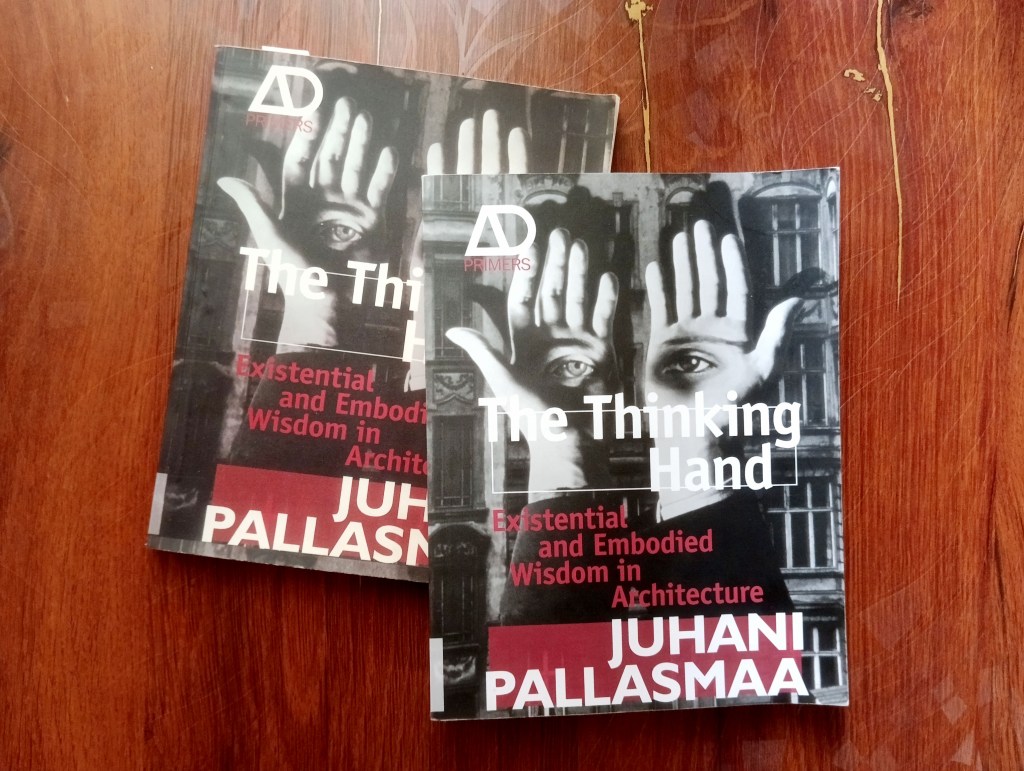
I have 2 copies of Juhani Pallasmaa’s ‘The Thinking Hand’. One of the few (or may be the only one) books on architecture i have read from the first page to the last page. A book very close to me. It has sustained 13 years of interest. Pallasmaa’s ‘The Eyes of the Skin’ is a more frequently read and referenced text . If you are an admirer of that text, this book is a great continuation.

The first one I read in 2010. I was in my third semester at the Theory and Design Master’s Program at CEPT. And it had taken almost the first year of my course to make reading a prominent part of my learning curve. I had read very less as an undergrad student. This book had just been published then and had arrived at CEPT library. After reading the library copy, i bought a copy to myself so that i can underline it and add my notes. It is in that mood i had read the book voraciously. I have to admit here, that the first copy is a photocopy. I think it costed me 300 bucks. The ‘xerox’ shop at CEPT made a wonderful job of photocopying book for the students. Most humane form for breaking the law i guess – by sharing knowledge. If you take a quick glance at the book now , you won’t make out that it is a photocopy. Even the cover is laminated colour photocopy. Unless someone has seen the original, this is good enough.

I recently (2022) bought the original book at ten times the cost. Still very expensive. I always felt guilty reading the photocopy, as i have been rereading parts of it for last 13 years! and i I have merrily ‘extracted’ a lot of quotes for my lectures and essays. This book puts in perspective for me on what is the role of architectural theory – its limits and possibilities. It is brilliantly articulated in these two phrases : “the discipline of architecture has to be grounded on a trinity of conceptual analysis, the making of architecture, and experiencing” and “whereas a theoretical survey that is not fertilised by a personal encounter with the poetics of building is doomed to remain alienated and speculative”.

By the way i have underlined notes in these two books, I can see my two different selves between the two books. Even though the first self is more ideal, optimistic than the sober, bit worn down academic; i am comforted to know i have highlighted similar sentences between both the versions and the consistence of my inclination towards certain ideas which still keep me going.

Below are a selection of my highly revisited quotes from my ‘extracts’ (all bold emphasis mine):

1.
“In my view, the discipline of architecture has to be grounded on a trinity of conceptual analysis, the making of architecture, and experiencing – or encountering – it in its full mental, sensory and emotional scope. The point that I wish to emphasise is that an emotional encounter with architecture is indispensable both for creating meaningful architecture and for its appreciation and understanding. Design practice that is not grounded in the complexity and subtlety of experience withers into dead professionalism devoid of poetic content and incapable of touching the human soul, whereas a theoretical survey that is not fertilised by a personal encounter with the poetics of building is doomed to remain alienated and speculative – and can, at best, only elaborate rational relationships between the apparent elements of architecture.” (146)

2.
“In addition to operative and instrumental knowledge and skills, the designer and the artist need existential knowledge moulded by their experiences of life. Existential knowledge arises from the way the person experiences and expresses his/her existence, and this knowledge provides the most important context for ethical judgment. In design work, these two categories of knowledge merge, and as a consequence, the building is a rational object of utility and an artistic/existential metaphor at the same time.

All professions and disciplines contain both categories of knowledge in varying degrees and configurations. The instrumental dimensions of a craft can be theorised, researched, taught and incorporated in the practice fairly rationally, whereas the existential dimensions are integrated within one’s own self-identity, life experience and ethical sense as well as one’s personal sense of mission. The category of existential wisdom is also much more difficult to teach, if not outright impossible. Yet, it is the irreplaceable condition for creative work” (119)

3.
“The great gift of tradition is that we can choose our collaborators; we can collaborate with Brunelleschi and Michelangelo if we are wise enough to do so” (146)

4.
“Drawing is an observation and expression, receiving, at the same time. It is always a result of yet another kind of double perspective; and giving a drawing looks simultaneously outwards and inwards, to the observed or imagined world, and into the draughtsman’s own persona and mental world. Each sketch and drawing contains a part of the maker and his/her mental world, at the same time that it represents an object or vista in the real world, or in an imagined universe. Every drawing is also an excavation into the drawer’s past and memory. John Berger describes this seminal merging of the object and the drawer him/herself: “It is the actual act of drawing that forces the artist to look at the object in front of him, to dissect it in his mind’s eye and put it together again; or, if he is drawing from memory, that forces him to dredge his own mind, to discover the content of his own store of past observations”” (90)

5.
In fact, every act of sketching and drawing produces three different sets of images:/the drawing that appears on the paper, the visual image recorded in my cerebral memory, and a muscular memory of the act of drawing itself. /All three images are not mere momentary snapshots, as they are recordings of a temporal process of successive perception, measuring, evaluation, correction and re-evaluation. A drawing is an image that compresses an entire process fusing a distinct duration into that image. A sketch is in fact a temporal image, a piece of cinematic action recorded as a graphic image.” (91)

6.
“The capacity to imagine situations of life is more important talent for an architect than the gift of fantasising space “ Aulis Blomstedt (114)

7.
Heidegger considers teaching even more difficult than learning: ‘Teaching is even more difficult than learning […] Not because the teacher must have a larger store of information, and have it always ready. Teaching is more difficult than learning because what teaching calls for is this: to let learn. The real teacher, in fact, lets nothing else be learned than – learning.”” (120)

8.
“One of the most demanding requirements of an architect is the capacity to sustain a sense of inspiration and freshness of approach for several years, and sometimes through several successive alternative projects.” (084)

9.
Architecture does not invent meaning; it can move us only if it is capable of touching something already buried deep in our embodied memories. (136)

10.
“My confidence in the future of literature consists in the knowledge that there are things that only literature can give us, by means specific to it, Italo Calvino in his Six Memos for the Next Millennium;

In my view, the task of architecture is to maintain the differentiation and hierarchical and qualitative articulation of existential space. Instead of participating in the process of further speeding up the experience of the world, architecture has to slow down experience, halt time, and defend the natural slowness and diversity of experience. Architecture must defend us against excessive exposure, noise and communication. Finally, the task of architecture is to maintain and defend silence. (150)

Composition of Loam

Below is short extract from the online discussion between Niall McLaughlin and Dominic Eley on books, reading and architecture. A great combo, which this blog seeks for.

Dominic : I think it is important to note your slight reluctance on addressing the literature that impacts your architecture. You were apprehensive about the insinuation that book equals building; that it could easily be misunderstood as you read a certain piece of literature and a building magically appears. During one of our discussions, you spoke about loam as an analogy for your relationship to reading and literature.

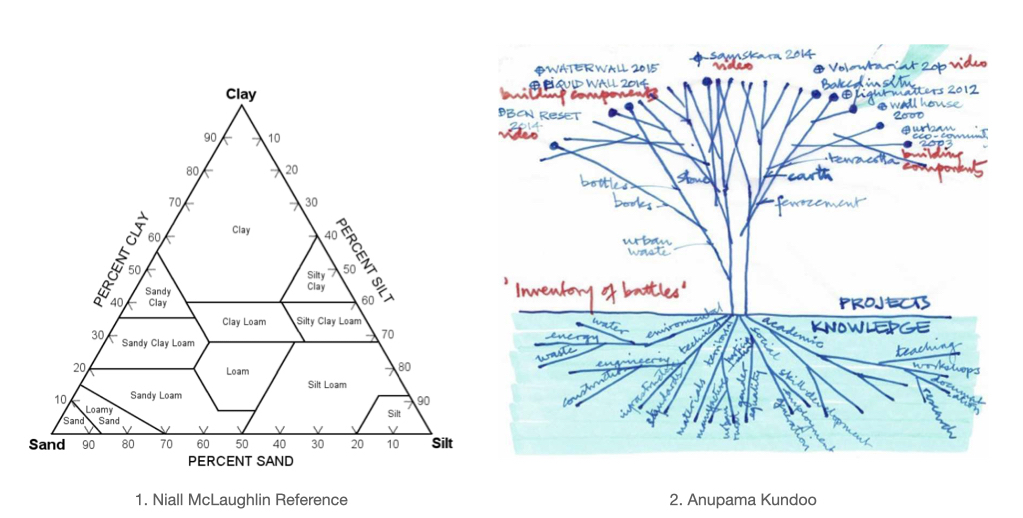
Niall : I do have a scepticism about architects showing off all their books and laying claim to a deep intellectual life that somehow has an equivalence in their buildings. I think I am sceptical to a degree about the idea that there’s a whole set of texts that I have read and a building that I have built and there is an equal sign between the two of them. It’s perfectly clear that many architects are extensive and careful readers and that reading must have some impact on the buildings that they are creating. However, unpicking the nature of that relationship seems to me to be trickier than creating any direct equivalences. I worry when I find myself, or others, at lectures reading from a text, and then the next thing is there’s a photograph of the building, a direct equivalence between the two appears. So, this is the idea of loam; the layers of soil that build up in a garden or a woodland. Whatever grows out of that loam is naturally dependent on it, but the relationship between the nourishing substructure growth is not as direct, or as necessary, as some people think. That was the metaphor I was using when discussing the tension in this lecture.” (emphasis mine)

(Click on the image to enlarge)

I felt this metaphor of the ‘loam’ is apt at so many levels. If we zoom out a bit, it could be between ‘theory’ and ‘practice’. There need not be a ‘direct equivalence’ but it can be a ‘nourishing substructure’. The metaphor can be interpreted at multiple levels – the seed in the soil can grow into any form or shape. It can also be about how different constituents (sand, silt and slay) make the soil fertile. The heterogenous nature of the constituents – a framework so well suited for the composition of faculties in a school and the triangle being the ‘school of thought’. Each component can be distinct and also co-exist with another component with a common ground / interests to operate. This also attaches well to the gardener metaphor used by Alison Gopnik for parenting (and teaching too) that “When we garden, on the other hand, we do not believe we are the ones who single-handedly create the cabbages or the roses. Rather, we toil to create the conditions in which plants have the best chance of flourishing.”

I came across a similar diagram by Anupama Kundoo – which she has labelled ‘inventory of battles’ – in which she talks about her ‘projects’ stemming from the process of ‘knowledge’. In this spectrum, I was curious that how teaching is an underground process – slow, unseen yet foundational. A good reminder for teachers to do what they do. 


Link to Anupama Kundoo drawing reference : https://www.architecturaldigest.in/content/anupama-kundoos-auroville-home-finds-a-place-in-the-venice-architecture-biennale-2016/

10 Books : Graphic Novels

Introductory Note
This is an invited post written by Shreyas Baindur . Shreyas and me have been teaching together for few years now. He introduced me to the amazing world of graphic novels. It was through the WCFA Book Club that we became friends. Shreyas used to bring frequently these graphic novels to the discussion and completed them at an alarming rate, when the other members like me were moving at a snail’s pace to complete the books. I had my prejudice then that these books were easy to read as they had a lot of pictures or only pictures . A shallow reading of what graphic novels meant from my side then. Then he introduced us to brilliant book – Unflattening, by Nick Sousanis – a Phd thesis in the form of a graphic novel. This book unfastened my opinion on what graphic novel means. The structure and the format is so suited to architectural thinking – this is thinking in visual from. So I invited him to put together a list of ten books as a starting point for those interested in this genre. Shreyas is well known between students for his sharp observations and the quiet sarcasm in design discussions. You will recognise a similar tint in this text too. Here is a pic of his envious collection of bookshelf (one of them) dedicated only to graphic novels.

(Click on the image for a larger view)
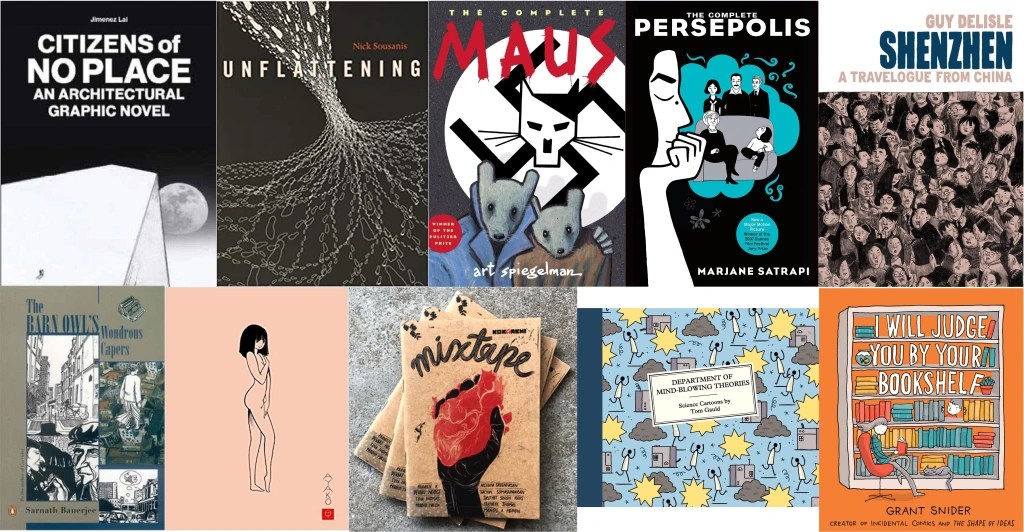
10 Graphic Novels : A curated list by Shreyas Baindur
(Click on the image for a larger view)

By Guest Writer – Shreyas Baindur
(His blog : thinkingtheinbetween.wordpress.com)

As a child, I hated reading. Seeing a book with words on every page brought nightmares. Though I might have exaggerated the scope of the issue, it was crippling enough. To alleviate my aversion to books, my mother introduced to me the Amar Chitra Katha series. Short, manageable and colourful, the graphic format of the books made me feel comfortable and were easy to consume. After reading quite a few of them, my mother found it difficult to find Amar Chitra Kathas that I hadn’t read. With this began my foray into reading graphic novels (though I would discover this joy once again many many years later), and subsequently reading in general. 

For a long stint, I didn’t pick up a graphic novel. During this stint, reading was a bit slow. The lethargy to read sank in over many years and I once again grew averse to reading. Rather than reading, I chose to wait for the film adaptation of the same. As part of my architecture undergraduate studies, we were never encouraged to read books other than the standard boring textbook-like manuals. The college had a measly little rack of books for architecture concentrating on filling the shelves with engineering manuals and coffee table picture books. It was only when I got to CEPT, Ahmedabad to do my masters in architecture that I felt stupid for not having read for years. Students there many years junior to me were discussing topics I had no clue about making me feel inferior. I would occasionally pick up a book or two at a bookstore at an airport or a street-side vendor, books that sounded fancy or had colourful covers, something to make me look all intellectual while moving around such places. But the curiosity to read a book never set in until CEPT. I was reintroduced to graphic novels thanks to a friend and housemate in Ahmedabad. The book was Citizens of no place: an architecture graphic novel by Jimenez Lai. And that is where the list begins.

  1. Citizens of No Place: An Architecture Graphic Novel (Jimenez Lai, Princeton Architectural Press, 2012): In my humble opinion, this is a must-read book for all architects, no matter how young or old. If I had the power, this book would be the first thing a student should read on day 1 of their journey in architectural education. The book is broken into 10 chapters each with a short one-paragraph introduction leading to a story that is imaginative, yet at the same time, presented as if it were plausible. 
  2. Unflattening (Nick Sousanis, Harvard University Press, 2021): Though the list started off with an architecture graphic novel, I hope to diversify it as it grows. The book’s description does most of the job when it says, “The primacy of words over images has deep roots in Western culture. But what if the two are inextricably linked, equal partners in meaning-making? Written and drawn entirely as comics, Unflattening is an experiment in visual thinking.” Sousanis uses the graphic or sequential art format to challenge the way we perceive text and images, creating pages that can be read both as a whole or in parts. What is most interesting about this book is that the author shows his process of how he put together the artwork for the chapters as mind maps at the end of the book.
  3. The Complete Maus (Art Spiegelman, Penguin UK, 2003): We have all heard and seen stories of the holocaust and the atrocities wrought upon the Jewish people by Nazi Germany many times over. But, The Complete Maus brings it too close to home. Spiegelman uses the graphic novel format to tell the story of his own father who survived Hitler’s Germany. In this book, people are depicted as anthropomorphised animals; the Jews as mice, the Germans as cats, and the Poles as pigs. Other ethnicities are shown as other animals as they appear in the storyline. The Complete Maus is the only graphic novel to be awarded the Pulitzer Prize. 
  4. The Complete Persepolis (Marjane Satrapi, Pantheon, 2007): In another of my humble opinion, which I seem to have too many of, graphic novels must be read as physical books, held in hand, to appreciate the art work. But, Persepolis was one of those rare books that I happened to read as a pdf on an ipad mini that was way out of date. The book is simple in structure and follows the life of the author in Iran as the country went through its cultural revolution. Reading (or seeing artwork) of this sudden shift in the political tectonics of a nation through the eyes of a child, herself at the cusp of womanhood, is poignant. The artwork itself is simple, bringing the story they tell to the forefront.
  5. Shenzhen: A Travelogue through China (Guy Delisle, Jonathan Cape, 2017): This book forms part of a series of 4 books, all by the same author and in the same travelogue format, by the author Guy Delisle. He seems to have had the good fortune to have travelled to some of the most restricted and highly sensitive countries in the world. From Shenzhen to Burma, and then to Jerusalem to Pyongyang, Delisle seems to find himself as an outsider looking into places he isn’t supposed to. His style matches the dreariness of the places he visits making the situations he finds himself both hilarious and extremely concerning. The first book I encountered of his was Shenzhen, on recommendation from a friend in Ahmedabad, and loved the story telling so much that I ended up reading all 4 in the series in quick succession.
  6. The Barn Owl’s Wondrous Capers (Sarnath Banerjee, Penguin Books India, 2007): When Kiran spring cleaned his library, he found a bunch of books he wanted to get rid off. One of those books happened to be Sarnath Banerjee’s book, The Barn Owl’s Wondrous Capers. I snagged the book immediately and happened to read it soon to realise that it was not an easy feat. The story is about a man who goes on a hunt to find a book, through Kolkatta, by the name of The Barn Owl’s Wondrous Capers. The book is about a man trying to look for a book that is in your hands. The whole book is a search for a book. I don’t recall if the man finds the book at the end or not, but the whole premise of searching for a book that is titled the same as the one you are reading is simply mind boggling. This also happened to be my first introduction to Indian graphic novel artists.
  7. Ayako (Osamu Tezuka, Vertical, 2013): Originally published in Japanese in 1989, the english translation of the book was published much later. Tezuka, I found out only after having read this book, was one of the first artists to contribute to the genre of graphic novels now popularly known as Manga. The story of Ayako is of a girl by the same name born out of incest in a rich land owning family who try to keep her entire existence a secret. She escapes and the story follows her life. The story of Ayako is tragic and triumphant at the same time. For readers of Manga, the artwork will be very familiar. 
  8. Kokaachi: Kokaachi is not a book, but the name of an art studio under which 2 artists (Pratheek and Tina Thomas). They published an anthology named Mixtape, which are 3 books each showcasing stories done by young graphic novel artists. They also make Matchbox Comix, stories so short they fit in an accordion fashion into a matchbox. 
  9. Department of Mind Blowing Theories: Science Cartoon (Tom Gauld, Canongate Books, 2020): Please read this book as a physical copy, never on a kindle. That is the mistake I made and I hope no one repeats it. The book is a series of small cartoons that Tom Gauld had done that were published in newspapers as single or 3 tiled stories. This book is all about science and all the hilarious ways things can go wrong.
  10. I Will Judge You  by Your Bookshelf (Grant Snider, Harry N Abrams, 2020): Another book I made the mistake of reading on Kindle. Well, I would justify this grave mistake by saying that it was the first lockdown and I was bored and desperate to read this book. For a person who reads, this is probably the best book to read. It displays in simple graphics a lot of things that we as readers take for granted. Graphs that show what genres we read to the various silly positions we take to do so, and the weird and the odd place where we read. Though heavily fictionalised, the book is a joy to go through and the cover graphic is cute.

Reading List : Theory

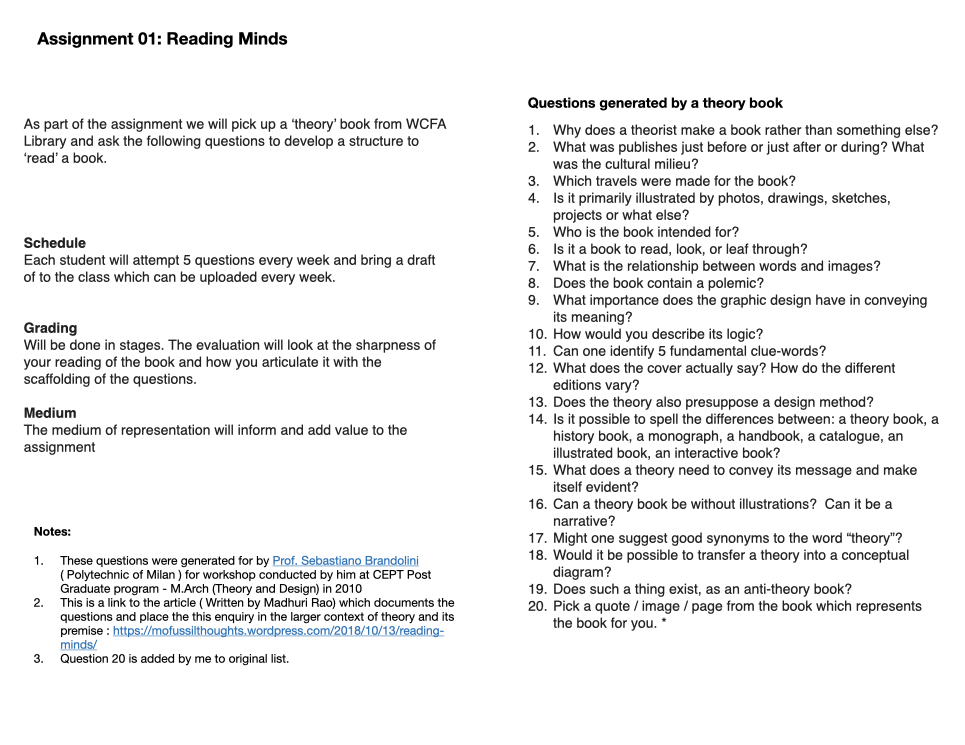
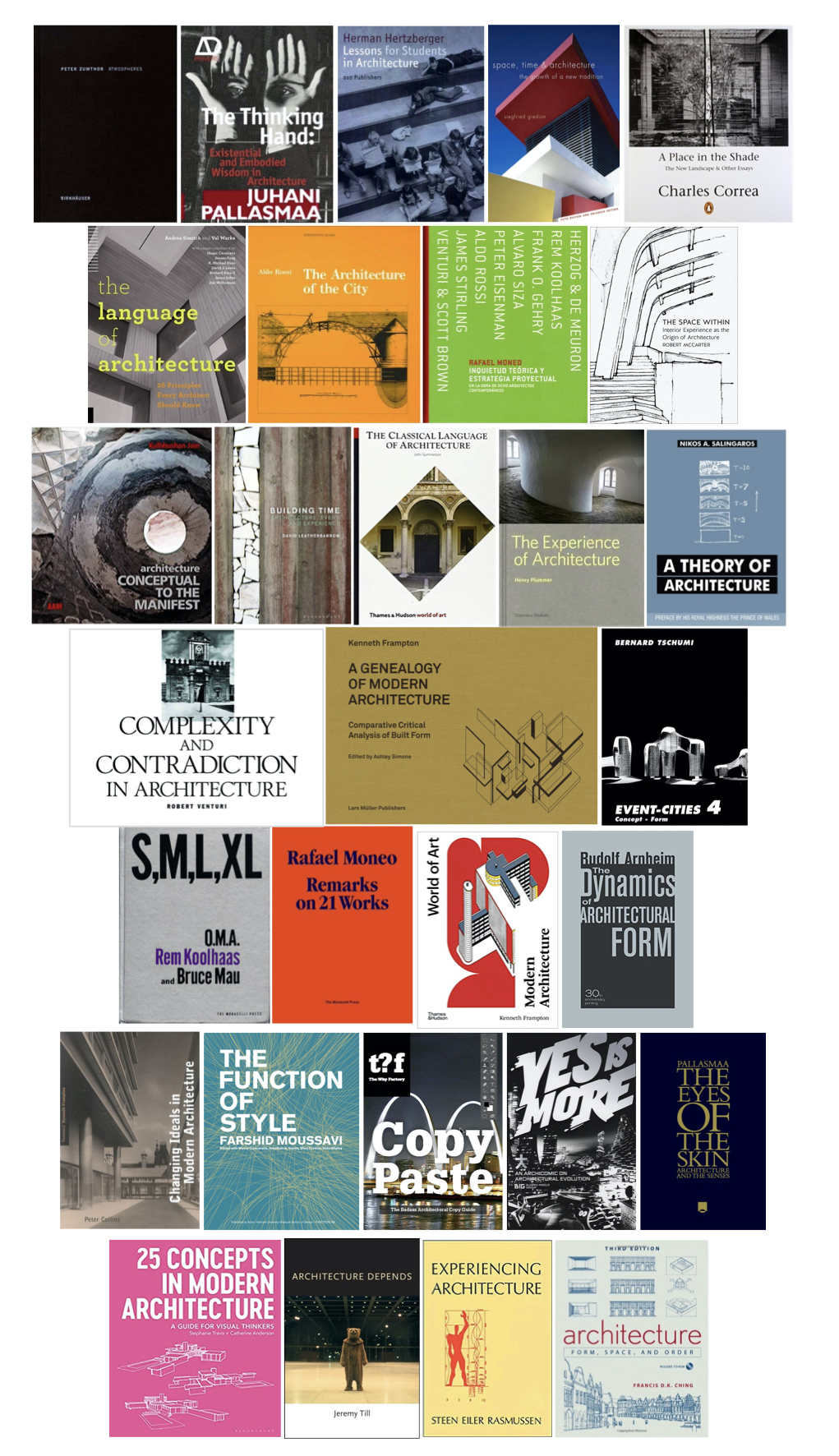
Here are a list of 30 books I picked for an assignment for the second year students for the ‘Theory of Architecture’ class (WCFA Batch 2020) . I have been intending to do a list which could become a sort of a starter set, if at all anyone is (still) inclined to read ‘theory’ books.There is general apprehension of theory being ‘cerebral and elite’ (1), both in profession and academics.This assignment is to soften that apprehension. The structure of the assignment is borrowed from an assignment I did as a student at CEPT under Prof. Sebastiano Brandolini. (Link  to the earlier post describing the framework). So I picked up books which fall into a wide spectrum ranging from phenomenology to ‘form’-al to basic analysis and which has the possibility to feed these 20 questions in diverse ways. One could also argue that some of these are not ‘theoretical’ enough – giving an opportunity to discuss in the class first-of-all what is ‘theory’ anyway. I feel ‘theory’ is somehow placed on the opposite deep-end of ‘experience’ in the spectrum of knowledge. Even though the student might not be inclined towards the book initially, the framework allows him/her to explore the overall structure and get an overview by reading parts of it. A sort of ‘case study’ of books.

Question no. 1 begins with a sharp note in that way – “Why does a theorist make a book rather than something else?” When the question is asked to diverse books like – Thinking Architecture and say Complexity and Contradiction – we can have a rich discussion on what made Zumthor and Venturi write a book – when they both practised architecture, in the ideology they intended to. One could argue that if Zumthor’s ‘Thinking Architecture’ is even a theory book at all? To me it is a ‘theory’ book, because it is articulating perception and memories and relaying it across space and time. Zumthor’s book can also be a response to Question 19 “Does such a thing exist, as an anti-theory book? “

Question no. 14 can be revealing, particularly for a mixed range of books we have listed – “Is it possible to spell the differences between: a theory book, a history book, a monograph, a handbook, a catalogue, an illustrated book, an interactive book?”. S,M,L,XL checks all these boxes, and hence radical in a way on what can theory book can do and cannot do. The book weighs 2.7 kgs and is 1376 pages long. An exaggeration on the physicality of a so called ‘theory’ book but still explored its format in eccentric and accessible way. 

Question no.12 “What does the cover actually say? How do the different editions vary?  reveals some interesting ideas of the different variations of the canonical ‘Modern Architecture : A Critical History’ by Frampton. The final chapter has been evolving till the recent 5th edition (2021) from the original first edition (1980) reflecting the deep and critical reading of Modernism and evolving the proposition of Critical Regionalism. There are dedicated sub chapters to less discussed counties like Peru, Chile and Bangladesh. Mary McLeod observes that “Frampton’s writings – a mixture of history, criticism and analysis – have inspired architects, especially those practicing outside of United States ( in places where the notion of “regionalism” or “locale” may have more resonance and meaning than in the states” (2) . It was this inclination from the beginning made Frampton to explore works of (then) less known works of architects like Siza and Barragan. This thread of thought has evolved fully in the fifth edition by including distinct interpretations of modernism across the world. 

In some ways the “the mixture of history, criticism and analysis” in varying proportions has been the DNA of the various books listed. In the class we discussed the multiple possibilites of interpreting architecture though these books. All 20 questions are not equally relevant to all the books. The sub-selection of the 20 questions will already reveal something about the book. The questions and the comparative analysis between the books provides an engaging platform to talk about what is ‘theory’?

The assignment shared with students (Click on the image to view larger)
The list of 30 books – each student picked up a title (Click on the image to view larger)
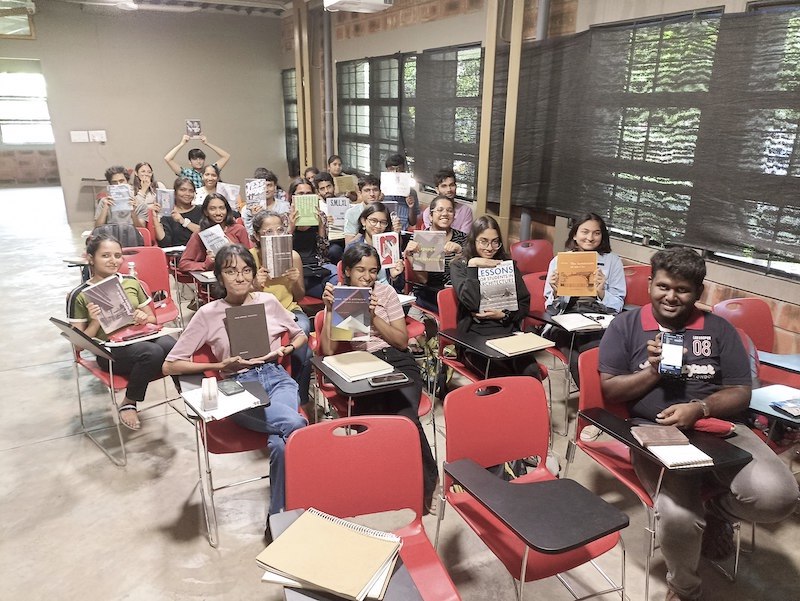
Here is a delightful moment from the class (WCFA Batch 2020, B) where everybody (almost everybody!) had managed to issue and bring the book to the class with some homework done. If you are a full time faculty, one would appreciate how rare these moments are. And if you belong to small tribe of history and theory faculty like me, this is a day of celebration!

Notes :

(1) In the introduction to the book ‘A Primer on Theory in Architecture’, Karen Cordes Spence has a detailed argument on this point

(2) In an essay ‘Kenneth’s Frampton Idea of he “Critical”‘ by Mary Macleod in the book ‘Modern Architecture and the Life World: Essays in Honour of Kenneth Frampton’ edited by Karla Cavarra Britton and Robert McCarter.