10 things I learnt from Ching

[Drawing] is the silence of thought and and the music of sight.

Orhan Pamuk, My Name is Red

Prof. Ching starts one of his online lectures with this quote. He replaces the word ‘writing’ from Pamuk’s writing with ‘drawing’ here. A delightful transfer of meanings. I had the privilege to accompany him on few occasions on his visit to Wadiyar Centre for Architecture, Mysuru (where I teach). So I tried to jot down few things to retain the experience.
.
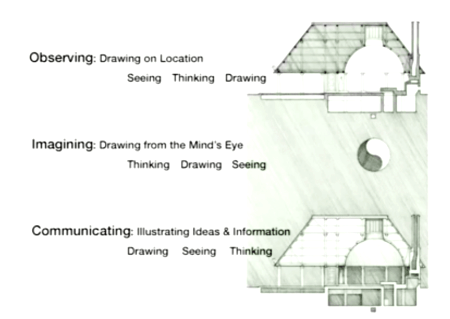
  1. Seeing. Thinking. Drawing. Cyclic nature of these words and their meanings seemed to be framework for his thinking. It is also name of his wonderful blog (https://www.frankching.com/wordpress). A great source to access his ideas and great clips of his process videos of sketching.
    .       

    screen-shot-2018-09-23-at-12-44-34-pm-e1539416857229

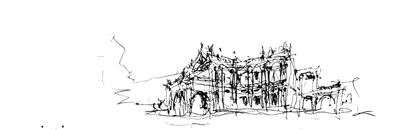
  2. Draw small. Concentrate on essentials. He said five small drawings are better than one large drawing. By drawing small one has to pick what to focus and what to leave out. Both acts equally important in the drawing. The sketch below is of the Jayalakshmi Vilas at Mysore. The actual size is not more than 2″ tall.EPSON MFP image
  3. Draw slow. Allows one to observe things better.
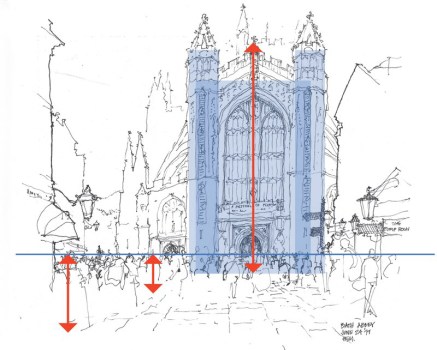
  4. Fundamentals. Gauge the composition by hand measurement. Make sure to get the horizon line right.  Transfer the proportion to paper. Discern the foreground, middle ground and background. Start filling the details in the same order. Never forget the fundamentals of drawing.ToNotice4
  5. Principle of Contrast. In his own words “I want to expand on the idea of contrast—the discernible distinctions in line weight, tonal values, textures, details, and even relative position on a page—that is essential to avoiding blandness and giving life to a drawing. …how the visual tension between the two contrasting elements or areas contribute to the composition of a drawing.” (To read more from his post: link)
  6. Frugality. He spoke less and drew more. His shoulder bag can act as an analogy here. It had an umbrella (when it rained unexpectedly on that day, only he had an umbrella), half litre water bottle, 2 sketchbooks, an I-pad, a golf cap. a tissue paper ( to wipe off the falling rain drops of the sketchbooks). The size of the bag was just enough not to disturb him sketching, even if the bag is hanging on shoulder.
  7. Restraint. He was consciously aware when to stop drawing and how much to draw (like how much details on the tree). I was surprised to see, for expert in drawing like him, to be uncertain in the drawing process.
  8. Abstraction. All drawings are abstraction, as they are all illusions of converting a three-dimensional view to 2D. And diagrams are scaffolding to hang ideas.
  9. Do it. He quoted the Nike ad ‘Just do it’.  He talked about how the ‘Architecture Graphics’ book happened. The collection of handouts which he gave the students of his class had an opportunity to get published. In 2 weeks, with the aid of .7 mm mechanical pencil and eraser shield, he flushed out a full book. The beginning of his publishing career began on by just ‘doing’.
  10. Act without striving. When asked, was he aware how many copies of ‘Form Space and Order’ was sold. He recalled a Chinese quote, which talked about acting without striving. This phrase as well could summarise his personality.
IMG_20180916_173211
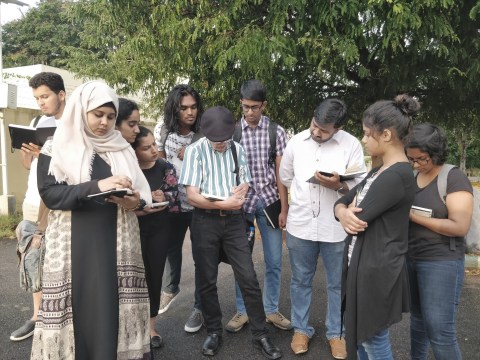
With Prof. Ching and students of WCFA at a sketching trip.  Photo Credits : Toshi Singh

Notes

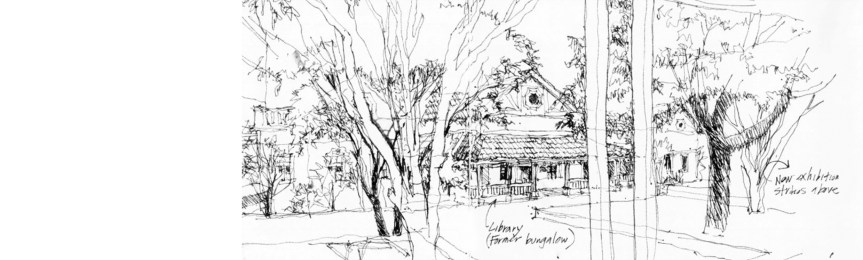
All the sketches are extracted from his blog. All the credits belong to him

The link to the online lecture he gave at University of Washington from which the first image is clipped  (https://vimeo.com/33296611)

The anti-thesis of the selfie

The essay is more about the ‘axonometric’ than the selfie. But it sounded tempting to start from the notion of a ‘selfie’, as now it is a very important social phenomenon. Even to remain aloof about it, is translated being a misfit.  Sontag says “To photograph is to appropriate the thing photographed. It means putting oneself into a certain relation to the world that feels like knowledge – and therefore like power”. In the light of these words written much earlier before the selfie-era, the selfie keeps re‘appropriating’ the self.

To probe further, lets look at the traditional projection methods of  drawing in architecture – Orthographic, Perspective and Axonometric. Weston beautifully talks about how these three ideas in book 100 Ideas that changed architecture .Simply put the orthographic drawings relays a three dimensional object into a set of two dimensional drawings. A perspective drawing  “invented as a technique to represent the world as we supposedly  perceive it, perspective projection became both a means of design and the catalyst for far reaching doubts that questioned the foundations of classical architecture”. Whereas the axonometric drawings  “one of several means of representing a three-dimensional object on a two- dimensional surface; unlike the more familiar technique of perspective projection it does not suggest how the object might appear to the eye. Lines do not converge to one or more vanishing points but remain parallel, enabling all dimensions to be preserved true to the chosen scale ”

Theo_van_Doesburg_191
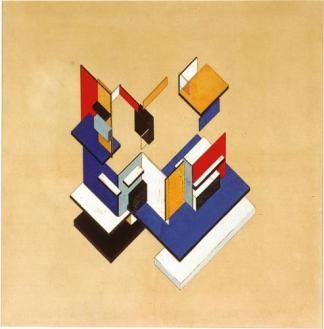
Theo Van Doesberg, Counter-Construction, Private House, 1923.


Only the orthographic and the axonometric are scaled formats. Even the simple ritual of ‘scaled’ set of drawings is as recent as Renaissance. An outcome  of the print technology and artist-builder divide pushed the necessity of scaled drawings.   Post Renaissance the impulse of the scaled ‘orthographic’ drawings (plan,section and elevation) gained importance. “..it was only in the Renaissance that scale drawings came into widespread use. The use of scale promoted an intellectual separation between the drawing and the building, and with it the emergence of the separate roles of the architect and the craftsman”. Weston also remarks “Axonometric projections found favor among early Modernists for two contrasting reasons. To those committed to shaping an architecture for the Machine Age, they evoked the objectivity of science and technology, while to others of a more metaphysical inclination such as Theo van Doesburg, leader of the Dutch De Stijl movement, the rather different “objectivity” of gravity-deffing colored planes floating in an inflnite spatial field was effectively evoked without implying the presence of an observer ”

The variables of three modes of representation being  the thing observed, point of observation and vehicle of observation. But what happens in the viewing the orthographic drawing is the the ‘point of observation’ could be any where in the plane parallel to the cutting plane. It could be any point in that parallel plane, thus a possible objectivity to the drawing (and thus may be in intent too).In the perspective drawing, the point of observation is a definite point in space, thus a very subjective matter of looking at things.Axonometric, an high capacity tool for of several architects, arises and  builds it reputation from its basis of objective methodology.  This absence of the observer  is what intrigues me. And this presence/ absence scenario of the observer, makes both the axonometric and selfie, interesting and opposing phenomenons.

But in the spectrum of a selfie, all the three variables the thing observed-point of observation-vehicle of observation  all collapses into the ‘self’. It collides all boundaries of the traditional projection systems. It creates a very interesting vortex of collapsed social constructions. ‘Appropriating’ the world through ‘the self’. Its so narcotic.


Bibliography : “On Photography” by Susan Sontag and “100 Ideas that changed Architecture” by Richard Weston

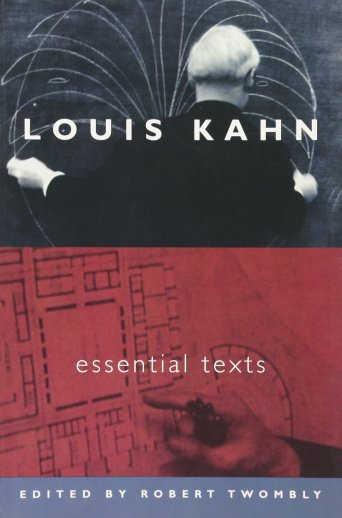
My First Architectural Book

kahn

First’s are always overrated. But not in this case. This entry is not about contents of the book per se, which was the initial intent of this piece, but experience of buying the book itself. Its entry into my life, is a bit theatric. I would like to talk about the first non-photo-copied book in my bookshelf : Louis Kahn’s Essential Texts (I am excluding Banister Fletcher here intentionally, because like everyone else, i did not have much inclination to pre-modernism history as a student, which i regret now). And also may be, talking about Banister Fletcher, is not an animated idea for a blog. And I realised just now, for this book how we use the author’s name always as replacement for the book’s title ‘History of Architecture’. Like xerox or dalda.

Kahn is simply everyone should seek, if one is underwhelmed by architecture. Both experientially and intellectually. Kahn had famously opened a graduate studio at Penn by uttering the words “Design a room” and walking out. This book gives you that edge. An edge to read into the fundamentals.

I remembering buying this book as a student after finishing my professional training. It is a proud possession, as i bought it from own earned money. My father would disagree to this point, as he paid for room rent, food, fuel, movie tickets. Somehow I have a strong memory of buying this book. May be because I bought it in a physical book shop. That’s sounds so antique already, with all the bookshops closing.
.
Art
.
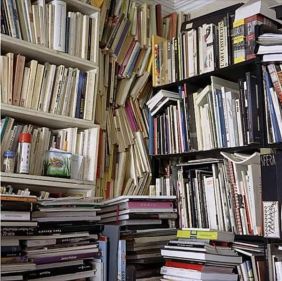
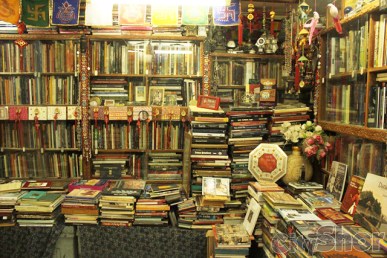
I had a great experience buying it from Art Book Centre in Ahmedabad. Its one of a kind beautiful little bookshop near Ellis Bridge in Ahmedabad. The books here are arranged like the streets of the old city itself. Structured chaos, deep Interlocks. No recognisable sectors or clarity like Chandigarh. One had to find their way in selecting the books. Only the shop owner knows where each book is placed in this matrix. Unfortunately i don’t remember his name, but i add him in the list of few people who would understand the significance of not having a real copy of Lang-Miki’s Architecture of Independence. The unfortunate ones like me need to move on with the life with the photocopy of the book (in which the words will be missing towards the centre of the binding, as the original CEPT library book could not be pressed further). If there was a survey of the most photo copied Indian book on Architecture, this would be in the top five. Because of the missing words towards the centre, the photo-copies have a ‘enigmatic’ edge over the original ones. Attaining a shade of ‘Kanhnian’ in the process.
.
It costed me 1000 bucks when i bought it. To put this in context today – Amazon rate: 3500 (For Non-Architects who are reading this piece, ‘Context’ is an artificial trope architects use to validate their design, even though if the buildings is covered by glass on all four sides, 1.5 times more expensive that clients budget) As a trainee i was paid per hour (This is a particular Ahmedabad strain, like their acquired taste to exposed brick and concrete ) , i used make around 1500 a month at 6 Rs per hour (like Ola rates). I was the highest paid trainee, as put in more fruitful hours hatching the CAD Plans, making area statements, folding large drawings for site etc. So the cost of the book amounts to 166.6 hours of working as a trainee.
.
Its inevitable here, i need to mention when i bought this book because of mentioning the cost. It was a decade ago. (The reader, if any, he or she is in their apprehensive 30’s like me will share my anxiety. The anxiety goes like this: Every year when you hear about the graduation day of the college, instinctively you count the years since one has graduated vs your productivity over the years) And I am told after 40, life soothes you and this anxiety is diluted. I hope so.
.
The following things happened to me after i bought this book:
1. Had the license to use the following words ‘mesurables’ and ‘unmesurables’ more frequently (more for flamboyance during my post graduation)
2. Started putting all the services in one core. I know, it is a  shallow understanding of the ‘served’ and ‘servant’ spaces idiom . But to my convenience, design started working better.
.
As i am new to writing and having made all the trivial notes above to overcome the anxiety, I want to share the deepest pleasure when I read these lines  from the essay  ‘Form and Design’ (1960) in this book :
.
/ “A young architect came to ask a question. “I dream of spaces full of wonder. Spaces that rise and envelop flowingly without beginning, without end, of a jointless material white and gold.When i place the first line on paper to capture the dream, the dream becomes less”.”
/ “I once learned that a good question is greater than the most brilliant answer”
/ He talks about the “the realization of what particularities the domain of spaces…”
/ Another one “Every space is intended to be dark should have just enough light from some mysterious opening to tell us how dark it really is”
/ “A great building, in my opinion, must begin with the unmeasurable, must go through the measurable means when it is being designed and in the end must be immeasurable.”
.
.

Notes:

Credit and link to the image of the bookshop if from this webpage. This link more photos of the bookstore :  http://www.cityshor.com/ahmedabad/art-book-center-ahmedabad/

Searching in Google for the photos of the bookshop, I found a delightful blog on the Art Book Centre it self. : https://talesalongtheway.com/2013/08/29/art-book-center-ahmedabad/