Operations of Reading

This piece is built around the ‘reading’ we had with Aveek Sen (Scholar in Residence at WCFA) in design studio. The blog (and may be all writing too) is a montage of imperfection of memory and shortcomings of  documentation ( A reference to a similar phrase by Julian Barnes in The Sense of an Ending) . I have tried to quote Aveek’s words as accurate as my memory and scribblings in my notebook allowed. We were reading the chapter ‘Cities’ in the brilliant book ’The Idea of India’ by Sunil Khilnani.

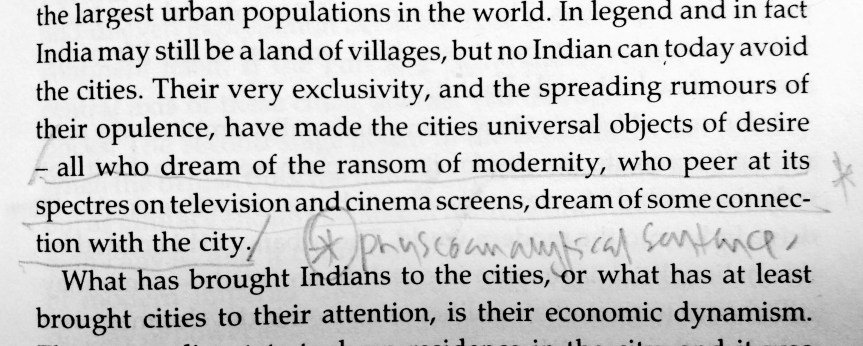
Aveek equated ‘tracing the line in the book to walking in the streets’. The way one meanders in a city shaping memories, is similar to how one reads the lines in a book. The acts of ‘walking, reading, talking’ are operative agents of engagement with the actions performed. And everyone ‘reads to one’s own unique printed voice’.  We discussed on how underling the text while reading is a process of archiving thoughts. When one visits the book again, these underlined words open new trajectories of thought. The act of marking and adding comments in an active way to engage with the text. We discussed the similarities between ‘reading’ a text and a drawing. Both acts reveal the fractures in the intellect. ‘Reading is a simultaneous act of listening to the printed voice and realisation of thoughts forming in the head’. It can trigger multiple associations. Reading can act as a ‘cartographic’ device of the mind by allowing ’thoughts to write itself into the text’ one is reading. Likewise, reading a plan can be a ‘architectonic exercise’. I mentioned of my recent reading of a courtyard in a plan for a house in Delhi, which recalled my design process for a courtyard I had designed earlier and reminded the courtyards I had visited/documented in my travels before. Aveek articulated this experience as ‘palimpsest’ , where ‘layers of memory are projected in the text/drawing one is reading’.

This reading led to me a piece I had read long time back. Tim Parks in his brilliant The New York Review of Books blog ’The Weapon for Readers’ writes about the habit of reading with a pen in hand :

“There is something predatory, cruel even, about a pen suspended over a text. Like a hawk over a field, it is on the lookout for something vulnerable. Then it is a pleasure to swoop and skewer the victim with the nib’s sharp point. The mere fact of holding the hand poised for action changes our attitude to the text. We are no longer passive consumers of a monologue but active participants in a dialogue”

“Looking back over the pages we have already read and marked, or coming back to the novel months, maybe years later, we get a strong sense of our own position in relation to the writer’s position. Where he said this kind of thing, I responded with that, where he touched this nerve, my knee jerked thus. Hence a vehicle for self knowledge is created, for what is the self if not the position one habitually assumes in relation to other selves? These days, going back to reading the books that have remained since university days, I see three or four layers of comments, perhaps in different colored pens. And I sense how my position has changed, how I have changed.”

The reinforcement of the ‘palimpsest’ in this occurence : is me remembering a piece on reading by Tim Parks , prompted by Aveek’s reflection on ‘operations of reading’, while reading an essay by Sunil Khilnani.


Space within a space : Weavers House, Melkote

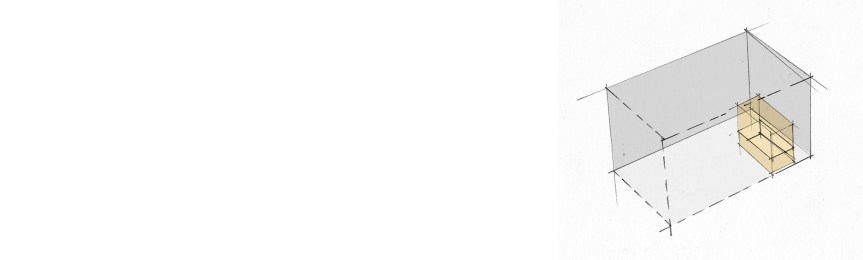
01-copy.jpgSpace with a space : A theme I am currently exploring where one can perceive two spaces simultaneously. Even though the smaller space is embedded inside the larger one, both have distinct  sense of enclosure independent of each other. The original trigger was the reading of the Orinda House designed by Charles Moore, in which the two rooms (the bathroom and living) are embedded  as pavilions with in the larger perimeter of the house. The thematic idea is to explore of the condition of ‘simultaneity’ in crafting of space
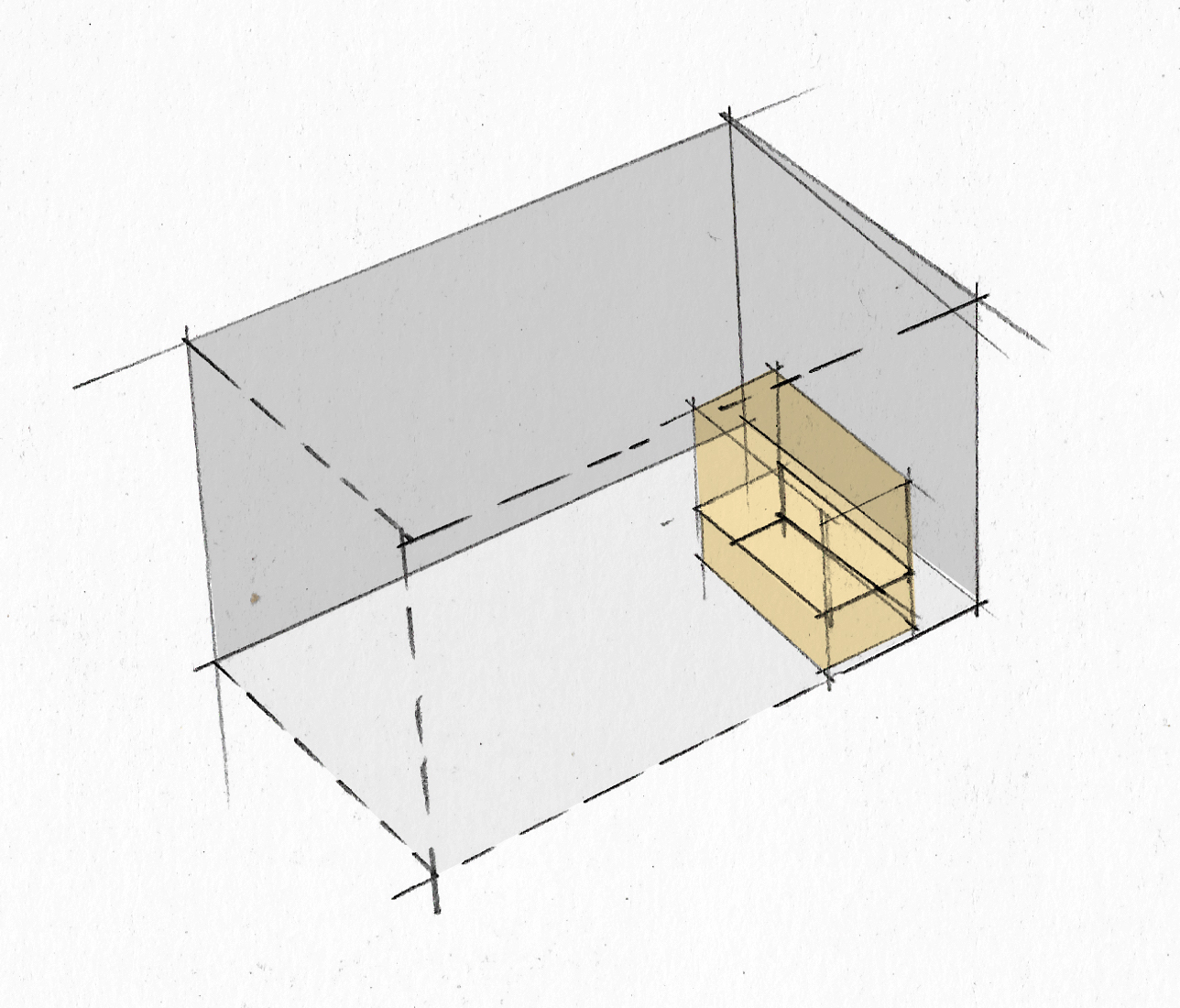
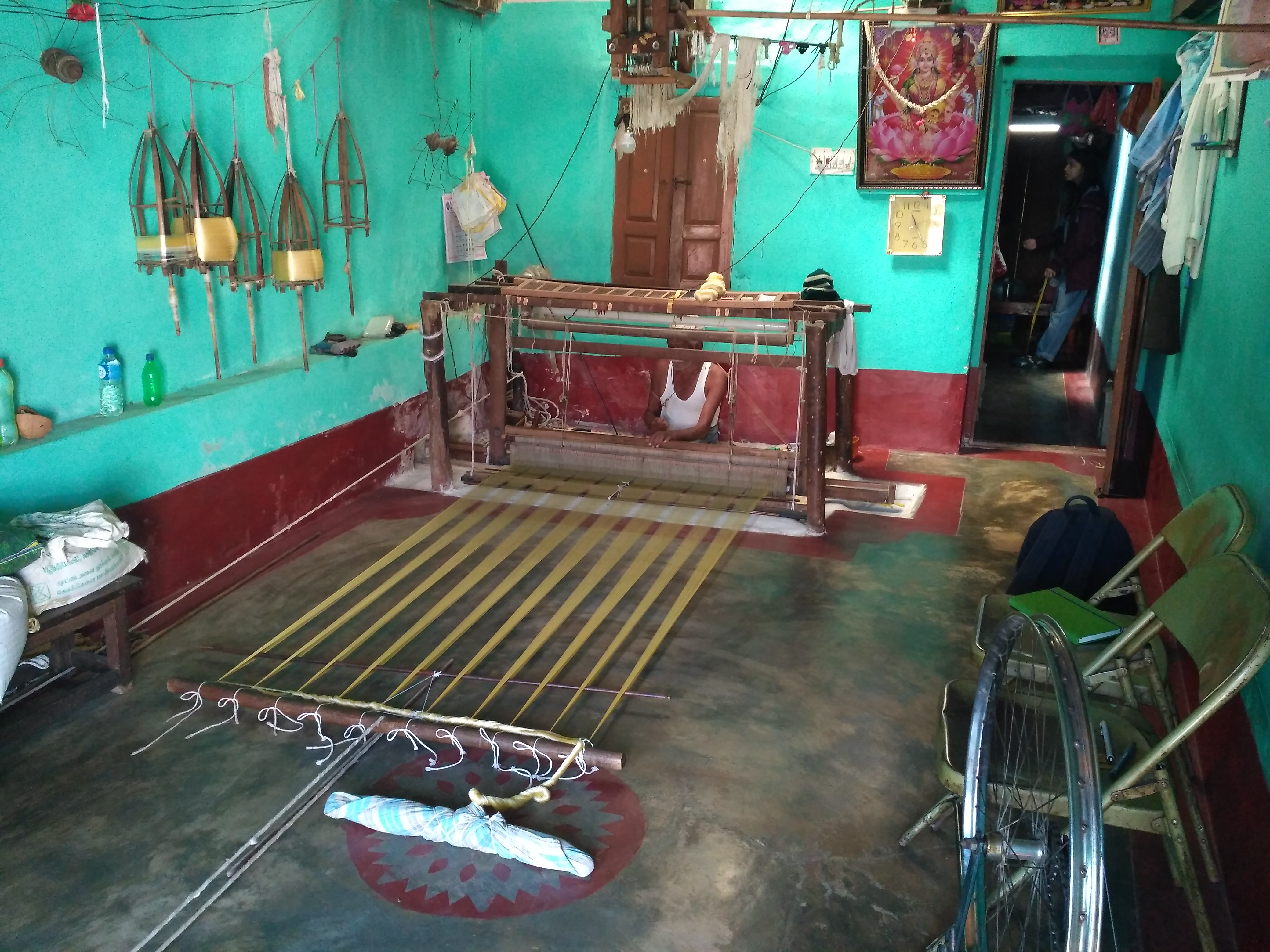

The below images are from a weavers house in Melkote. Melkote was a thriving place for weaving. Now because of the impact of the power-looms. this craft is only pursued by 30-40 families here. The weaving equipment sits above a pit carved out of the ground. This incision in the ground made by the the instrument forms an intimate working space within the larger living space. He simultaneously perceives his workspace and the living room. The house has two zones : this living room with the workspace and a small kitchen and a washroom behind. So this place of occupation becomes the core premise of the house.

Melkote


IMG_20190222_112622


Visual distribution of cognition

IMG_20190805_120036_HDR
.
This phrase ‘visual distribution of cognition’ can also be simply a fancy word for drawing according to Dan Roam¹, who is the bestselling author of several books on drawing and visual thinking. But this phrase, for architects, primarily can reveal the subtle difference in meaning between drawings and diagrams. Drawings are generally descriptive and diagrams are abstract. Diagrams form the integral process of design process.
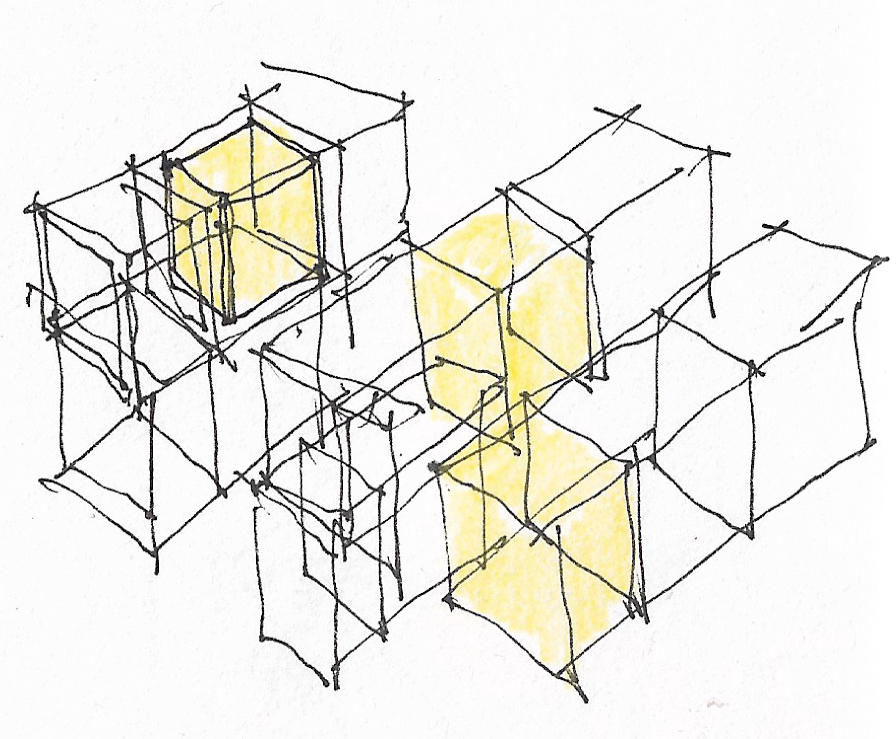
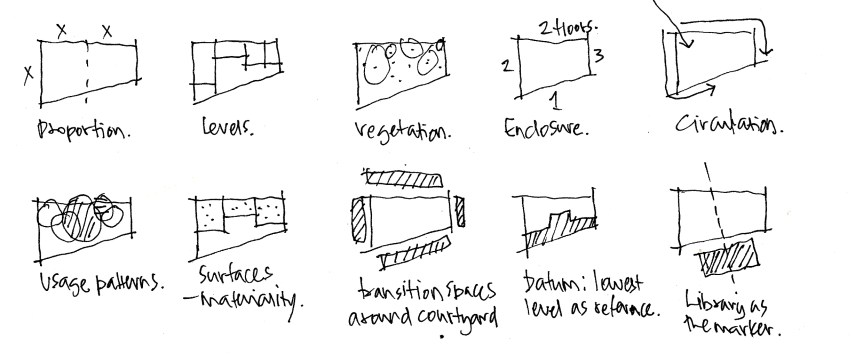
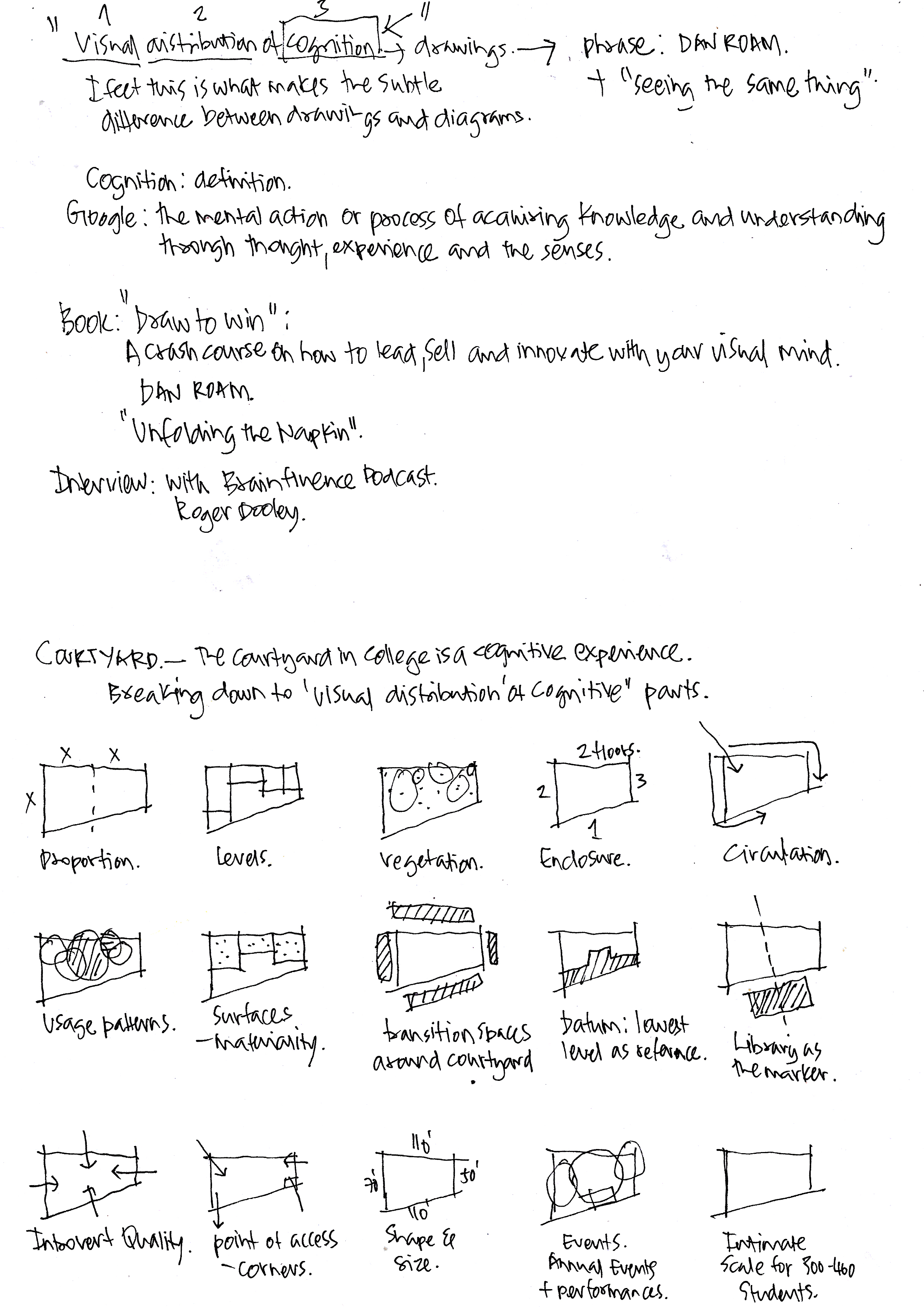
So if I break this above phrase into three parts and probe a bit more. Starting from the last word ‘cognition’, the dictionary meaning is “the mental action or process of acquiring knowledge and understanding through thought, experience, and the senses”. Architecture has a lot of cognitive load.  So if I take the case of courtyard of WCFA , the college where I teach now.  It sits at the heart of our campus and forms the core of  campus activities.The life of the college revolves around this single space and forms the DNA of campus life. How can I make this experience more tangible for purpose of design understanding.  We can use diagrams to decipher the quality of this space. Thats when we need to fragment and distribute this experience visually in the form of drawings. These are simply called ‘diagrams’, but when if you label it as ‘visual distribution of cognition’, the meaning becomes precise and neat. So in this sketch below is ‘distributed’ layers of the courtyard. So the perception of the place gets better. Diagrams work well usually when presented in clusters. Because a single layer can sound reductive sometimes. And diagrams are supposed to be reductive, as they reveal one prominent idea at a time.
So I can use a diagram to make the students ‘see the same things’ as I see. It brings a bit more clarity in the discussion. It was interesting to decipher what they are already familiar with. It can also lead to understand the potential of conceptual understanding built on real and familiar examples. The concepts built around the familiar, establishes a ground for understanding unfamiliar examples. Through discussion we identified many layers for this courtyard. Each layer can be separated and tied to a similar cluster of examples, as D.K.Ching does in Form, Space and Order. This suggestion of universal principles that can be appropriated to suit particular conditions.
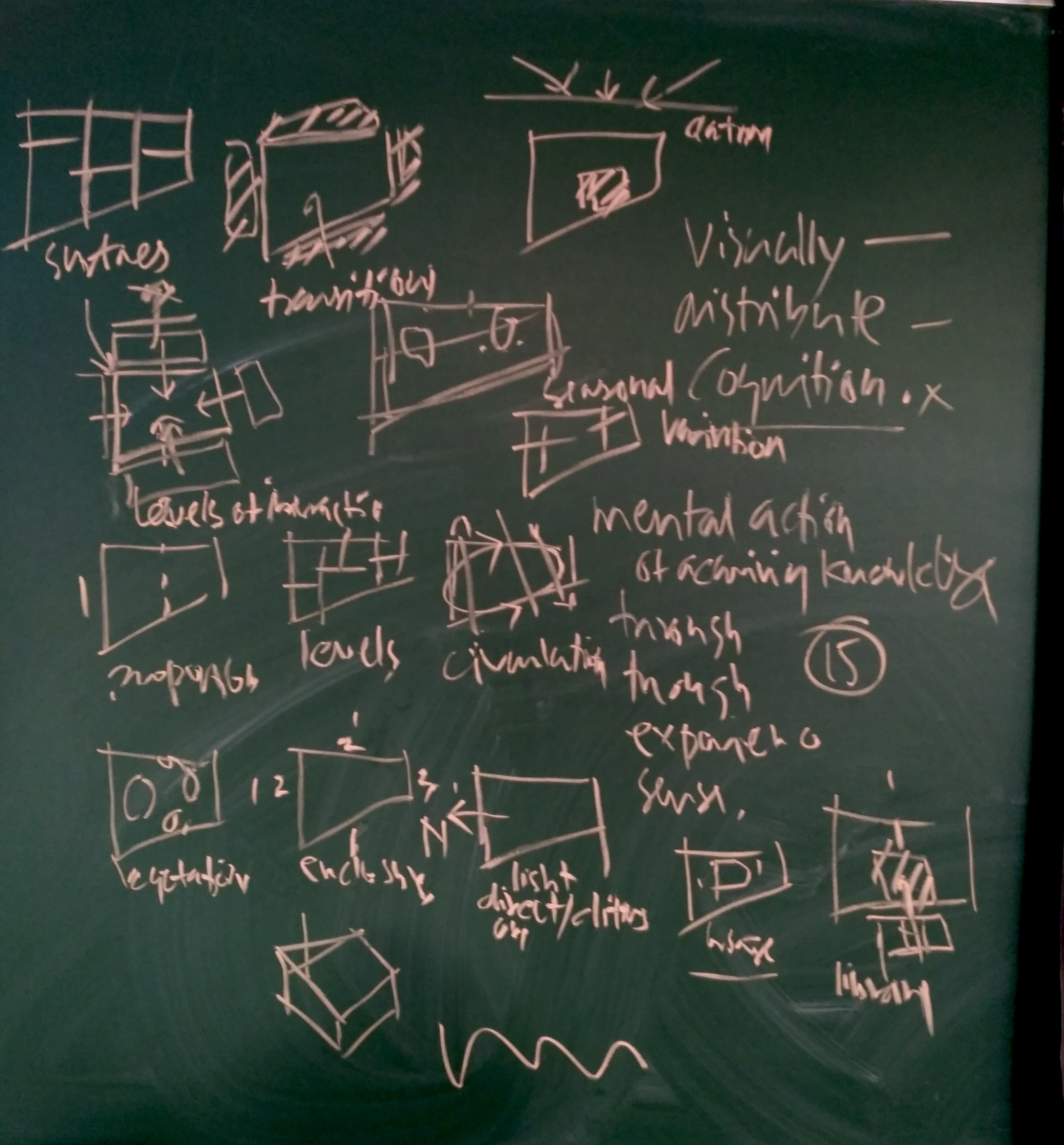
The photo above is the exploring this concept in the class and below is the notes i took after the class so i can build on it later.
.
.
02


01 . I came across this phrase in his interview with Roger Dooley in Brainfluence podcast. The link to the transcript


Drawings with measurements

Drawings have capability to hold memory and fix experience. I had casually drawn some of the plans of the rooms i had stayed which i found interesting. Going through my old sketchbooks, i think casual exercise might have more potential. As a small test, i have picked up some sketches here (most of them are not bigger 5″ wide, drawn in the corner of the page) and try to write from memory what i can remember of those spaces. To my surprise, they have some triggered some strong memories of being in that place : like the balcony jutting into the street, mosquito net over bed, a study table.. Looking back i think it is the study table, which has triggered to make these sketches. A place to draw is also important to support the act of drawing. Another unique trait of these drawings are dimensions. They make the experience of the specific. It allows one to mentally appropriate a place. I get a sense of relief, when i guess and get the size of the room right (which does not happen always). The dimensions help to understand scale better. Here are some of my drawings (1 to 4) and from others (5 to 7) which i admire.

LAnka1
01 : The room on the left is the one i stayed in Galle in 2016.  I very vivdly remember this room for the small balcony (4’6″ wide by 1’6″ deep) which cantilevered into the street. It was a secondary street, so not much noise. A balcony door which also was a window, so we had to engage with its constantly. So i had to keep it open most of the time.  The room on the right was a room in Colombo. Even though it was a small room, it was carefully done. Just simple white walls and elegant wooden furniture. Geoffrey Bawa is a household name here. Both the hosts (non-architects) were aware about his works. This was also the first time i tried Airbnb. So both these rooms were homestays. Looking at a place by staying at a home stay carries a different texture, by giving a sense of the non-touristic view of the city.
lanka.jpg
02 : I vaguely remember the details of this room in Sri Lanka  (2010) . Again this was part of a homestay. I remember having authentic SriLanknan breakfast in this place. I think there was a old and heavy study table by the window looking at the corridor. This was more like a hostel. And a very strong memory of sleeping inside mosquito net on the posts of the bed. It was like a room within a room.
Rooms 3
03 : This drawing (2018) is from practice. A dead end enquiry (one of many) on a small renovation. I like this drawing, because I think I got the proportion of the rooms bit right here when compared to the top two.  A little yellow makes the interior bit distinct. I also used a digital tape here, a useful tool for single-person-practice like mine.
Masingudi
04 : This drawing (2019) is from a resort in Masinagudi. A great room with wonderful views. A distinct nature of this room was that you arrived at a small foyer from the verandah in the front. This foyer had room length mesh with  blinds but no glass, which had a distinct quality which was neither that of the verandah nor of the room inside. It captured a subtle shade of enclosure in between them.
jerwood
05 : Chris Eckersley won the Jerwood Drawing Prize in 2011 for this drawing. Chris is my recent find and can’t stop admiring his drawings. This measure drawing is of his stay at Le Corbusier’s Unite d’Habitation in Marseille. It captures the the atmosphere of the room through dimensions. Each and every object in the room is measured here.  He writes in his website “I’m interested in proportion, anything from Serlio to the Modulor. Is there such a thing as ‘good proportion’? – certainly some things look more ‘right’ than others, and so this has led me to the idea of measuring as a way of finding out. I’m always amazed at what measured drawings can reveal. This type of drawing need not be to any scale, but has something of a survey about it. It can tell you quite a lot”
Screen Shot 2019-07-20 at 2.58.02 PM
05. Another brilliant one by Chris from his Instagram 
28 - Principal
07 : Foster’s mesaure drawings of the Post Mill Cambridgeshire as a third year student shows inclination of inner workings of technology. A trait very evident is his later practice,


Foster’s Drawings

Attached below are drawings made by Norman Foster as a third year student!

I remember seeing these drawings as a student from USD library (even though we had a small collection in the initial years, it was very resourceful). This small library was my only source to the outside world, as it was early days for easy internet access. If i remember correctly, it was in the fat monograph number one, where i came across these drawings. I was amazed at that time, how one could draw with so much care, an ordinary mill like this.  I recently came across these again in pages of  Norman Foster Foundation, a very resourceful place which has some crazy documentation of most of  his works. It is common to preserve professional stuff with a lot of care (usually one gets to know the value of archiving/documenting only late in student life). Foster has preserved all his students works, even his first year student design projects, including the history sketchbooks. This archive is a timely reminder for us to document properly. One can sense in these drawings, the seed of ‘Fosterness’ is already evident in the way he is measure drawing an ordinary looking functional building. The care to observe details of how things are put together, a strain which he carried over in his practice.

In an interview, he talks about this building :

“This is one of the buildings I measured as a student while in Cambridgeshire. I measured a group of buildings, a big barn, a thatch barn, and a post mill, which you can see here. It’s not about old buildings being really rustic and picturesque and part of our heritage, but making the point that there are valuable lessons to be learnt from these buildings. Most people would probably not think twice about these. Because these buildings were so functional people often ignore the aesthetics of them. Maybe I’m trying to be too clever, maybe your readers will think I’ve lost my marbles or something. But it’s a very personal thing, and it’s one of the first buildings I measured, and one of the first buildings I looked at with an architect’s eye.”

46 - Principal47 - Principal27 - Principal28 - Principal