‘Preparing’ for a lecture

IMG_20200303_103635
.
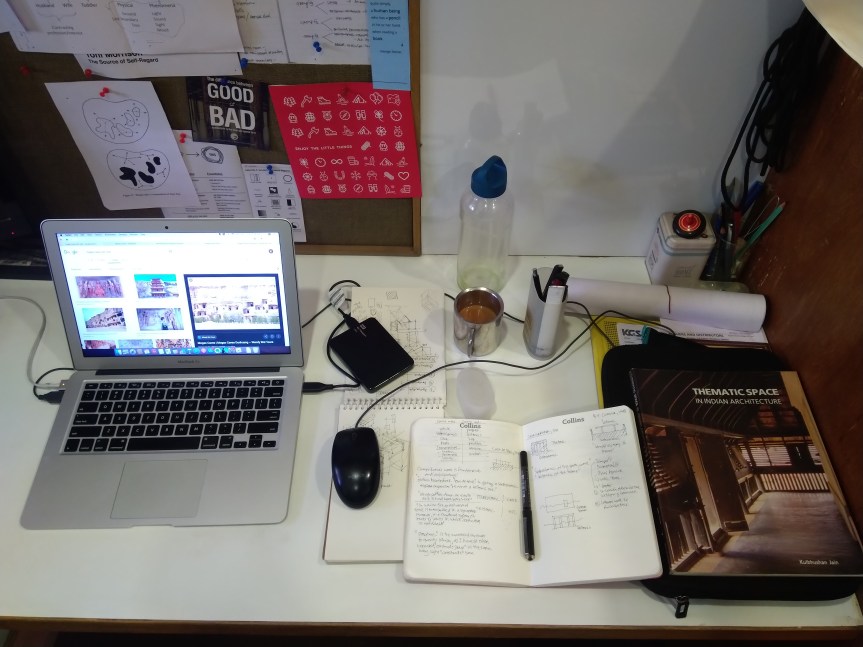
This is how I ideally would like to prepare for a lecture. The average assumption is that is the normal scene of teaching process. No. It is not. One has to earn this moment/s between other things – discussing, meeting, attending, lecturing, getting lectured, guiding, correcting, formulating, etc.  I feel that this is the most important threshold of teaching for teachers, preparing for a class (could be for a theory subject or design studio). This moment is rarely discussed or acknowledged because it is not visible normally. I feel this is the crux. To make and articulate connections. As an academic, one is not making buildings or also involved in pure research. The making and pure research are at the extreme end of the spectrum of architectural thinking. Both are tangible in their own ways – buildings and books/papers. It is the general assumption that academics are closer to pure research. Slowly I am realising this distance is also far. We play in the middle ground. Also I am realising that the middle ground has a lot to offer. It is a fertile zone to make connections, which can allow some fundamental insights to inform the ends of the spectrum. Then what makes our work tangible?  We make connections and articulate conditions between ideas, buildings and ideas of buildings. So this photo is of a moment where I am preparing for a lecture for second semester design studio. The topic I am going to discuss in class is the architecture of pavilion and the room. My co-faculty Kavana will be starting the lecture with the plinth and the wall.
So here are the components of the preparation (Starting from right)
  1. The book ‘Thematic Spaces in Indian Architecture’ by Kulbhushan Jain is an object of pure research. A book which I have from long time but recognised only recently. I am partly aware of the processes/struggles he goes through to publish these book. Dedicating years to each of them. I had the wonderful opportunity to study under him. Hence this book is really important for me. Not only for what is says and but also what it means, to be teaching.
  2. A A5 hardbound sketchbook is the core of the thinking process. An anti-dote to the virtual. I try to carry it always. It is a collections of readings, observations, scraps of thought, drawings.
  3. A A5 spiral portrait cartridge sketchbook – is what I call the ‘college notebook’ has ideas particular ideas for my classes.
  4. A laptop – limitless-overwhelming connection to information. I like to ground/check this virtual platform this with the sketchbook.  The mostly minimised PPT file (or the Keynote file for Apple users) in the parallel window.
  5. A hard disk – unorganised messy pdf’s of books, old presentations, previous semester works, lesson plans, notes, etc.
  6. Coffee – I added it to the scene deliberately to make the mood creative-like ( not to feel left out from the “real” world of  “practicing” architects)
  7. Soft board – A collage of references, lists, academic notices, schedules, time table.
Nolan’s Drawings

inception-flowchart-by-nolan

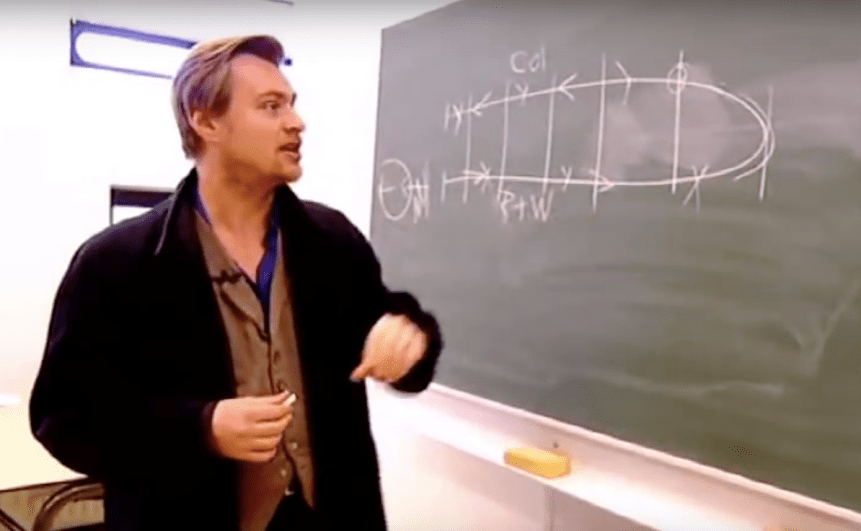
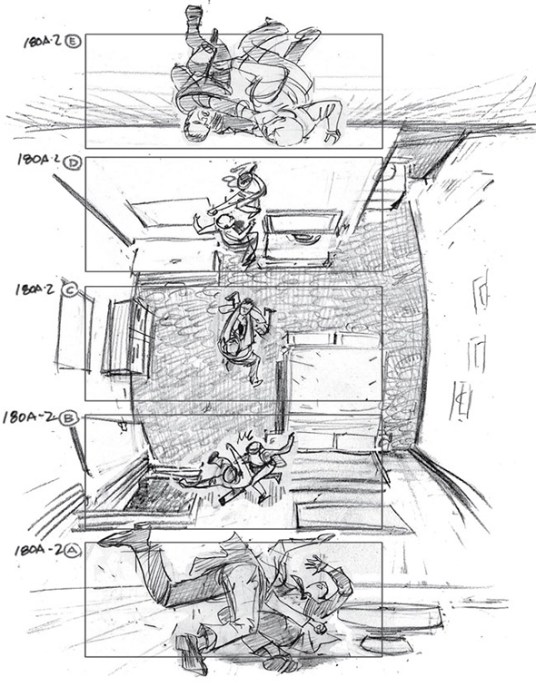
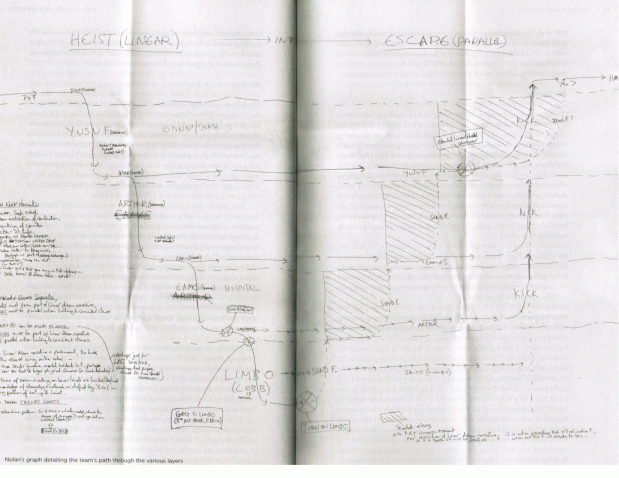
I use this Christopher Nolan’s diagram in my lectures a lot. I end up asking every new batch, if they have seen the movie. Always surprised only few have watched. This is the outline of Inception movie. Whoever has watched the movie will agree with me that it is even difficult to narrate the movie to anyone who has not seen it. There are lot of interesting fan made posters on the web to unravel this complex narrative. Then imagine the trouble Nolan might have had to explain this narrative to his collaborators. I find this diagram (if you can call it one) brilliant. If Nolan make a drawing like this to explain Inception, I don’t think there are any excuses on what a drawing or diagram can  not represent ( this tone of exaggeration come the rhetoric nature of teaching). It shows time and space together. A layer underused in architecture, as we deal with static objects most of the time. This another sketch below is from the story board his team made for  Inception, which shows movement in a single frame. I found this Youtube video (clip below) where he is discussing and constructing the story of ‘ Momento’. The interviewer prompts him to draw. Even though Nolan says “It’s confusing because I don’t think pictorial/diagramatically” makes this brilliant diagram of ‘hairpin bend’ which is stroke of genius and this gesture cracks the whole narrative of the movie. And looking at the video, Nolan here is ‘extrapolating’ the time-space nature of the screenplay into a single diagram here.

In an interview he gave to the Wired magazine he talks about the importance of
“distinct undercurrent about the importance of architecture” in his movies. Nolan answers :

“The only job that was ever of interest to me other than filmmaking is architecture. And I’m very interested in the similarities or analogies between the way in which we experience a three–dimensional space that an architect has created and the way in which an audience experiences a cinematic narrative that constructs a three–dimensional -reality from a two-dimensional medium—assembled shot by shot. I think there’s a narrative component to architecture that’s kind of fascinating.”

Nol
A clip from the Youtube Video
Storyboard
From the story board of ‘Inception’

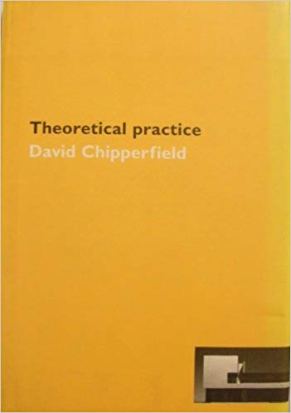
Notes from ‘Theoretical Practice’ 

I was cleaning my old notes and found a paper where I had noted these from the book ’Theoretical Practice’ by David Chipperfield. One of the few texts written by Chipperfield. This was when I was a student and had just discovered Chipperfield. I was intrigued then by the title of the book, as one would always associate with the likes of Tschumi and Eisenmann for architects inclined towards theory. This tone of the text felt different for ’theory’. It was more crisp and basic. I could understand what I read for a change (which was unusual compared to other theory texts). I am so thrilled to see these notes for two reasons. My interest in Chipperfield is still very alive, reminding the ideal-seeking-mindset of college days. The second reason is the much needed reminder “architecture is (only) the backdrop of our life” (only added by me). I always refer to this another quote of Chipperfield that ’scale’ and ’time’ are our enemies, but was never  able to place the source. It is a relief now. This book has been out of print for sometime. This piece of note and what it articulates is important reminder for me. I am delighted that I had written this down around a decade back and reassures the need for reading and writing.
.
“Once we accept that architecture is capable of changing little, we can consider it as real power. The questions architecture can pose are limited, and architecture cannot, by definition, provide answers. Architecture is the backdrop of life and has, as such, the possibility of influencing the way we act. It can make our lives much easier and can offer a vision of order in the world of chaos. It can remind us of simple values. It can make our world more material and bring us in touch with the very elements it shelters us from. It can heighten our senses, our anticipation and experience”
.
“Its modest ambition is to make the spaces we inhabit more beautiful and the thing we touch more meaningful. The power of architecture is to be silently profound”
.
“We need to find ideas and clues in the resolution of the simple and everyday problems, to avoid the spectacular in order to make the everyday special. In this vision the simple decisions become the most critical, the margins become more central, in making architecture in which, while questioning the way we act, affirms values and resolves contradictions”
.
“Our enemies are ‘scale’ and ‘time'”
.
.
31dfb3S2zyL._SX349_BO1,204,203,200_

Spaces between buildings

Sitting in a recent review for campus design, I kept using the phrase ‘space between buildings’ repeatedly. After the review i was just wondering if I overemphasised this notion, as we know how teachers can hold to only few things dearly. Just to cross check myself, I tried to think of two examples to support my own thought.


01.

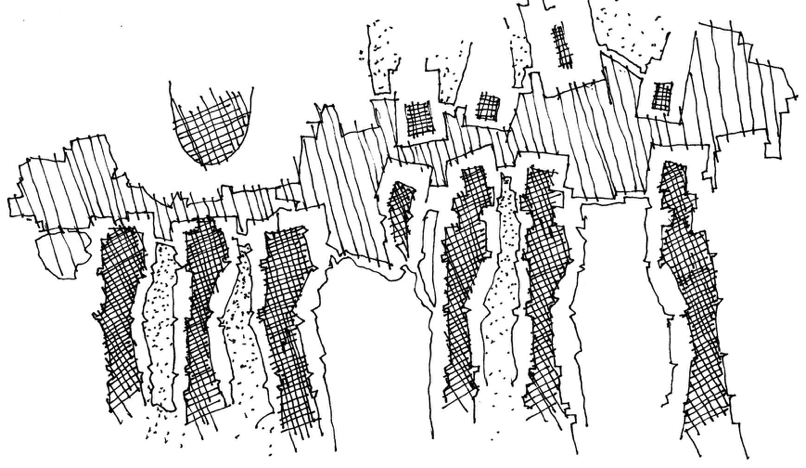
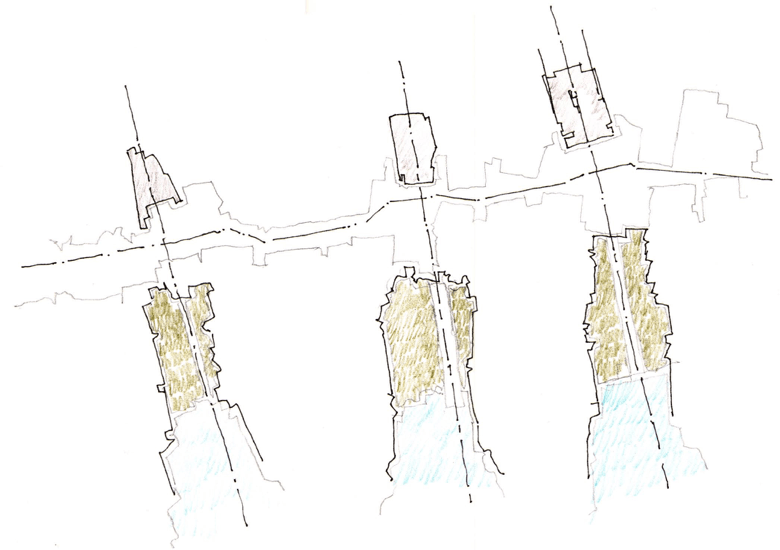
The drawing below was part of early process for the proposal for Nalanda University Competition. I was a member of the Hundredhands team which participated then. The particular intent of the drawing is to take the figure/ground drawing to the next level. Different density of hatches depict different types of in-between-unbuilt space in the project. The parallel line hatch depicts the central spine along which the faculty buildings and the major public buildings (library, dining, etc) were organised. The cross hatch highlights the intimate space within each faculty department zone (academics + hostels + faculty housing) .

01

In this other drawing below for the competition, I tried to mark the public buildings ( library, dining, etc) along the spine, which would release to a large vista of open space. A strategy to both control and establish the scale of the campus and also to interrupt the length of the spine to articulate its linear experience.
02

02.
I am sharing an extract here from Paul Goldberger’s impeccable explanation of the University of Virginia’s central lawn and the buildings around it. This is from the book “Why Architecture Matters”, a must read anyway. The point to select this piece is not only for the relevance, but also for the delicate and precise description of an architectural space, which is so difficult to describe because of its tectonic nature.
.
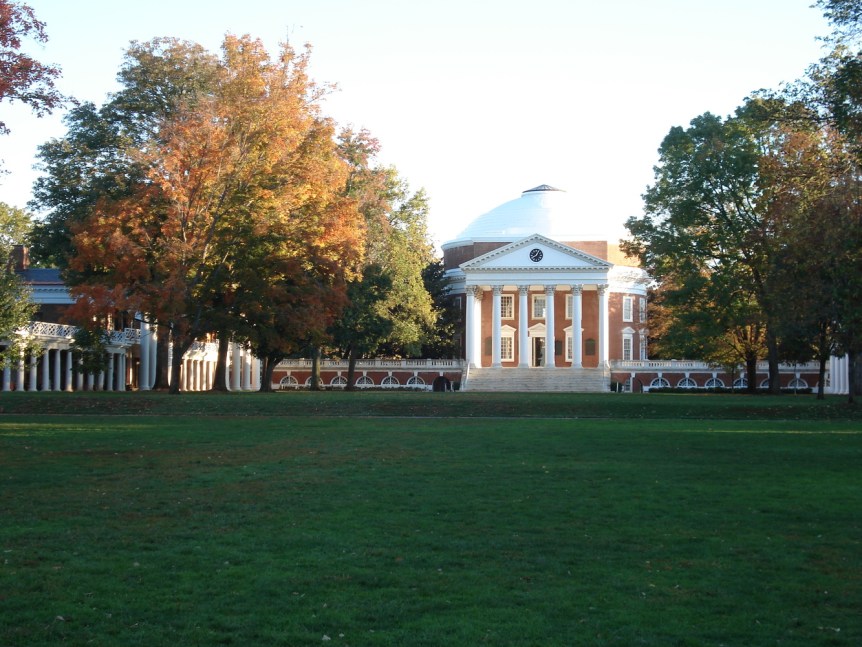
“Designed when (Thomas) Jefferson was seventy four, the “academic village” as he liked to call it, consists of two parallel rows of five classical houses, called pavilions, connected by low, colonnaded walkways, which face each other a wide, magnificently proportioned grassy lawn. At the head of the lawn, presiding over the entire composition, is the Rotunda, a domed structure he based on the Pantheon in Rome.
The whole place is a lesson, not just in the didactic sense of the classic orders, but in a thousand subtler ways as well. Ultimately the University of Virginia is an essay in balance – balance between the built world and the natural one, between the individual and the community, between the past and the present, between order and freedom. There is order to the buildings, freedom to the lawn itself – but as the buildings order and define and enclose the great open space, so does space makes the buildings sensual and rich. Neither the buildings nor the lawn would have any meaning without the other, and the dialogue they enter into is a sublime composition.
The lawn is terraced, so that it steps down gradually as it moves away from the Rotunda, adding a whole other rhythm to the composition. The lawn is a room, and the sky is the ceiling; I know of few other outdoor places anywhere where the sense of architectural space can be so intensely felt.
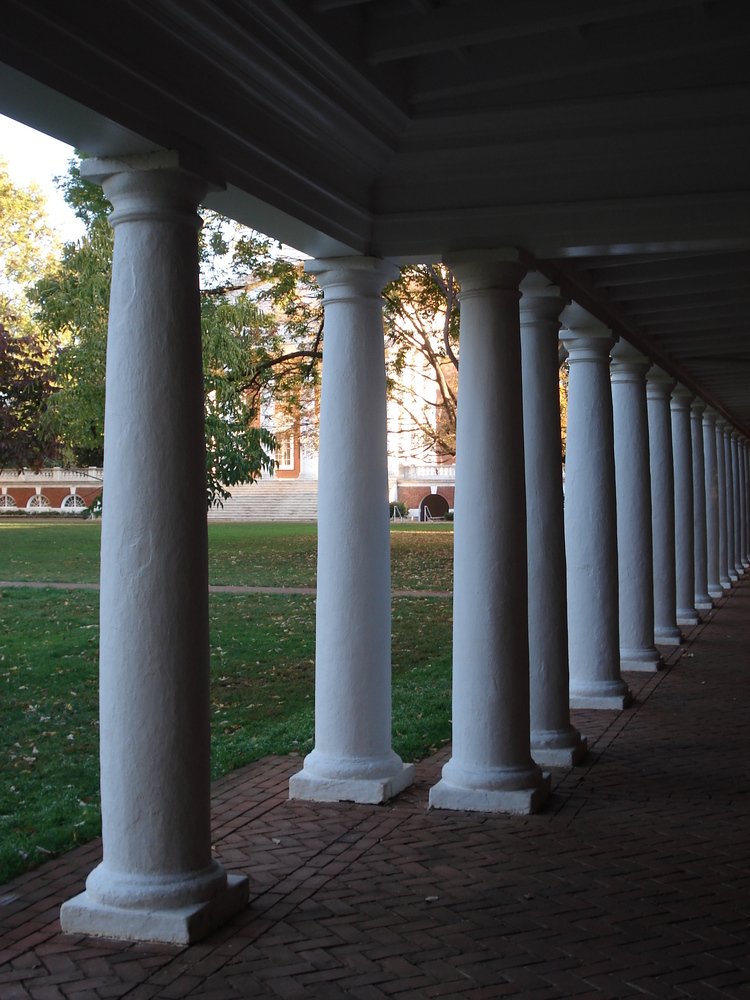
In Jefferson’s buildings, there are other kinds of balances as well, between the icy coolness of the white-painted stone and the warm redness of the brick, between the sumptuousness of the Corinthian order and the restraint of the Doric, between the rhythm of the columns, marching on and on down the lawn, and the masses of the pavilions. In the late afternoon light all this can tug at your heart, and you feel that you can touch that light, dancing on those columns, making the brick soft and rich. There is awesome beauty here, but also utter clarity. It becomes clear that Jefferson created both a total abstraction and a remarkably literal expression of the idea. Architecture has rarely been as sure of itself, as creative, as inventive and as relaxed as it is here” ( Pages 13-15)
.
Some images for below for reference ( Source Archdaily Classics, Photo Credits : Larry Harris)
.DSC09373
.
DSC09354
.
DSC09376
.
DSC09377

Christopher Alexander’s 15 principles

Theory Assignment, Semester 3, Batch 2016, WCFA  :  To reinterpret and redraw fifteen fundamental principles formulated by Christopher Alexander. Drawing by student : Vismaya N

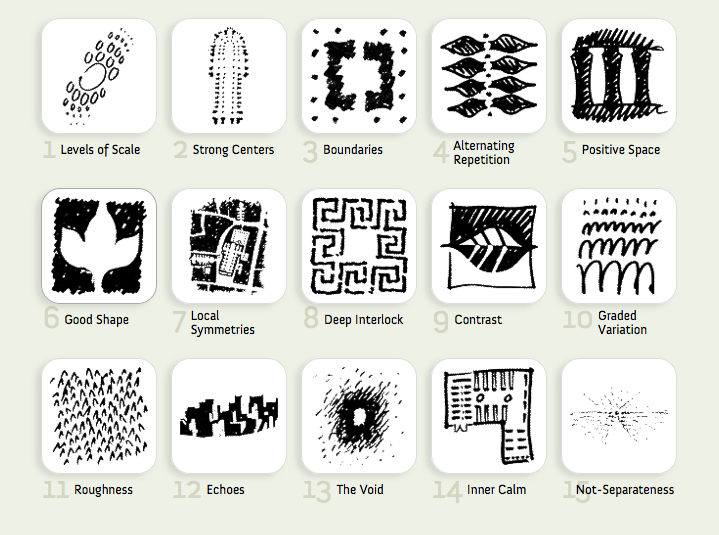
Alexander formulates these principle in the book “The Nature of Order, Book One : The Phenomenon of Life”  This has guided me immensely in my teaching process, especially for design studios. The drawing below is interpretive drawing from the architecture office TWKA, which they have used as guiding principles for their practice. They also have summarized and written here. I feel Alexander’s texts are grossly under-read.

60733d51608550fc3d86995dbc4c69b3

In the class we discussed these diagrams and the students were asked to redraw the diagram. Vismaya’s drawing below inventively reinterprets these ideas. My favorite one  is ‘inner calm’ which is left undrawn and for ‘void’ literaly a hole is made in the sheet.

Vismaya1
click on the image to enlarge