Drawing 31

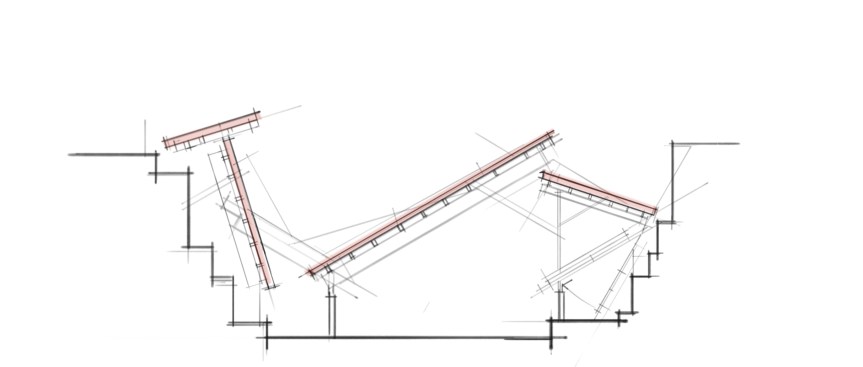
While drawing this, I had some sense of what I wrote below, but I had to draw and then write to clarify that thought.

A strongly modulated, weighted ground paired with a lighter, almost dematerialised roof sets up a clear gravitational dialogue: the ground as anchor, the roof as release. The roof “wanting to float” but being held down suggests a tension between earth and sky, heaviness and lightness, permanence and transience. This is not accidental—it frames architecture as something negotiated between forces, not simply assembled.

Drawn digitally in Procreate. Text edited with help of AI.

The Graphics Checklist

Checklists are the opposite of playlists (which I discussed in a previous blog post). This image above is from my tagboard at college, and the drawing in the center is the ‘Graphics Checklist’. It is a drawing checklist I made many years before and have been using consistently since then. While playlists are playful and flexible, checklists can feel dry, nerdy, and dull. But I appreciate them greatly and use them frequently in my teaching, to the point that my students may grow wary of them. My attachment to checklists likely stems from the frustration of repeatedly teaching basic drafting skills to first-year students and having to reinforce the same principles all the way through their thesis—and often in between.

To streamline this, I introduce the concept of a checklist in their first-semester drafting class and continue to use it as a reference tool whenever I meet them over the next five years. It’s not that these drawing conditions are hard to apply; they’re just easy to forget. Wittgenstein writes “The aspects of things that are most important for us are hidden because of their simplicity and familiarity.” We all rely on checklists, especially when we travel, and in many other contexts. They guide critical processes, from prepping an airplane for takeoff to setting up an operating theater or packing for a trip. Checklists are invaluable.

The book The Checklist Manifesto is one of the trigger to consolidate the fragmented rules into a single and visible narrative. This book is a great narrative on the simple need of lists and how they can be life saving (not exaggerating) – It traces the the birth of the checklist from the early plane (bombers), construction industry, etc. In the book , Gawande writes

Substantial parts of what software designers, financial managers, firefighters, police officers, lawyers, and most certainly clinicians do are now too complex for them to carry out reliably from memory alone.”


In a complex environment, experts are up against two main difficulties. The first is the fallibility of human memory and attention, especially when it comes to mundane, routine matters that are easily overlooked under the strain of more pressing events. (When you’ve got a patient throwing up and an upset family member asking you what’s going on, it can be easy to forget that you have not checked her pulse.) Faulty memory and distraction are a particular danger in what engineers call all-or-none processes: whether running to the store to buy ingredients for a cake, preparing an airplane for takeoff, or evaluating a sick person in the hospital, if you miss just one key thing, you might as well not have made the effort at all.

A further difficulty, just as insidious, is that people can lull themselves into skipping steps even when they remember them. In complex processes, after all, certain steps don’t always matter. … “This has never been a problem before,” people say. Until one day it is.

Checklists seem to provide protection against such failures. They remind us of the minimum necessary steps and make them explicit. They not only offer the possibility of verification but also instill a kind of discipline of higher performance.”

Below is the Graphics Checklist and many variations and reflections in student works at WCFA of it over the years – tested from first year drafting to various other semesters in different forms. Unless credited all the drawings are made by the author of the blog.

Architectural Playlist

I recently bought a car, and one of the pet peeves I discovered was listening to music in a closed space (unlike with headphones). I started making a playlist for my car, and after almost 2 years and 24 songs later, I have a slow-cooked personal playlist that can make and change my mood.

During my school and early college days, I had the delight of making playlists on cassettes. Because one couldn’t afford to buy all the albums, one had to carefully select songs and go to a cassette shop, either choosing a 60-minute or 90-minute cassette and filling it with favorite songs. The logistics, availability, and cost of making the playlist made it precious by default. The playlist was a collection—a place of refuge to spend time with things that were very dear to you.

One of the recent songs I added was ‘O Sanam’ by Lucky Ali. I serendipitously stumbled upon that song recently and had forgotten the calmness it brought me when I listened to it a decade and a half ago. Listening to the song now brings back those feelings. I am enjoying my 24-ish songs so warmly. When I am distracted, I play the list in the order I have decided; if I want to have some fun, I just shuffle—a delight when you don’t know which is your next song.

Why write about playlists now, and that too when they are easy to make? Just right-click and add it to a playlist. Yes, that’s the point: it’s easy, and it is too easy. You can add a thousand songs to a list and make a hundred lists on ten devices with just a few clicks. You don’t have to find a cassette shop that has stocked all A R Rahman albums in Tamil version, and if you found one, it would become a sanctuary.

Now, the playlist has to become a filter to resist the overloaded world. If I am not wrong, it is philosopher Søren Kierkegaard who said we are tranquillized by the trivial.

Why is this important? It is important because I can get overwhelmed even if I have six tabs open in my browser. (One of my students had 24 tabs open, and I think she had another window with more tabs open, which she didn’t show me.) This is a true reflection of our time.

Playlists can become tools of resistance. Now I will make this relevant by placing it in the context of this blog, where topics are generally related to architecture (though I hope to deviate when needed). The playlist should be very personal—so personal that you should not share it either. I will follow that here and not share my full playlist, not because it is a secret, but because it is personal and not relevant to anyone without the meaning I have attached to it over time. Make a list of references and build a fort around it. Don’t let in or let go of ideas or thoughts without strict scrutiny. When one’s position is attacked, take refuge in the playlist and see if the attack is constructive and borrow something from it.

My playlist will contain projects I visited and relished (like Alhambra in Spain—a night visit on a full moon day), projects I adore analyzing (such as Wall House by Anupama Kundoo), words that thrilled me as a student (like order), books I wish I had known in my first year—not in my final year or master’s (Lessons for Students in Architecture by Herman Hertzberger), books I wish I could rediscover and want to read freshly every time (The Thinking Hand by Juhani Pallasmaa), definitions or quotes on theory, drawings, and design; memories of being in architecture and being moved calmly by it, memories and generosity of my teachers and mentors, specific dialogues with friends and students, a little detail I admire, a material finish I enjoy, the unique smell of my grandfather’s grocery store at my native place, etc.

My playlist consists of things I resonate deeply with, not just a shallow list of things I like (that is easy). One needs to dig deep. I am not talking about bookmarks in ArchDaily, saved items on Pinterest and Instagram. I am talking about things that hold significant value in one’s own journey. This playlist needs to be visible or accessible on an everyday basis.

Being a teacher, what I teach becomes a sort of playlist in itself. I have found other uses for the list as a teacher. I decide the precedent studies in class, so I can be sharp about my argument and it can become a common ground for discussions in class. I think young architects can also benefit from this, as their Instagram (like mine) constantly bombards them with interesting and useful information at an unfathomable rate. Social media has the nature to make us feel inadequate. It is never enough. Anne Lamott beautifully says, “Try not to compare your insides to other people’s outsides. It will only make you worse than you already are.” Social media gives this feeling on a platter. I try to use the playlist as a piece of resistance to that.

I casually made a note on the differences between case studies and precedents in a lecture. Case studies are made out of need—to tackle a problem or situation. Precedents, I think, are perennial, long-term. That list can bring a moment of calmness and joy when one engages with it. When one is lost, it can become a guidepost to not lose hope and affirm one’s pursuit in architecture.

Note : Used AI help only to check grammar (which seems like a very useful tool – when used carefully)

Growing ideas

This exercise is one of my favorite problems to give second-semester drawing students. It serves as a reminder and recall of the fundamentals learned in the first semester.

Elsewhere, I’ve written about this exercise: “This drawing exercise explores the possibilities of the exploded axonometrics technique. It involves exploding an imaginative Rubik’s cube in multiple stages, with each stage leaving a trace of its path. To start the drawing, one does not need to know exactly how it will end. The composition shapes itself as the drawing progresses. This method illustrates a wonderful quote on writing by E. L. Doctorow: ‘Writing is like driving at night in the fog. You can only see as far as your headlights, but you can make the whole trip that way.’

This also connects to a brilliant quote by Brian Eno. ““Try to make things that can become better in other people’s minds than they were in yours ” He wrote this in the context of conceptual art and music, which perfectly fits what teaching means to me

All the drawings are from WCFA Batch 2016. Co Faculty : Rishi